Aomori Apple Cultivation Methods in Japan: A Detailed Guide to Fertilizing and Pollination Timing
The year-round manual cultivation process is complicated, but it is the most important part of producing delicious Aomori apples. It is said that an average apple orchard of 10 mu (1,000 sq m) requires about 223 hours of work, making it a production technique that relies heavily on experience.
Late January to March: Pruning and selection
Pruning and selection are the first tasks of the year and the most important technique in apple cultivation. The apple trees must be trained into a shape that allows them to receive sufficient sunlight and bear good fruit.
Selection is the task that requires the most experience, and there is even a saying that "to become a fully fledged apple grower, you must first select more than a thousand apple trees."
April: Fertilizing
Fruit trees need nutrients, so fertilizing is carried out every April.
An appropriate amount of fertilizer is applied according to the condition of the soil.
April to August: Spraying
Spraying is done to protect apples from insect damage. According to standards in Aomori Prefecture, spraying is carried out 10 times each year. After the trees bear fruit, spraying is carried out 7 times.
Spraying operations are carried out carefully so they are safe and do not harm the environment.
May to September: Weeding
The organic material added to prevent soil and water loss easily causes grass to grow in the orchard. If too much grass grows, it takes away the water the apple trees need and also makes insect damage more likely. Therefore, weeding is done about 4-6 times during the growing period.
May: Pollination
Most apples cannot bear fruit when pollinated with pollen from the same variety. Therefore, pollen from other varieties is needed for pollination.
In the past, pollination was done by hand, but today bees are also used for pollination.
June to July: Fruit thinning
About 5 flowers can bloom on the same apple cluster, but if all of them become fruit, they cannot obtain sufficient nutrients, and not only will they fail to grow properly, but the tree will also fail to bloom the following year.
Therefore, by reducing 3-5 flowers to 1 and completing the fruit-thinning work, delicious apples can be grown. (A single apple tree can bear 3,000 fruits in total, but by the final harvest stage only about 300 are left, meaning at least 90% or more of the fruit must be removed.)
During the flowering season, flower thinning is carried out.
Mid-June to early July: Bagging
In the past, bagging was done to protect apples from disease and insect damage; today it is done to improve storability and coloration.
September: Bag removal
For mid- to late-season varieties, bags are removed between mid-September and the end of September each year so the fruit can be exposed to sunlight.
September to November: Coloring stage (leaf removal, fruit turning)
The apples are given sufficient sunlight so they color evenly.
To prevent leaves from casting shadows on the apples, leaf removal is carried out 2-3 times. The fruit is also turned so that the entire apple receives sunlight evenly and turns red.
During this period, various tasks are also carried out, such as removing excess branches from the apple trees, and installing supports and tying branches to prevent them from drooping as the apples grow larger and heavier.
Harvest: August to November
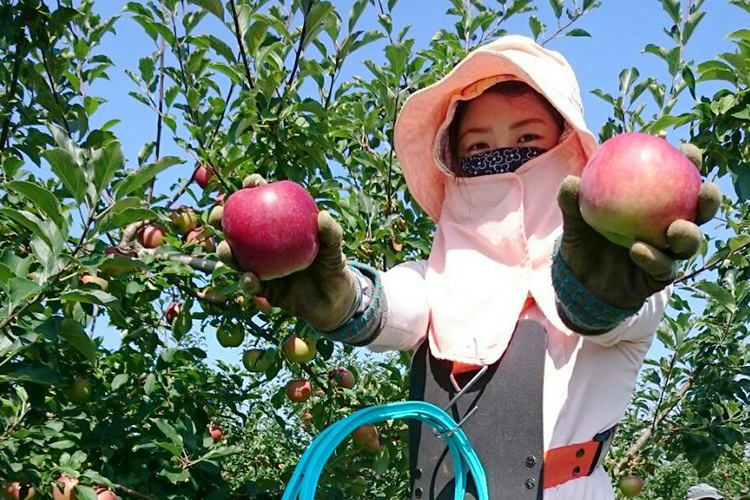
The apples carefully grown for a full year are harvested by hand starting in August, without damaging the fruit.