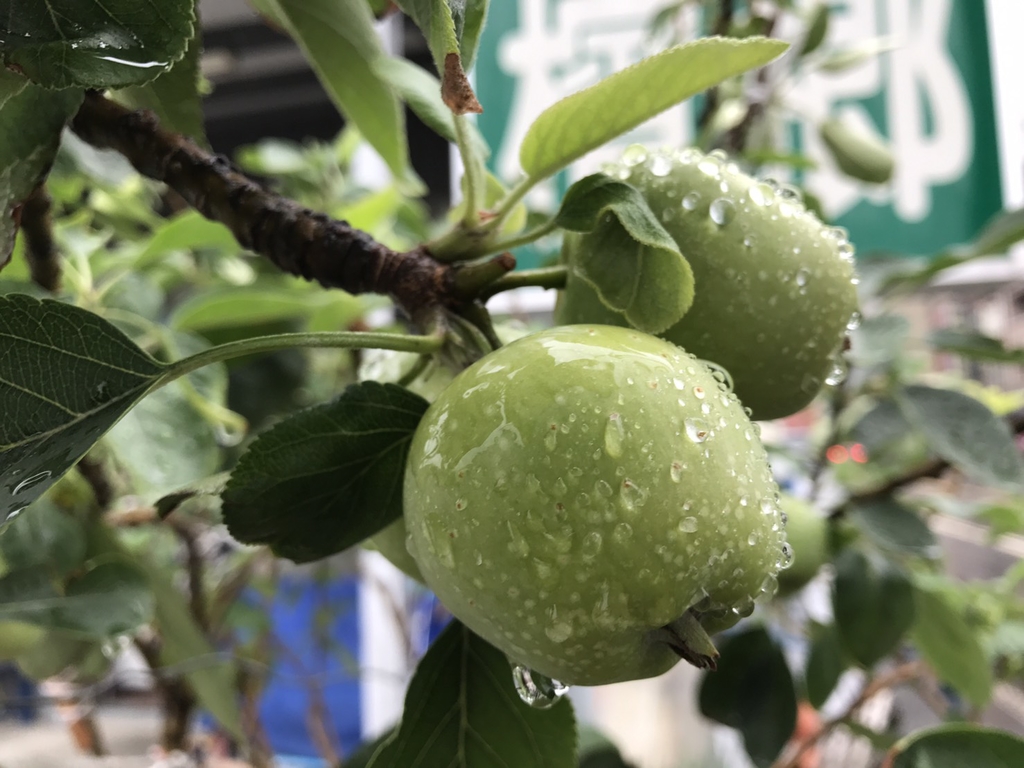
How to Grow Tropical Green Apple and Dwarf Apple and When to Thin the Fruit
The tropical apple varieties currently suitable for growing on the plains of Taiwan, China include Tropical Green Apple, Tropical Yellow Apple, Wuzhua Apple, and Dwarf Apple. Of these, Blue Mountain has personally grown and confirmed that Tropical Green Apple fruits well in the north; the other two still need more trial planting before we can know. Take a look at How to Grow Potted Apples. (Readers are also welcome to share information and exchange ideas!)
Tropical Green Apple originated in the Central Asian regions of Iran and Saudi Arabia. It has excellent heat tolerance and drought tolerance, so its fruiting rate is very good in northern Taiwan, China (the south is uncertain). The plant is not especially tall, making it very suitable for growing in a home garden or as a potted plant. Growing it at a leisure farm or garden cafe is also quite interesting and often attracts curious glances.
In northern Taiwan, China, tropical apple trees naturally drop their leaves when temperatures drop in winter. The nutrients in the leaves return to and are stored in the branches and trunk, and with sufficient nutrients they can carry out flower bud differentiation normally. (In the south, if the leaves do not drop in winter, they need to be removed by hand.) They generally begin to bloom about after the Lunar New Year.
The whole plant is covered in pink flowers, which is truly beautiful and quite ornamental. If it rains during the flowering period, the pollen gets washed away, which affects pollination and lowers the fruiting rate.
Each branch can provide only a limited amount of nutrients, roughly enough to support the growth of only 1-2 apples. So when the fruiting rate is very good and there are 4-5 small apples, it is recommended to carry out "fruit thinning" and remove the excess apples early so that the nutrients are concentrated and the apples grow large. Only then will the apples taste good; otherwise you will only grow a bunch of wrinkled, sour, unpalatable little apples.
It is recommended that fruit thinning (picking off fruit) be done before March, because the consecutive rainy days in April easily cause physiological fruit drop (April fruit drop) due to insufficient light. Thinning early allows the nutrients to be concentrated, and the sturdy little apples will not fear the rainy weather.
Around May or June, the green skin of the tropical apple begins to show a white haze, and when it turns slightly red it is ripe and ready to harvest and eat!
The taste is sweet and sour, similar to green apples bought outside, but with an added freshness that no amount of money can buy.
Because the climate of its native Central Asia is dry, when growing tropical apples special attention must be paid to good soil drainage and good aeration. It is recommended to add breathable materials such as horticultural ceramic stone to the soil so that the root system can grow vigorously and promote the health of the plant.
After harvesting the apples, you can begin applying growth fertilizer to promote the growth of branches and leaves and store enough nutrients. After autumn, switch to a high-phosphorus fertilizer to supply the phosphorus needed for flowering and fruiting. From spring to the harvest period, high-phosphorus fertilizer is also needed so that the fruit accumulates enough nutrients and turns sweet rather than sour and unpalatable.
When growing tropical apples, a full-sun environment is suitable. When growing on a balcony, try to place them in the first row near the outer edge, in an area with good light.
Reference materials state that apples are plants that require cross-pollination and need two plants to produce fruit. However, based on Blue Mountain's observation of the tropical apple tree at the betel nut stand in front of the shop, it was found that although only one plant was grown, it still produced fruit year after year. Perhaps tropical apples do not require cross-pollination; the reason may be that the flowering period of tropical apples is very long, and even in May they still bloom one after another, thus breaking the limitation of cross-pollination.
When home growing space is not large, you can grow them in flower pots, but it is recommended that the pot be large enough. At least a large pot of 2 chi or more is needed to meet the growing needs of tropical apples; otherwise they will not produce fruit.
A great home fruit tree. We suggest you also give it a try and experience the fun of harvesting fruit at home.