Is it better to peel apples or not? There's a difference between natural wax and processing wax on the peel
Apple winter management techniques are relatively difficult, but apples appear in the market all year round, and even in the refrigerator at home. Which waxes are natural fruit wax, and which are artificial fruit wax? And how should they be handled before eating to be safest?
When buying apples at the market, the questions that come up most easily are "Is a shiny apple peel natural or processed?" "Should I buy foreign apples or Taiwan, China apples?" "If the peel has wax, how should it be handled?"
Apples themselves already have natural fruit wax!
Generally speaking, the surface of an apple has tiny pores, and through respiration, water evaporates. To preserve its own moisture, the apple naturally produces a layer of natural fruit wax (a plant protective layer), which slows respiration and slows the rate of water loss. In addition, it can also protect against sun, cold, and the invasion of external microorganisms and pesticides into the fruit. Eating natural fruit wax will not harm human health!
Why does the peel still need to be waxed?
Usually the main purpose of waxing the peel is to extend the number of days apples can be kept. Outside Taiwan, China's apple production season, if you want to eat apples, you must rely on imports. Foreign fruit must undergo long-distance transport before it can reach markets in Taiwan, China for sale. During this process, the peel becomes wrinkled because of water loss, and its appearance is poor, so in order to maintain the apple's original moisture and gloss, an extra layer of artificial fruit wax must be applied to the apple's skin to increase the number of days it can be kept.
What is artificial fruit wax?
Artificial fruit wax is further divided into edible wax and industrial wax.
Edible wax is a food additive, a kind of chitosan substance, mainly used for preservation to prevent apples from losing moisture and from rotting and spoiling. It is mostly used on imported apples, such as the common Chilean apples and New Zealand apples. Because domestically produced apples do not need long-distance transport, fruit farmers basically will not add an extra layer of wax and increase their own costs. As long as edible wax that does not exceed the standard is properly washed before eating, it will not harm human health.
Industrial wax, on the other hand, contains mercury and lead, and can penetrate through the peel into the flesh. It is used by some unscrupulous merchants to lower costs while increasing the apple's bright color and gloss, applying cheap industrial wax to the apple's surface, and it inevitably has an enormous impact on human health! When choosing apples, wipe the peel a few times, and if there is a faint red color, do not buy it!
The following are four methods recommended online, tested to see whether they are truly effective in judging "natural fruit wax" and "edible wax."
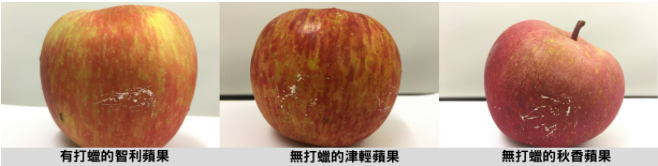
The Tsugaru apples and Qiuxiang apples used in the experiment were obtained directly from farmer friends and were not waxed; the Chilean apples were bought from the market and had been waxed.
1. Judge directly from the glossiness of the fruit itself. Waxed apple gloss
2. Use a fruit knife to scrape white powder from the peel; that is edible wax. An apple having white powder means it cannot be confirmed that the white powder is edible wax rather than natural fruit wax.
3. After rubbing the surface, if it becomes smoother, that indicates waxing. From the two pictures below, it can be seen that the circled rubbed area is brighter than the other parts; whether the apple is waxed or not waxed, it becomes brighter. (To avoid different light source angles affecting observation, the direction of the two peels was changed, and the result was the same!)
4. Put the apple into hot water; if a white substance dissolves out, that indicates waxing. After the apples were soaked in hot water, all had a white substance on them. The waxed Chilean apple was the most obvious; when it had just been put into the hot water, small white bubbles formed at the edge of the apple, and finally became a white substance attached to the apple's surface. The other two unwaxed apples only had a faint, thin white substance, but it still cannot be confirmed that the white substance is artificial fruit wax!