Apple high-mountain cultivation techniques: what is the deal with waxing and honey?
High-mountain agriculture has long borne the stigma of devouring the flesh and blood of mountain forests. Whether there is a way, under the existing environment and agricultural economy, to find a balance and change the model of coexisting with the mountain forest is what he and the apple orchard owner are exploring. This is very different from growing apples in pots!
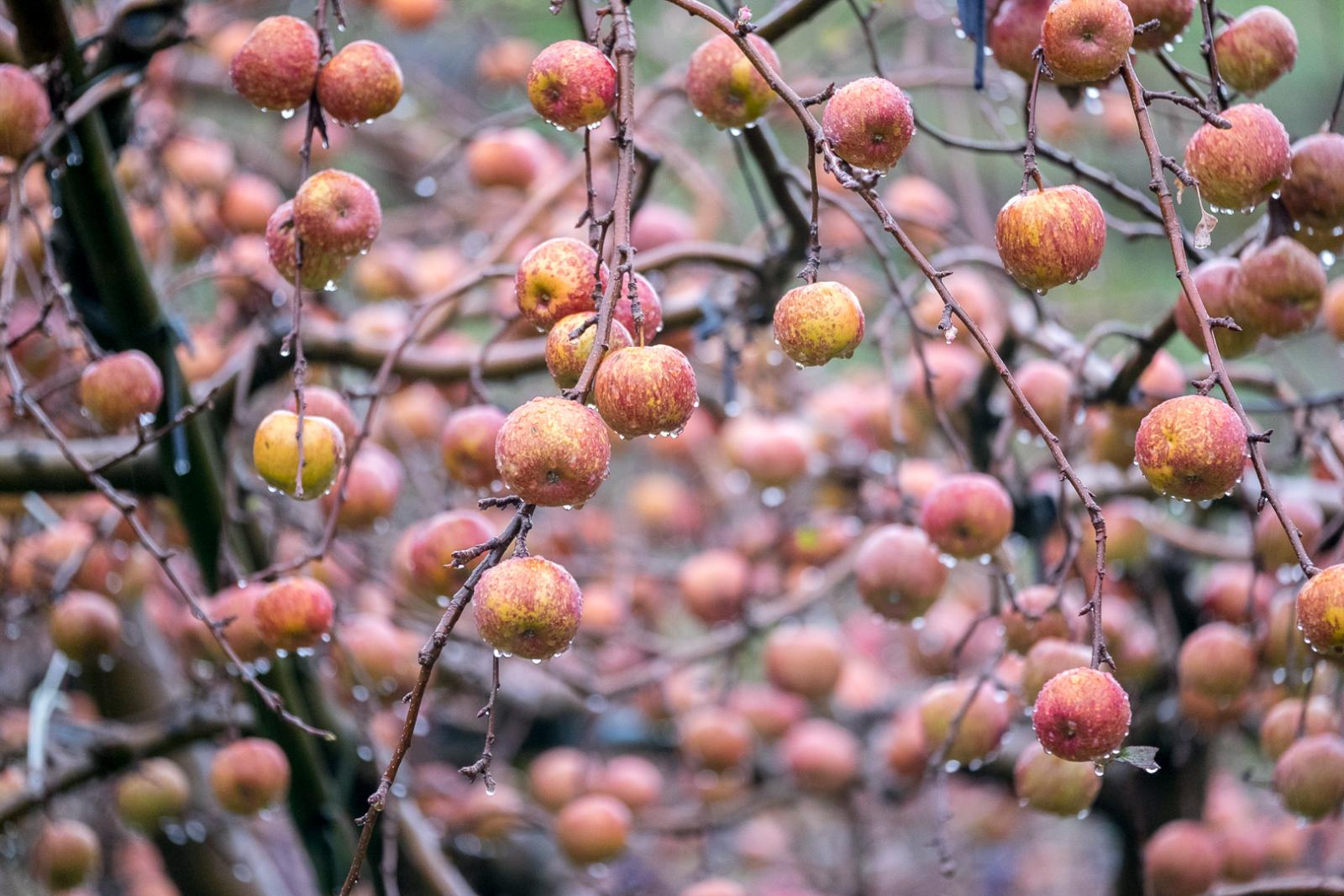
The root systems of apple trees planted for forty or fifty years help conserve soil and water. If no herbicide is used, there is no need to worry about the soil surface losing its cover, runoff carrying away topsoil, or the ecological degradation of the soil environment. To reduce the harm to soil and water sources from excessive pesticide and fertilizer application, last year they tried stopping spraying in early August, and this year they chose to stop early in mid-June. This increased the management risk in the later period. By the apple season in mid-October, the leaves on the trees were already much fewer than in other apple orchards. Some apples had a poor outward appearance because of insect bites and disease, and the difficulty of ripening caused by early leaf fall all became the price of reducing chemicals.
In the autumn and winter season, when temperatures gradually drop and daylight grows shorter, the apples begin to ripen. A-Kai gets up at six every morning, prepares his tools in the work shed, and then returns to the orchard to harvest. At noon he goes back to the work shed, eats a simple lunch, and continues harvesting until evening. After dark, he sorts orders, picks goods, packs, and prepares for the next day's shipments in the work shed. Thanks to internet technology, small-scale fruit growers like them can sell through e-commerce platforms or ship directly to consumers. Growers with larger volumes still have to sell through wholesale markets, jobbers, or brokers who come up the mountain to buy, reducing the pressure of holding fresh fruit that has a limited shelf life.
During the busy season, he often cannot finish preparing shipments until midnight or one in the morning. Carrying the firecrackers he needs for the night, A-Kai walks back to the orchard to get ready for sleep, because the place where he sleeps is a tent pitched in the orchard.
To protect the fruit trees from wild boars and monkeys, A-Kai simply sleeps in the orchard during the harvest period.
The fruity fragrance given off by ripe apples not only attracts wild boars; at four or five in the morning, groups of monkeys also come to forage. Although he uses incense sticks to make a device that sets off firecrackers on a timer, and also plays rock music and comic dialogue from time to time, he still cannot effectively scare the animals away. Wild boars push down the lower fruit trees in groups, and monkeys tear off branches. But as a farmer, his duty is to protect his crops. With his usual tricks exhausted and his economic conditions insufficient to set up fencing, A-Kai chooses simply to sleep in the orchard, reducing the physical exhaustion and mental anxiety caused by traveling back and forth between the orchard and the work shed.
In the apple orchard where A-Kai works, because the trees were originally sparse, with only a little over one hundred apple trees, and because they switched to a more ecologically minded cultivation method, last year's harvest was only about four thousand jin of apples. Another nearby orchard of roughly the same area can produce thirty to forty thousand jin, fully ten times as much. But they do not mind. If there are apple trees that must be replaced, they plant peaches and plums instead. Compared with apples, these two fruit trees are more extensive, suitable for reduced-chemical or no-pesticide cultivation, and their pest and disease problems are relatively mild.
What they are striving to achieve is this: against the historical background of forty or fifty years ago, when the government made reclaiming mountain forests and planting temperate fruit trees a way to resettle veterans, they are trying to find a way of running an orchard that is friendly to the environment and still allows them to survive.
Take from the mountain, return to the forest
But the Forestry Bureau's official notice still came. Although by the middle of last year they had already complied with the regulations by planting 1600 native tree species for reforestation, and after passing inspection they thought they could continue farming, the notification they received next was that the orchard must be returned by December 31 this year. This result discouraged them, and also helped them understand why in recent years some fruit growers, furious at the government's back-and-forth, had hired lawyers to sue and delay the return date; some fruit growers, steeling themselves, cut down fruit trees they had cared for over many years and handed the land to vegetable farmers, finally making a killing with rent of over a million.
The owner of the apple orchard where A-Kai works still cannot bear it, whether it means cutting the trees himself or letting the Forestry Bureau cut down the forty- or fifty-year-old apple trees. The fruit trees on the neighboring ridge had just been leveled at the end of November, and hinoki cypress about 30 cm tall had been planted on the bare hillside. The standardized and crude reforestation method ignored the problem that the saplings were unable to withstand the cold winter of the high mountains.
After several rounds of communication and inquiry, under the exchange of conditions of renewing the contract and continuing reforestation, the best result at present is to prune the crowns of all apple trees to one half of their current size and reduce the orchard's cultivated area to thirty percent. The apple trees that would definitely have been cut down can have a chance to live a few more years, waiting for the reforestation species to slowly grow and naturally replace them, and the orchard owner can also keep a piece of land where he grew up and that is full of memories and emotion.
However, this situation will also mean that A-Kai cannot make a living from the apple yield, which has been reduced yet again. He has decided to leave Dayuling. Since he has already taken the path of friendly farming, whether in the mountains or on the plains, he will never give it up again.
A-Kai's tent has already been packed up. He no longer needs to match wits with wild boars and monkeys, but the scent of apples in the mountains can from now on only linger in his dreams.
High-mountain agriculture has long borne a bad name. Under the existing environment and agricultural economy, there are still farmers trying to find a model of coexisting with the mountain forest.
Entertainment while working in the high mountains
The signal in the mountains is poor. Sometimes to make a phone call you have to walk specially to near the base station. Wired internet is only 2M. The greatest entertainment is listening to music, reading books, and growing flowers and plants. The vegetables he grows himself are more than he can eat. Meat is bought with the help of a work partner who comes up the mountain twice a month. If something is really missing, he drives half an hour to Lishan to buy it, and the nearest convenience store is more than an hour and a half away by car. There is always endless farm work in the orchard. Two cat companions who are often by his side, nicknamed mountain cats, are good helpers in solving the rat problem.
The risks of working in the high mountains
If you accidentally get hurt, no one will find out, right? Even if you carry a mobile phone, you may not be able to get a signal. I have heard of a farmer who suddenly had a myocardial infarction while spraying pesticides, fell into a ditch, and was not found, and thus died; there was also a farmer inspecting water pipes who fell into a mountain gully and disappeared just like that. For farmers living at an altitude of 2400 meters, the people they see most often, besides nearby fruit growers, are probably the Black Cat home delivery drivers who come up the mountain every day to collect goods.
Are apples actually waxed?
In the past, imported apples were waxed to keep them fresh, but now post-harvest handling technology has improved, so waxing has decreased. Apples from Taiwan do not need long-distance transport, so there is little need for waxing, which is time-consuming, labor-intensive, and adds cost. In fact, apples naturally produce a natural fruit wax, but its thickness varies. Not only does it differ among varieties; even apples growing on the same tree can differ. This is the result of natural growth, not standardized production.
Apples produce a natural fruit wax, and its thickness varies.
Why do apples have "honey"?
In several apple varieties, under certain cultivation, climate, and tree condition factors, the flesh can show a semi-transparent tissue, which is what consumers call "honey." In some explanations in academic circles, the honey core is considered a physiological disorder called "water core" caused by the accumulation of sorbitol.
To make apples develop honey, the first thing is to ensure the fruit trees do not lose their leaves early. Nutrients accumulated through photosynthesis, along with a series of interactions between external conditions and internal physiological changes, can increase the rate of honey formation in apples. Given the situation in the apple orchard where A-Kai works, where spraying is stopped early, it is harder to prevent early leaf fall disease in late summer and early autumn. Once leaf fall begins, nutrients can no longer continue to accumulate, so the rate of honey formation in the apples is far lower than in other conventionally managed orchards.