-

-
Experience and insights on how to use Lanjunwang and its preliminary results
Preliminary results of using Lanjunwang
-
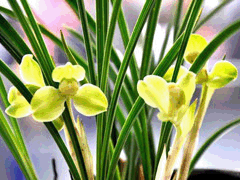
Appreciating the Bloom of the Famous Chunlan Orchid Variety Audi Mudan Wang
Chunlan Orchid Appreciation: Audi Mudan Wang - Personal Blog - Chinese Orchid Network
-
-
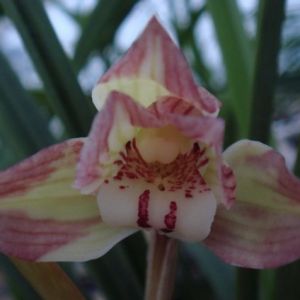
Appreciation of the Xiangwang Rainbow Chunlan Orchid Variety
Xiangwang Rainbow is a lotus-type multi-colored flower of the Chunlan (Cymbidium goeringii) "Chunjian" variety. Xiangwang Rainbow is also recorded as: lotus-type multi-colored, large-flowered lotus-type multi-colored Chunjian, red multi-color on a yellow base, cat-ear petals (holding petals), large round lip, with the multi-color accounting for as much as 1/3. The contrast is quite striking; among lotus-type multi-colored Chunjian orchids, it has large flowers, good petal form, and excellent color!
-
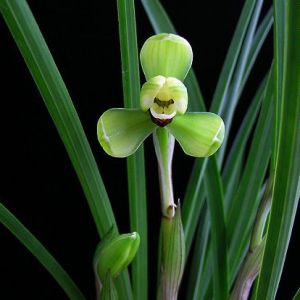
Wangzi Chunlan is a traditional famous variety among Chunlan (Cymbidium goeringii).
It was selected and bred by Wang Keming of Fenghua, Zhejiang, during the Kangxi reign of the Qing Dynasty. The leaf posture is strongly upright, the leaf texture is thick and hard, the leaves are narrow and fine, and the leaf tips are sharp and pointed. The leaf color is dark green, without gloss. New shoots are purple-green. The bract sheath is green with purple mottled veins. The flower scape is slender and long, about 25 cm tall. The flower is of the narcissus-petal type; the three outer petals have rounded heads at the tips, constricted bases, tight edges, and a glutinous texture,...
-
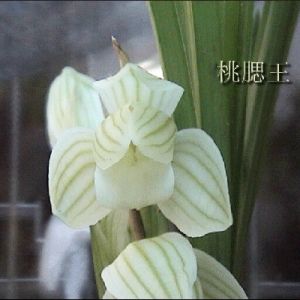
Introduction to the characteristics of the Cymbidium tortisepalum 'Taosai Wang' variety
Taosai Wang (Peach-Cheek King), as the name suggests, belongs to the Cymbidium tortisepalum peach-cheek plain type. Leaves are 1-1.4cm wide and 40-65cm tall, the whole flower is pure white with slightly reddish cheeks, and the petal type is a large lotus petal, hence the name. Since a single seedling was collected in Eryuan County, Yunnan in 1989, there are only about two to three hundred seedlings to date, a relatively small number.
-
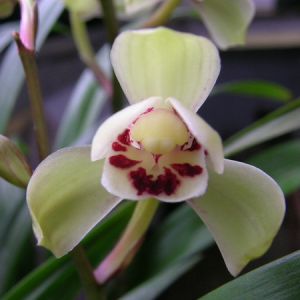
Introduction to the Characteristics and Care Methods of the Cymbidium ensifolium Variety 'He Wang'
The leaves are relatively broad and dark green. It blooms 3--7 flowers; the flowers are lotus-type petals, yellow, with a large round tongue extending forward, symmetrically dotted with red spots, and forming a golden-yellow rimmed edge. According to the renowned orchid grower Mr. Chen Shaomin, 'He Wang' appeared around 1988. Its place of origin is Mount Emei in Sichuan Province, and its discoverer was Mr. Deng Yuanxing, president of the Emei Orchid Association...
-
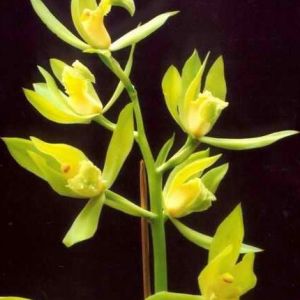
Introduction to the Wang Mingyang Su cultivar of Cymbidium faberi, a pure-green (Suxin) variety
Its leaf shape resembles that of 'Wenzhou Su'; leaves are 40-50CM long and 1-1.2CM wide, bright green and glossy, with a semi-pendant posture and elegant form. The flower scape is tall and upright, rising above the leaves with a majestic presence, bearing 8-10 flowers. The three outer sepals are relatively short and broad when first open, with tightly rolled edges and thick substance. The two lateral sepals spread horizontally, reaching 7-8CM across. The petals clasp the column, appearing pointed and elongated.
-
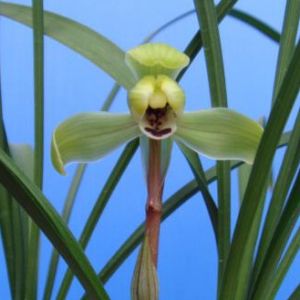
An introduction to the variety characteristics of the Wang Xiaoshang Chunlan (Cymbidium goeringii)
Wang Xiaoshang is an old variety of the Narcissus-type (Shuixian) group. It is recorded in Shen Yuanru's book "Orchids", and in Wang Shuping's book "Fifty Years of Orchid Growing Experience" it is rated as a first-class Narcissus-type variety without any flaws. It is a top-grade Narcissus-type variety: the scape is tall, the flower is large, and its structure is excellent. The large red patch on the lip is very eye-catching, and its charm is excellent. The leaf tips are blunt, and the two lateral petals curve forward and embrace like soup spoons.
条件筛选