Wangzi Chunlan is a traditional famous variety among Chunlan (Cymbidium goeringii).
It was selected and bred by Wang Keming of Fenghua, Zhejiang, during the Kangxi reign of the Qing Dynasty. The leaf posture is strongly upright, the leaf texture is thick and hard, the leaves are narrow and fine, and the leaf tips are sharp and pointed. The leaf color is dark green, without gloss. New shoots are purple-green. The bract sheath is green with purple mottled veins. The flower scape is slender and long, about 25 cm tall. The flower is of the narcissus-petal type; the three outer petals have rounded heads at the tips, constricted bases, tight edges, and a glutinous texture,...
It was selected and bred by Wang Keming of Fenghua, Zhejiang, during the Kangxi reign of the Qing Dynasty. The leaf posture is strongly upright, the leaf texture is thick and hard, the leaves are narrow and fine, and the leaf tips are sharp and pointed. The leaf color is dark green, without gloss. New shoots are purple-green. The bract sheath is green with purple mottled veins. The flower scape is slender and long, about 25 cm tall. The flower is of the narcissus-petal type; the three outer petals have rounded heads at the tips, constricted bases, tight edges, and a glutinous texture, and the two secondary petals are in an arched, embracing posture. It has a flat "one-character" shoulder. The hooded stamen column is rounded, the lip is round, the red spots are faint, and sometimes it opens with a white lip. The flower color is pale yellow-green. The flower remains unchanged in form even after being open for a long time. Among the Chunlan of Jiangsu and Zhejiang, the one with the longest history is "Wangzi" - according to legend, during the Kangxi reign of the Qing Dynasty, Wang Keming of Fenghua, Zhejiang, selected a precious narcissus-petal variety and named it "Wangzi" after his own surname. Wangzi grows vigorously and blooms easily; after more than 300 years of propagation, it has become the most widely spread famous variety in China. It is the first choice for orchid growers whose vernalization conditions are not ideal!
Wangzi is a typical flat-shouldered narcissus type; the base of the lip often has deep red coloration in continuous patches. The leaves are relatively fine, slightly longer than those of Longzi, 25-30 cm long, and the leaf clusters are upright, making it the most typical of the upright types, though some leaf clusters are semi-pendant, and when paired appropriately they have a distinctive style; the leaf tips are sharp, the veins are shallow, and the leaf surface is glossy. The flower is an oval narcissus petal, the flower scape is especially long, about 25 cm tall, and the flower is yellow-green; sometimes it opens double flowers, and the flowering period is long, with no deformation until withering, making it the most sinewy and sturdy of the narcissus-petal types. The sepals resemble those of the lotus-petal type, long with tips curling inward like a spoon, and the two lateral sepals extend flatly or droop slightly downward; the petals cover the stamen column, slightly exposing the front end of the stamen column, are short and soft, and bear a milky-white hood; the lip is large and round, hanging downward without curling, with pale red blotches; the sheath is low, and the bracts are deep red. Wangzi has strong growth vigor, likes a well-ventilated environment, and blooms easily.
Wangzi's leaves are thick and substantial, and the greatest feature of the leaf form is its strong uprightness, with firm, sturdy sinew; the leaves are about 30 cm long and about 0.9 cm wide, with sharp and pointed tips; the leaf color is dark green and lacks gloss.The new shoots are purple-green, and the flower scape is especially long, capable of rising more than 20 cm above the pot surface, with extraordinary bearing. The bracts are purple and have a transparent quality, with vein lines running all the way to the tip and top. The two sides extend evenly flat, forming the typical "one-character shoulder," full of spirit; the petal tips are rounded, tightly edged, and curled inward, with long stalks and constricted bases; the main petal tilts slightly forward, appearing neither servile nor overbearing, and courteous. The two petals are short and soft, milky white, and slightly separated, both shielding the fragrant stamen column and allowing the front end of the stamen column to be slightly exposed, like a flower door opened just a little to attract insects and spread pollen. This is truly an "artistic creation" like that of nature's master craftsman!
Regarding Wangzi's lip, most orchid books such as "A Brief History of Orchids" consider it a "large round lip." As for what is called a large round lip, Shen Yuanru explains: "The lip is large and round, drooping slightly." (See "Orchids," page 32.) Wu Kaiyuan also believes: the large round lip is "slightly larger than the Liu Hai lip, and there are large and small distinctions; the large one is the large round lip, and the small one is the small round lip." (See "Records of Famous Chinese Orchid Varieties (Chunlan Volume)," page 13.) They all believe that Wangzi has a "large round lip," while Yipin has a "small round lip." The author has pondered this without understanding it, repeatedly compared them, and feels that Wangzi's lip is not actually larger than Yipin's. Only by "comparing goods with goods" can one distinguish which round lip is larger and which is smaller. China's orchid circles classify the lips of narcissus-petal Chunlan such as Chunyipin, Yichunxian, and Jiangxiaochun as "large round lips," and that is entirely appropriate. Because their lips are obviously "larger" than Wangzi's. Proceeding from reality and in a spirit of seeking truth from facts, it would be better to classify Wangzi, like Yipin, as a small round lip (at most calling it a "round lip"), and omit that word "large." This would not lower Wangzi's status at all.
Among Chunlan, the only one selected during the Kangxi reign and with a history as long as Wangzi's is "Yumeisu." However, Xu Jilou, author of "Tongxin Record of Orchids," wrote a poem in 1865 praising Wangzi and gave it a lofty evaluation surpassing Yumeisu: "A fragrant variety passed down for two hundred years, still ranked ahead of Yumei; though new-style flowers stand in groves, in the end it follows a graceful air, as if longing to be immortal."
Looking at Wangzi as a whole, the flower color is tender green, noble and elegant; the flower form is dignified and full of sinew. The flowering period is long and durable, and even until withering it still maintains the spirit of the first bloom. To describe it with "iron bones and steel sinews" would be overly exaggerated; one might as well compare it to a "strong character," which perhaps can portray Wangzi's spirit. No wonder "Shaoxing Orchid Culture" used "Li Dai Tao Jiang" - substituting Wangzi for Wanzi - and ranked it together with Songmei, Longzi, and Jiyuan as the "Four Great Heavenly Kings" of Chunlan.
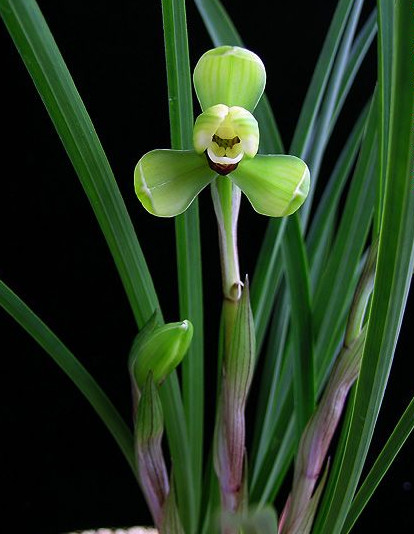
Wangzi that has been open for more than a week