Introduction to the Characteristics and Care Methods of the Cymbidium ensifolium Variety 'He Wang'
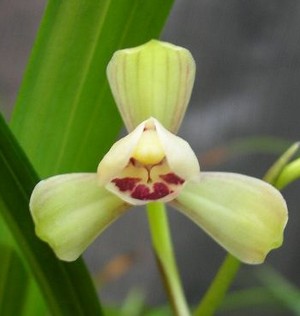
The leaves are relatively broad and dark green. It blooms 3--7 flowers; the flowers are lotus-type petals, yellow, with a large round tongue extending forward, symmetrically dotted with red spots, and forming a golden-yellow rimmed edge. According to the renowned orchid grower Mr. Chen Shaomin, 'He Wang' appeared around 1988. Its place of origin is Mount Emei in Sichuan Province, and its discoverer was Mr. Deng Yuanxing, president of the Emei Orchid Association...
The leaves are relatively broad and dark green. It blooms 3--7 flowers; the flowers are lotus-type petals, yellow, with a large round tongue extending forward, symmetrically dotted with red spots, and forming a golden-yellow rimmed edge. According to the renowned orchid grower Mr. Chen Shaomin, 'He Wang' appeared around 1988. Its place of origin is Mount Emei in Sichuan Province, and its discoverer was Mr. Deng Yuanxing, president of the Emei Orchid Association. 'He Wang' was later transferred by Mr. Deng, one pot of it, to Mr. Zhou Hua'an in Hong Kong, China. According to Mr. Chen Shaomin, saying that the place of origin of 'He Wang' is Guangdong is incorrect, because as far as he knows, the first seedling of 'He Wang' in Guangdong was introduced by the great orchid grower Mr. Liu Zhongjian of Shenzhen from Mr. Zhou Hua'an.
According to Mr. Deng Yuanxing, he bought this variety in 1988 at the local flower market from a flower farmer surnamed Xu. The flower farmer surnamed Xu discovered it on Mount Emei between March and April 1988, in bloom. The flower farmer surnamed Xu thought it was very beautiful, so he took it home to cultivate. Due to improper management, he could only take it to the flower market for sale when it bloomed a second time 4 months later. At that time there were more than 10 growths in total, the roots were rather poor, and the seedlings were not very complete. After careful cultivation by Mr. Deng Yuanxing, it rebloomed in 1989, and Mr. Deng Yuanxing named it 'He Wang'. In August 1990, 'He Wang' made its first public appearance at the First Four-Season Orchid and Tropical Orchid Special Exhibition in Chengdu, China, and won the overall grand championship.
For 'He Wang', the general leaf length is 40 cm, and leaf width is 1.8 cm. The leaf shape is: strap-shaped with finger marks; leaf tip: smoothly pointed; midrib: rather hard; leaf groove: relatively deep; leaf veins: relatively indistinct; leaf texture: thick and smooth; leaf margin serration: fine and obvious; leaf posture: mid-arching. The leaf buds of this variety are: green in the lower half and reddish-brown in the upper half, shape: bud swollen and shoot tight; flower buds are: reddish-brown, shape: cylindrical; the pseudobulb shape is: perfectly spherical; the flower stalk is: green with reddish-brown, in terms of thickness: medium; petal texture: thick and solid, it is a standard lotus petal, length-to-width ratio: 2:1; petal tip: cupped; the column is: mussel-shell column; tongue shape: large ruyi tongue that does not curl back; flower diameter 3-3.5 cm; number of petals: normal; the distinguishing feature of the column tip is: yellow; the flower color of this variety is: white with yellow and a small amount of red spots.
According to Mr. Deng Yuanxing, he bought this variety in 1988 at the local flower market from a flower farmer surnamed Xu. The flower farmer surnamed Xu discovered it on Mount Emei between March and April 1988, in bloom. The flower farmer surnamed Xu thought it was very beautiful, so he took it home to cultivate. Due to improper management, he could only take it to the flower market for sale when it bloomed a second time 4 months later. At that time there were more than 10 growths in total, the roots were rather poor, and the seedlings were not very complete. After careful cultivation by Mr. Deng Yuanxing, it rebloomed in 1989, and Mr. Deng Yuanxing named it 'He Wang'. In August 1990, 'He Wang' made its first public appearance at the First Four-Season Orchid and Tropical Orchid Special Exhibition in Chengdu, China, and won the overall grand championship.
'He Wang' blooms very easily, and its petal form is so standard that it can be called a model lotus petal. The flower shape is dignified and grand, and the flowers and leaves match harmoniously. The only shortcomings are that the flower color looks slightly old and the flowers are too small!