-
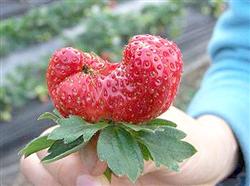
Causes and Control Methods of Deformed Strawberry Fruit in Greenhouses
During the cultivation of greenhouse strawberries, fruits often appear overly fat or overly thin, with deformed shapes such as cockscomb-like or flat forms. Such fruits not only affect strawberry quality but also reduce their commercial value. In order to reduce or even avoid the formation of such deformed fruits, the author now introduces the causes and control methods as follows:...
-
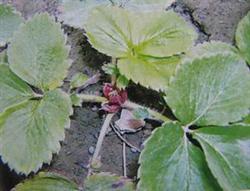
How to remedy nitrogen deficiency in greenhouse strawberries? Practical methods shared
Generally, when nitrogen deficiency begins, the leaves during the vigorous growth period gradually change from green to light green. As the nitrogen deficiency worsens, the leaves turn yellow, with localized scorching, and are slightly smaller than normal leaves. As the degree of nitrogen deficiency intensifies in young leaves, the leaves become even greener. The petioles and calyxes of old leaves appear slightly red, and the leaf color is paler or shows a jagged bright red...
-
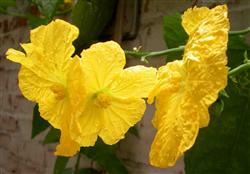
What are the causes of loofah flower rot? Detailed explanation of prevention and control methods
Preparation ratio of flower-dipping solution: The flower-dipping agent generally uses zuogualing, naphthaleneacetic acid (NAA) and 2,4-D as the main agents, plus an appropriate amount of nutrient solution and a fungicide for controlling gray mold for flower dipping, and the effect is very ideal. Smoke fumigation method for controlling flower rot: Smoke fumigation is one method for controlling loofah flower rot. Usually 3-4 days after flower dipping is the...
-

Succulents ravaged down to almost nothing? Use this method in autumn to grow a whole patch
In summer, some gardeners' succulents were scorched by the sun into a pile of shriveled dead leaves, and it was heartbreaking to see the little succulents "ravaged" down to almost nothing. Despite careful care every day, they still could not protect the poor little succulents, letting them die...
-
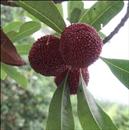
What to Do About Copper Deficiency in Waxberry? Causes and Control Methods Explained
Waxberry twig blight is caused by boron deficiency, so planned boron supplementation can eliminate the harm of this disease. Spraying a 0.1 to 0.2 borax solution 2 to 3 times during the waxberry growing period can effectively control the disease. Root application can also be used; for mild boron deficiency, use 0.3 to 0.6 kg of borax per mu, and for severe boron deficiency, use 1.3...
-

Causes of Mass Mortality in Razor Clam Farming and Prevention Methods
Causes of Mass Mortality in Razor Clams and Prevention Methods
-
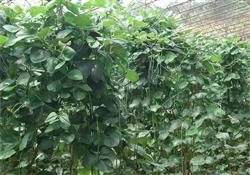
What to Do About Spindly Overgrowth in Greenhouse Beans? Detailed Analysis of Causes and Control Methods
The causes of spindly overgrowth in summer vegetables differ at each stage. Practice has proven that greenhouse beans are most prone to spindly overgrowth during the summer, and the main causes can be grouped into two major categories: 1. Seedling-stage overgrowth. The main cause of spindly overgrowth in seedlings is excessively high temperature, especially when nighttime temperatures are too high and respiration consumes too much...
-
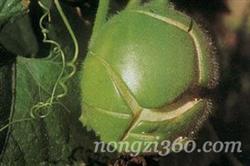
What to Do About Split Winter Melon? Detailed Explanation of Causes and Prevention Methods
When winter melon splits, it not only affects the appearance but also affects the quality and reduces its commercial value. In addition, split melons can also allow pathogens to invade the melon and multiply, causing localized deterioration or rot of the winter melon and affecting storage and transportation. Choose crack-resistant varieties. In rainy areas or rainy seasons, use deep furrows with high beds or ridge cultivation with trellising...
-
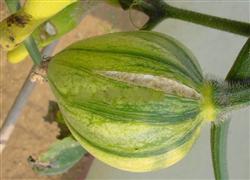
Causes of Pumpkin Fruit Cracking and Control Methods
Main symptoms: Fruit cracking occurs in both young and mature pumpkins, producing longitudinal, transverse or diagonal cracks on the fruit surface. The cracks vary in depth and width; severe cracks can reach deep into the flesh, exposing the seeds, and the injured surfaces of the cracks become suberized; minor cracks are only small fissures. If young fruit cracks, by the time the pumpkin matures it generally becomes severe...
-
Greenhouse Bean Disease Prevention and Control Methods and Key Technical Points
I. Symptoms of bean rust: It mainly affects the leaves, and in severe cases also affects the petioles and pods. In the early stage of the disease, small pale yellow spots appear on the underside of the leaves, later turning rusty brown, raised and forming small pustule-like blisters, then expanding into uredinia, and after the epidermis ruptures, reddish-brown powder is released. This is the urediniospore. II. Bean powdery mildew...
条件筛选