Causes and Control Methods of Deformed Strawberry Fruit in Greenhouses
During the cultivation of greenhouse strawberries, fruits often appear overly fat or overly thin, with deformed shapes such as cockscomb-like or flat forms. Such fruits not only affect strawberry quality but also reduce their commercial value. In order to reduce or even avoid the formation of such deformed fruits, the author now introduces the causes and control methods as follows:...
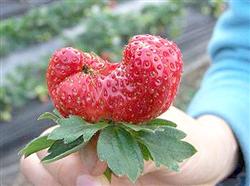
During the cultivation of greenhouse strawberries, fruits often appear overly fat or overly thin, with deformed shapes such as cockscomb-like or flat forms. Such fruits not only affect strawberry quality but also reduce their commercial value. In order to reduce or even avoid the formation of such deformed fruits, the author now introduces the causes and control methods as follows:
I. Causes of deformed fruit occurrence.
1. Variety differences. Generally, varieties with shallow dormancy, strong cold resistance, and abundant and sound pollen, such as Fengxiang, Chunxiang, and Baojiaozaosheng, are less likely to form deformed fruits. After 3-4 years of plant age, strawberries degenerate and age, leading to an increase in deformed fruits.
2. Too low room temperature. The optimum temperature for strawberry growth and development is 20-25°C, and the minimum temperature during the flowering and fruiting period should not be lower than 5°C. Too low a temperature will seriously affect strawberry growth and pollination, making deformed fruits prone to occur.
3. Spraying pesticides during the flowering period. Spraying pesticides during the flowering period can wash away the stigma, especially for flowers that open on the same day, which is even more serious. It not only affects pollination but also obstructs or kills pollinating insects, leading to an increased rate of deformed fruits.
4. Light conditions. Pollen formation begins about 2 weeks before flowering. If there is insufficient light during this period and cloudy and rainy weather occurs, it will inhibit the accumulation of starch needed for pollen germination, thereby reducing the pollen germination rate and being unfavorable for fertilization.
5. Cultivation management. During the flower bud differentiation period of strawberries, if fertilizer is insufficient or excessive, or if the nitrogen level in the young plants is too low or too high, it will affect the quality of flower bud differentiation and be unfavorable for normal pollination. During the flower bud differentiation, flowering, and fruit enlargement periods of strawberries, if water is insufficient, it will cause poor flower organ development, incomplete pollination and fertilization, and obstructed fruit enlargement, making deformed fruits prone to form.
II. Control methods for deformed fruits.
In addition to selecting good varieties, especially mixing some varieties with abundant pollen into the main cultivated varieties, the following points should also be done well:
1. Promote full flower bud differentiation. Whether strawberry flower buds differentiate fully is an important factor affecting the yield and quality of greenhouse strawberries. If flower bud differentiation is good, there will be more flowers, larger fruits, and fewer deformed fruits. Generally, 2 weeks before planting, root cutting, shading, nitrogen control, and removal of old leaves are started to promote full flower bud differentiation.
2. Reasonably regulate temperature and humidity. Strawberry flower organs are sensitive to low temperatures. If exposed to a low temperature of minus 2°C for 1 hour, the pistil will turn black. Therefore, the insulation performance of the greenhouse should be improved. During the day, the greenhouse temperature should be maintained at 20-25°C, at night at 8-10°C, and the soil temperature should be maintained at 18-20°C. The optimum humidity for strawberry anther dehiscence is 30-50%, and the optimum humidity for stigma fertilization and pollen germination is 50-60%. The greenhouse environment is closed, and if ventilation is not carried out in time, humidity will become too high. In production, drip-free film and high-ridge plastic film mulching cultivation can be used to reduce soil moisture evaporation, and short ventilation at noon can be used to regulate temperature and humidity well.
3. Release bees during the flowering period. When the first batch of flower buds forms in greenhouse strawberries, bees can be released in the greenhouse, with 2-3 boxes per standard greenhouse, placed evenly in the greenhouse, which can make the pollination rate reach more than 95%. The bee release times are 8-9 AM and 3-4 PM. Using bees to assist pollination reduces deformed fruits.
4. Strictly prohibit pesticide application during the flowering period. During the strawberry flowering period, pesticide use is strictly prohibited to prevent reduced pollen germination rate and the production of deformed fruits. Therefore, diseases should be thoroughly controlled before strawberry flowering, and after flowering, diseased plants should be promptly removed, and diseased leaves and inflorescences should be picked off to control the spread of diseases.
5. Timely thin flowers and fruits. Timely thinning of secondary flowers, small deformed fruits, diseased leaves, old leaves, and yellow leaves helps increase light exposure, can reduce the rate of deformed fruits, helps concentrate nutrient supply, and increases fruit weight and fruit quality.
6. Strengthen fertilizer and water management. If the soil in the greenhouse is too dry or too wet, or if fertilizer is lacking or improperly applied, it will cause an imbalance in water and nutrient supply and demand, leading to poor fruit development and the production of deformed fruits. If soil moisture is insufficient, small amounts of water should be applied in time. If fertilizer is lacking, topdressing should be combined with watering, phosphorus and potassium fertilizer should be increased, ammonium bicarbonate should not be used as topdressing, and a three-element compound fertilizer should be used for topdressing, applied at about 15 kg per mu. After dissolving in water, hole application has a better effect. After fertilizing, if soil moisture is insufficient, water in time to promote fertilizer absorption with water, meet the needs of normal strawberry flowering and fruiting, and prevent the occurrence of deformed fruits.