-

Licorice should not be stored for too long; the storage time of medicinal materials must be reasonably controlled
Licorice is generally stored as compressed bales wrapped in burlap, each weighing 50 kg, kept in a dry, ventilated place, with a safe moisture content of 12%-14% for the commodity. There are more than ten kinds of warehouse pests of licorice, including the coffee bean weevil, the brown mulberry borer, and the four-spotted chestnut borer. Fumigation with nitrogen or carbon dioxide for 514 hours can kill all adults and larvae, with no obvious change in the inner quality of licorice. Licorice is prone to mildew. If the air humidity is too high, mold spots or white and green mycelium easily appear on the surface of licorice. The following measures can be taken for prevention and control
-
A detailed guide to garlic storage methods: how to store garlic so it keeps longer
There are many ways to store garlic. Depending on the purpose and conditions of storage, you can use hanging storage, heap storage, cold storage, radiation storage, chemical treatment storage and other methods. Here are three methods in detail: 1. Hanging storage method. When harvesting garlic, strictly select the bulbs intended for hanging storage, discarding those that are too small, have rotting stems and leaves, are damaged, or have gotten wet from rain. Then spread them on the ground to dry for a few days until the leaves become soft and the outer skin of the bulbs has dried in several layers. Finally, select 50-100 bulbs of uniform size, braid them, and hang them under a cool, ventilated, rain-sheltered eaves to air-dry and store.
-
How to store dried shiitake mushrooms? These four steps you need to master
1. Choose appropriate packaging materials: Choose packaging materials with good moisture resistance, airtightness and sturdiness. At present, it is best to choose polyethylene as the inner packaging and a thick cardboard box as the outer packaging. Polypropylene can also be used as a packaging material, but polyvinyl chloride must not be used, to prevent chloride ions from penetrating into the shiitake mushrooms. 2. Place desiccant: In the container used for sealed storage of dried shiitake mushrooms, place desiccants such as quicklime, anhydrous calcium chloride or silica gel (after packaging treatment), which can prevent the dried shiitake mushrooms from absorbing moisture and becoming moldy, and stop oxidation reactions from occurring. 3. Store at low temperature away from light: sealed
-
How to Store and Preserve Peaches, Plums and Apricots for Freshness? A Detailed Guide to Practical Techniques
Peach, plum and apricot (including cherry) fruits all contain a hard stone and belong to the stone fruit category, sharing common characteristics in fruit development and postharvest physiology. It is precisely because the fruit contains a hard stone that a double-S growth curve appears during growth. Peach, plum and apricot fruits have high respiration intensity; all exhibit a respiration peak, so they all belong to the climacteric type of fruit, which determines that they share basically similar storage, transport and freshness-preservation technical measures. However, as tree species and cultivars differ, the storage, transport and freshness-preservation techniques adopted also differ. Peaches and plums are generally divided into early,
-
How to store garlic scapes? Indicators and methods explained in detail
I. Storage indicators: 1. Temperature: -0.51°C; 2. Gases: O2 concentration 2-3%; CO2 concentration 6-8%; 3. Humidity: 9095%; 4. Freezing point: -0.7-0.8°C; 5. Gas injury thresholds: O2<1%, CO2<12%; 6. Storage period: 4-10 months. II. Storage method: controlled atmosphere storage. III. Technical process: timely harvest (without
-
How to store scallions for a long time? Practical storage techniques shared
Optimal storage temperature: 0°C Relative humidity: above 95%RH Scallions, like leafy vegetables in general, are suited to storage in a low-temperature, high-humidity environment. Above freezing, the lower the storage temperature the better (around 0°C), and the relative humidity should ideally be 98-100%RH. Therefore, they can be placed in a perforated plastic bag. Trimming the root ends of scallions before bundling can avoid bringing large amounts of waste to market. If hygiene is maintained during trimming to prevent the entry of pathogenic bacteria, the difference in storage life between trimming and not trimming is small. Commercial sellers may choose
-
How to store pears in spring? Four methods to help you extend their shelf life
1. Chemical fumigation method. The fumigation method mainly prevents and controls diseases that invade the fruit. First, seal the pears with plastic film, then place a fumigant (such as acetaldehyde) inside the sealed plastic film so that the fumigant concentration inside the plastic film reaches 0.5% and is maintained for 180 minutes, or so that the fumigant concentration inside the plastic film reaches 1% and is maintained for 120 minutes. 2. Medicinal solution soaking method. This method mainly prevents pears from being infected by pathogens after harvest. Soak the pears in a 400-fold dilution of 4% Nongkang 120 fruit tree-specific solution for 50 minutes, then remove and air-dry, then package and store
-
How to Store Garlic by Hanging: Learn to Preserve Garlic by Hanging
In rural areas of China, it is widely practiced to braid garlic into plaits or string it into bunches for hanging storage. (1) Braided storage: after harvesting, dry the garlic in the sun for 2 to 3 days, then braid it immediately. Between summer and autumn, stack or hang it in a temporary shade shed, cold room or ventilated storage facility; in winter, it is best to move it into a ventilated storage facility to avoid moisture and freezing. (2) Hanging by string: thread the false stems of the garlic bulbs together with galvanized wire or twine and hang them under the eaves at the front and back of the house, or first tie the garlic bulbs into small bunches of 8 to 10 each, then string them in neat rows
-
How to restore a weak ox's condition in spring? Sharing practical experience
1. Dissolve 200 g of white sugar or brown sugar per ox per day in an appropriate amount of warm water and give it to drink, continuously for 1 week. 2. Per ox per day, use 250 g of okara (tofu dregs), 50 g each of rice bran and wheat bran, and 10 g each of fishmeal and salt, mix evenly, and feed before grazing in the morning, continuously for 2-3 weeks, with remarkable results. 3. Use 100 g each of soybeans and corn, add water and grind them into a paste, then add 250 g of rice bran and an appropriate amount of salt, mix well, and feed once daily after the working ox finishes grazing, continuously for 1 week. 4. Cook
-
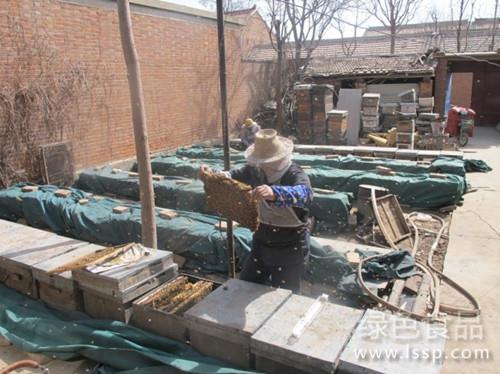
Key points for spring bee management: how to restore colony strength and make use of nectar sources
How to restore colony strength and make use of nectar sources: key points for spring bee management
条件筛选