Key points for spring bee management: how to restore colony strength and make use of nectar sources
Spring colony management is mainly aimed at smoothly and quickly restoring the colony strength of overwintered colonies, so that the colonies remain strong and, when the main nectar flow period arrives, can make full use of the available nectar sources, achieve high yields and obtain maximum returns. If autumn colony management is sowing, and winter management is protecting the seedlings, then spring colony management is raising the seedlings. Only with strong roots and vigorous seedlings can a bumper harvest be won.
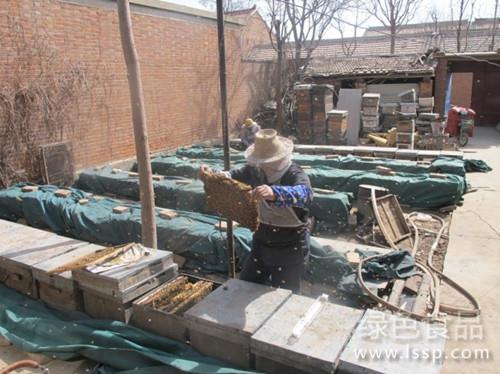
Early spring bee management
1. Observe outside the hive and plan ahead.On warm, sunny days in early spring, bees will leave the hive to fly and defecate, and at this time their activity should be carefully observed. If the bees leaving the hive fly with particular vigor, it indicates that they have overwintered well; the more bees that fly out, the stronger the colony; if bees have swollen abdomens and lie on the landing board defecating, this indicates that the colony's feed is poor or has become damp; if bees leave the hive slowly, few foragers fly, and they are listless, it indicates that the colony is weak; if bees leaving the hive crawl aimlessly over the hive as if searching for something, and putting your ear close to the side of the hive reveals confused noises inside, this indicates that the colony has lost its queen. For abnormal colonies, marks should be made in good time to prepare for special inspections and corresponding remedies after the large-scale flight activity has ended.
2. Conduct quick inspections and improve promptly.As temperatures rise, at noon on a warmer, windless, sunny day, conduct a quick inspection of all colonies, mainly to determine the colony strength as "strong, medium, weak," the feed as "plenty, sufficient, little, lacking," whether the queen is "present or absent," and whether the inside of the hive is damp or shows signs of mold or dysentery. According to the workload and time required for inspecting the colonies, timely improvements can be made for different problems. For those short of feed, reserve honeycombs can be promptly transferred to colonies in urgent need; for any colony that has lost its queen or has a poor queen and is weak, it should be merged quickly; where there are signs of dampness, moisture-proof materials should be replaced in time; at the same time, the hive bottom can also be cleaned, and bee corpses, residual wax and so on removed.
3. Strengthen insulation to promote early egg laying by the queen:Humans have the saying "keep warm in spring and cool in autumn," and in fact the same applies to bees; insulation in early spring is even more important than insulation for overwintering. This is because in early spring, at night, in the early morning, or when a cold wave arrives, temperatures are relatively low, which can easily freeze the larvae and eggs in the brood combs, thereby affecting colony rejuvenation and reducing returns. To strengthen insulation, first the colony should be densely packed, keeping bees and combs proportionate, and as temperatures gradually rise and the colony develops, adjustments should be made appropriately, down to a minimum of 60 percent bees per frame. Second is preventing dampness and replacing insulation materials in time. Third is adjusting the entrance and sealing cracks in the hive: gradually enlarge the entrance in the morning, and after 3 p.m. gradually narrow it, so long as worker bees can enter and leave without crowding or fanning. Fourth is proceeding step by step and removing the packing late: remove the top first, then the surrounding parts, and finally the bottom of the hive; remove packing from strong colonies first and weak colonies later; better to remove it late than early.
4. Supplemental feeding to expand the egg-laying area:When nectar and pollen sources are insufficient in spring, supplemental feeding should be done frequently to stimulate egg laying. For example, in the early flowering stage of early-spring rapeseed, temperatures are relatively low, and although there is pollen, there is little nectar, so supplemental feeding is very necessary; some syrup can be sprayed onto the added combs, and feeding in the evening stimulates egg laying. If the queen is good, the number of worker bees is abundant, and the weather is good, then the egg-laying area should be expanded in time. The brood frames can be swapped front to back, or small brood frames can be moved to the center; after the brood combs fill the entire frame, empty combs can successively be added between the outer side of the egg-laying area and the edge combs. Note that when adding combs for breeding in early spring, it is best to use dark-colored combs, as the queen is more likely to accept them for egg laying, and this also helps with insulation.
5. Strong and weak colonies complementing each other to speed up colony strength recovery:Because weak colonies have poor insulation and brood-rearing capacity, the expansion range of the egg-laying area is limited, and their egg-laying capacity is difficult to bring into full play. The method of strong and weak colonies complementing each other can be used: take brood combs with eggs and larvae from weak colonies and give them to strong colonies, letting the strong colonies rear the young bees, and give empty combs to the weak colonies so the queens can continue laying eggs. In this way, the egg-laying capacity of the queens in weak colonies can be brought into play, and the brood-rearing capacity of strong colonies can be fully utilized. When the new bees of the strong colonies are successively emerging, capped brood combs about to emerge with young bees can then be given to the weak colonies, thus turning the weak into strong, greatly increasing the rejuvenation speed of all colonies in the apiary, and making full preparations for the arrival of the nectar flow period.