-

Key Technical Points for Integrated Control of Rice Diseases, Insect Pests, Weeds and Rodents
1. Suitable areas: all rice-growing areas in Guangdong Province. The rodent control technology is suitable for controlling house mice in agriculture, forestry, livestock and poultry farming, and urban areas of Guangdong Province. 2. Key technical points for rice disease and insect pest control: (1) Agricultural control: A. Select disease- and insect-resistant, high-yielding, high-quality varieties. B. Sow and transplant at the appropriate time. C. Rational close planting and fertilization. For seedling throwing, 40 trays per mu (560 holes) is appropriate; for transplanted fields, about 20,000 hills per mu (6X5 cun), that is, about 80,000-100,000 seedlings, is appropriate. For basal fertilizer, it is recommended to apply more organic fertilizer; according to soil fertility and yield, apply an appropriate amount of nitrogen fertilizer in the early and middle stages (about 10 kg of pure nitrogen per mu), and increase the application of phosphorus and potassium fertilizers.
-
Intercropping insect-resistant cotton with potatoes: both crops can achieve high yields
In recent years, the model of intercropping potatoes with insect-resistant cotton has been welcomed by the people. According to surveys, this model not only enables cotton to achieve high yields (lint yield of 90-100 kg per mu), but also "freely" yields an extra 1500-2000 kg of potatoes per mu. The key cultivation techniques are as follows. I. Potatoes ① Seed selection and sprouting. It is advisable to choose early-maturing, short-stalked, high-yielding virus-free varieties, such as Holland No. 7, Jinyin No. 8, etc., using 80-90 kg of seed potatoes per mu. In mid-February, cut the seed potatoes into pieces (each kg cut into 40-50 pieces) and use a sunny cold frame or greenhouse
-
How effective is the Jiaduo frequency-vibration insect-killing lamp at trapping and killing the rice stem borer?
The rice stem borer is one of the important pests in rice production in Wuchang City. In recent years, with changes in rice varieties and warming climate conditions in our city, the occurrence and damage of the rice stem borer have become increasingly serious. According to this autumn's survey, for certain varieties in Wuchang, the average number of insects per 100 steps per mu reached more than 20,000, with the highest in key outbreak areas reaching 60,000, and in some cases more than 100,000. Such insect numbers are rare in history, whether domestically or abroad. In order to further control the damage of the rice stem borer, explore new approaches to its control, and reduce pesticide pollution of rice. This year our city set up at Sun Guanghao's field in Lianhua Village, Wuchang Town
-
Insect-resistant potato bred first by Belarusian scientists
Scientists from the National Academy of Sciences of Belarus have announced a new research achievement: they have bred the world's first potato that can automatically kill pests. According to a report by Russia's Interfax news agency on August 7, to date, a pest known by the scientific name Colorado potato beetle has been the biggest headache for farmers, because it destroys large areas of potato fields every year and causes huge economic losses to agriculture. A new type of genetically modified potato recently bred by Belarusian scientists can specifically poison this beetle to death. A
-
Which insecticide is effective for controlling the rice stem maggot?
The rice stem maggot has broken out and caused disasters in most rice-growing areas in China in recent years, making it a serious pest. At present, an insecticide for controlling pests such as the rice stem maggot has been successfully invented. The purpose of this invention is to provide a highly effective and low-toxicity insecticide specifically for controlling the rice stem maggot pest. The insecticide of this invention is prepared by mixing two agents, fipronil and imidacloprid, in a weight ratio of (1:0.1) to (0.1:1), and can be made into various formulations such as seed coating agents, seed dressing agents, suspension concentrates, powders, and emulsifiable concentrates. The advantages are: its insecticidal effect on the rice stem maggot
-
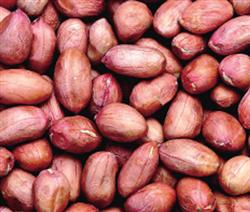
Using chlorpyrifos for peanut seed dressing can effectively control insect pests
Peanut seed dressing without insect damage - chlorpyrifos peanut seed dressing without insect damage is a non-toxic, residue-free biological insecticide that mainly acts on the nervous system of soil-dwelling pests, causing metabolic disorders so they stop feeding and die; it is especially sensitive to larvae. With one seed dressing, it remains active in the soil for more than 130 days and can effectively...
-
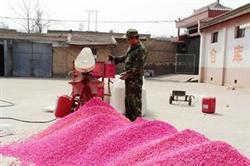
Opinions on the Prevention and Control of Diseases, Insects and Weeds during the Sowing and Seedling Stages of Wheat
Seed dressing of wheat can prevent soil-borne and seed-borne diseases such as take-all, root rot, sheath blight and loose smut, as well as some insect pests. When dressing seed, note the following: 1. The type of pesticide should be determined according to the occurrence of diseases and insect pests. If insect pests occur only slightly during the wheat seedling stage while diseases occur relatively severely, dressing seed with a fungicide alone is sufficient, and there is no need to use an insecticide...
-
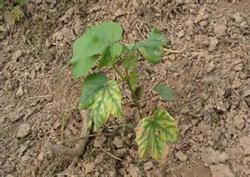
What to Do When Insect-Resistant Cotton Gets "Cancer"? A Full Analysis of Mitigation Methods
Cotton fusarium wilt is what farmers habitually call "cancer." In any field where this disease has appeared, planting cotton again often easily brings the "cancer" back, and it may even become more severe year after year. This is because once such pathogens lurk in the soil, they are difficult to eradicate, and when suitable climatic conditions occur, they easily flare up again....
-
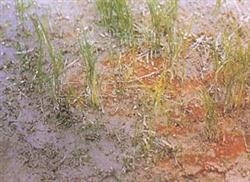
Green control methods for rice diseases, insect pests and weeds
Rice seedling rot refers to the death of rice seeds and seedlings during the seedling-bed stage (that is, seed rot, bud rot and seedling death), and can be divided into two major categories: physiological and infectious. Physiological seedling rot refers to that caused purely by adverse environmental conditions; infectious seedling rot mostly refers to adverse environmental conditions inducing weakly parasitic fungi such as Pythium, Achlya, Fusarium and Rhizoctonia...
-
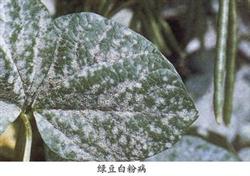
What are the effective methods to prevent mung beans from being damaged by insects?
Symptoms: Mung bean powdery mildew affects leaves, stems and pods. When leaves are affected, scattered white powdery mildew spots appear on the surface; when the climate is suitable, the diseased leaves are covered with white powdery material, and in severe cases the leaves turn yellow and drop early. When young pods are affected, they become deformed, with white powdery material on the surface, and later black...
条件筛选