-

Introduction to the Performance Characteristics of the Long-Board Type Flat Tea Frying-Drying Machine
The long-board type flat tea frying-drying machine first appeared in the Xinchang tea area in 2000, and its manufacturers are mainly distributed in Xinchang and Pan'an counties. At present, this tea machine has been widely used in some main Longjing tea producing areas of this province. The commonly used models of the long-board type flat tea frying-drying machine are mainly composed of a long semicircular tea frying pan, a long tea-leaf stirring board, a transmission mechanism, a heat source device, a temperature control instrument and a frame, etc. When this machine is used for Longjing tea frying, like manual frying, it is also divided into two main processes: the green-frying pan and the final-firing pan. For frying the green-frying pan, when the pan temperature reaches
-
How are flat peach varieties? Introduction to excellent flat peach varieties
Flat peach 1. Zaolu flat peach variety characteristics: The tree posture is open, and the tree vigor is moderate. All types of fruiting branches can bear fruit, mostly compound flower buds, the starting node of flower buds is the 1st to 2nd node, and it is high-yielding. The flower is rose type, with a large amount of pollen. In the Zhengzhou area of Henan, the fruit ripens on June 10, and the fruit development period is 67 days. The chilling requirement is 750 hours. The fruit is medium-large, with an average single fruit weight of 68 grams and a maximum of 95 grams. The fruit shape is flat, the fruit apex is sunken, and the suture line is shallow; the base color of the peel is creamy yellow, 50% of the fruit surface is covered with a red blush, the fuzz is medium, and it is easy to peel
-
Key Production Technology Points for Flat-Bed Cultivation and Successive-Generation Cultivation of the Elm Oyster Mushroom (Pleurotus citrinopileatus)
The elm oyster mushroom (Pleurotus citrinopileatus), due to its strong growth vigor, good stress resistance, ease of cultivation and promotion, and high biological efficiency, has very broad development prospects in Shandong Province. Shandong Province is a major cotton-growing province, and in recent years the cotton planting area has risen sharply, with cottonseed hulls being of high quality and low price. The following is an introduction to the production technology for cultivating the elm oyster mushroom using cottonseed hulls as the main substrate, employing fermented substrate flat-bed cultivation and successive-generation cultivation. I. Spawn Production 1. Spawn Selection Select strains with strong growth vigor, good stress resistance, high and stable yields, and a broad temperature adaptation range, such as Yuhuang-1 and Yuhuang-2. The mycelial growth temperature is 5-35 degrees, with 20-30 degrees being suitable; the fruiting body differentiation and growth temperature is 10-30 degrees, with the optimum temperature being 8-25 degrees. It is tolerant to carbon dioxide. Under conventional cultivation, the biological yield can reach 150%, and under successive-generation cultivation, the conversion rate can reach 200%. It is an excellent strain suitable for cultivation in Shandong Province.
-
What are the pathological changes of aflatoxin poisoning in pigs?
In acute cases, anemia and hemorrhage occur, with massive bleeding in the thoracic and abdominal cavities, and petechial spots often on the serous membrane surfaces. Hemorrhage occurs in the subcutaneous muscles in front of the thigh and under the scapula. The liver is enlarged with bleeding points. In the part of the liver adjacent to the serous membrane there are pinpoint or ecchymotic hemorrhages, obvious hemorrhages are common on the epicardium and endocardium, and hemorrhages are often present throughout the body muscles. In chronic cases, there is proliferation and sclerosis of the liver bile ducts, yellow fatty degeneration of the liver, white spots or necrotic lesions on the liver surface, and effusion in the thoracic and abdominal cavities. The renal cavity is pale and swollen. The systemic lymph nodes are congested and edematous.
-
Introduction to the new flat peach variety Ruipan 21
The extremely late-ripening white-fleshed flat peach variety "Ruipan 21", bred by the Institute of Forestry and Pomology of the Beijing Academy of Agriculture and Forestry Sciences, recently passed variety approval in Beijing. All types of fruiting branches of this variety can bear fruit, mainly long and medium fruiting branches, with a high natural fruit-setting rate. The fruit development period is about 166 days, and the annual growth period is about 208 days. The fruit is large, with an average single fruit weight of 235.6 grams and a maximum fruit weight of 294 grams. The skin is moderately thick and difficult to peel. The flesh is yellow-white, with no red streaks beneath the skin, and red near the pit. The flesh is of the hard-melting type, juicy, with few fibers, sweet flavor, and relatively firm.
-
Ruipan 21 is a new extremely late-maturing flat peach cultivar
The flat peach is a variant of the peach and a unique resource of our country. The Institute of Forestry and Pomology, Beijing Academy of Agriculture and Forestry Sciences launched a flat peach breeding program in the late 1970s, and several cultivars bred from it have already been widely promoted in production, but extremely late-maturing cultivars with a fruit development period of more than 160 d are still rare. 'Ruipan 21' (see color photo on the inside back cover) is an extremely late-maturing flat peach cultivar obtained from the cross 'Fantasia' x 'Ruipan 4' (1996), and was approved by the Beijing Municipal Crop Variety Approval Committee in 2006.
-
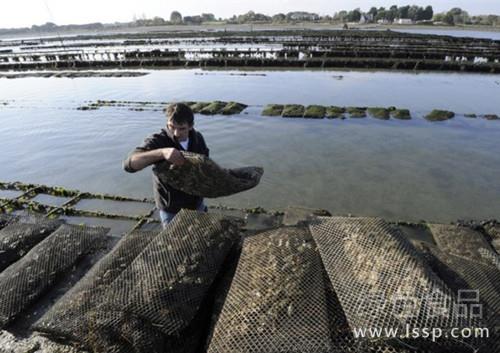
Oyster mudflat farming has good returns, key points for high-yield vertical farming
Oyster mudflat farming has good returns; key points for high-yield vertical oyster farming
-
What to Do About Aflatoxin Poisoning in Pigs? Detailed Treatment Methods
Aflatoxin poisoning in pigs is a toxic disease characterized by liver damage, caused by pigs eating feed contaminated with aflatoxin. Cause: Aflatoxin is a toxin produced by Aspergillus flavus, and it is not easily destroyed in the external environment. Ordinary heating and boiling cannot decompose the toxin (B1 toxin is only decomposed when heated to 268°C-269°C). It is a liver-cancer-causing substance. Aspergillus flavus is widely distributed in nature and readily parasitizes and reproduces in corn, peanuts, rice, wheat grains, as well as cottonseed cake,
-
Mechanized Processing Flow and Key Technical Points for Flat-shaped Tea
At present, the machinery used for processing flat-shaped tea is mostly the multi-purpose wok-trough machine. This machine is easy to operate, low in cost and high in output, and is well received by the great majority of tea farmers. The processing flow of flat-shaped tea with the multi-purpose wok-trough machine includes spreading fresh leaves -- green-fixing wok (fixing and shaping) -- spreading to cool and regain moisture --
-
How to prevent and treat aflatoxin poisoning in deer
Aflatoxin poisoning is a fungal toxin poisoning disease shared by humans and animals and is seriously harmful. It mainly attacks the liver, causing bleeding, digestive dysfunction and neurological symptoms as its features, and it has carcinogenic effects. [Cause]: Because feed is poorly kept and stored, or because it rains for a long time during the grain harvest period, the grain spoils, and some toxic molds (such as Aspergillus flavus and Fusarium) often parasitize it, leading to mildew. Eating a large amount of this kind of feed can cause poisoning. Among them, Aspergillus flavus is relatively strong in toxicity, and deer are even more likely to be poisoned after eating this kind of moldy
条件筛选