Oyster mudflat farming has good returns, key points for high-yield vertical farming
The oyster, commonly known as "lihuang" or "hao," has white, tender flesh, is rich in nutrients, and is incomparably delicious, long known as "milk of the sea." The oyster farming techniques are introduced below for reference.
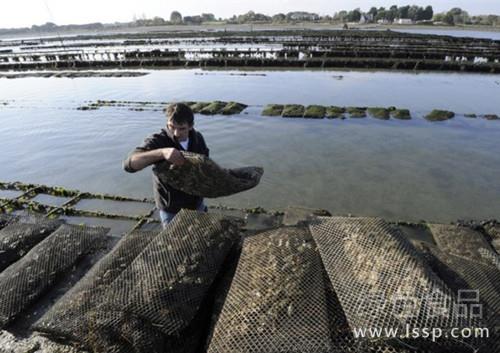
Oyster farming management
I. Choosing a good spat-collection sea area:
The oyster spat used in farming everywhere is natural spat from the ocean. For collecting oyster spat, it is best to choose a muddy-sandy mid-to-low tidal zone with small waves, slow current, and freshwater inflow (tidal exposure time 3-4 hours). During the spat-collection period, the seawater salinity should preferably be 17‰-20‰, because within this salinity range the oyster larvae secrete the most gelatinous adhesive, and once attached to the spat collector they do not easily fall off, giving good spat-collection results. In addition, the parent oyster resources (that is, two-year-old and three-year-old oysters) in the spat-collection area should be abundant; during the peak spat-collection period, only when there are 250-300 oyster larvae per cubic meter of water can enough oyster spat be collected.
II. Spat collector specifications and production:
1. Spat collector (cement pillar) specifications. Specifications vary from place to place, but they are generally flat in shape, 78 cm wide, 5-6 cm high, and 60-80 cm long. Cement pillars that are too large are inconvenient to handle and transport, while those too small affect spat attachment and unit yield.
2. Cement pillar production. Mix cement (high grade), yellow sand, and small stones evenly with water, pour into a wooden mold frame, tamp solid, smooth flat, and polish. During production, 2 thin steel wires (with both ends not exposed) should be placed in parallel in the middle of the cement pillar to increase its breaking strength.
III. Spat-collection season and methods:
1. Spat-collection season. Because oyster species and sea area environments differ, the spat-collection season also differs. For the Zhejiang coastal area's folded oyster (Saccostrea cucullata), the breeding season is concentrated in late spring and early summer; spat collected from "Summer Solstice" to "Minor Heat" is of the best quality, commonly called "mold spat," with a robust constitution, large individuals, uniform spat attachment, and fast growth; whereas spat collected in August, commonly called "buckwheat black," has a weak constitution, small individuals, excessively high spat-attachment density, and poor quality. Within half a month of the parent oysters' (referring to oysters two years old or older) first spawning peak, spat collectors should be placed into the sea area at the proper time; placing them too early makes them prone to deposition and attachment by barnacles, hydroids, and the like, which occupy the attachment space for oyster spat and affect the number of attached spat; placing them too late results in overly dense spat attachment or missing the spat-collection season.
2. Spat-collection methods. The first is the cluster-standing type. Several cement pillars are inserted obliquely into the mud and leaned against each other to form a ""-shaped trestle or gathered into a cluster. The second is the horizontal-pillow type. Two cement pillars are laid parallel on the mudflat (about 60 cm apart), and then several cement pillars are laid horizontally side by side on top of them.
IV. Transplanting for grow-out and fattening:
1. Transplanting for grow-out. After 3-4 months of cultivation, oyster spat should be subjected to "deep transplanting and sparse rearing" as early as possible, moving the densely placed cement pillars from the spat-collection area to the low tidal zone for sparse rearing, so as to extend the oysters' feeding time and obtain sufficient bait; at the same time, it frees up space for spat collection the following year. Oyster spat transplanted early grows fast, has large individuals, and has plump, delicious flesh.
2. Fattening. Five to six months before the oyster harvest, the cement pillars are again moved to a muddy beach with fertile water quality and fast current for fattening. After fattening, the oysters have thick shells and deep color, with plump grains, and the yield can be increased by about one times. To facilitate operation and management, the arrangement of the cement pillars is best as "single-row upright insertion," with a horizontal spacing of 40 cm and a longitudinal spacing of 70 cm between two pillars, with every 4 rows as one small plot, and a spacing of 4 m between plots. At the same time, the inserted cement pillars are required to be neat in rows and columns, firmly set into the mud, with smooth tidal flow and convenient passage for boats.
V. Strengthening management of the mudflat:
During the oyster farming period, management of the mudflat should be strengthened; if the cement pillars tilt, they should be promptly righted or reinserted, and silt and miscellaneous algae attached to the oyster shells should be removed. At the same time, closely monitor weather changes; for example, typhoons and rainstorms in summer and autumn often knock down large numbers of cement pillars, causing the oysters to sink into the mud and suffocate, so oyster beds must be urgently repaired and fallen cement pillars righted to reduce losses. In addition, various harmful organisms should be removed, such as carnivorous fish like rays and sea perch, which can be caught with fishing gear or hooks, or have soft bamboo, tree branches, and the like inserted at their points of entry and exit, using the sound produced by the vibration of the tide to scare them away; there are also various snails such as the lychee snail (Thais), red snail (Rapana), and spotted moon snail (Neverita), which can be caught in surprise operations during their peak occurrence or removed together with their egg masses.