-
Where in China is suitable for growing wasabi? Mid-altitude wasabi in Alishan may make a comeback
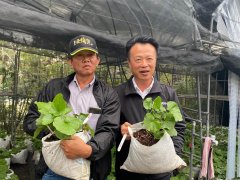
The distinctive crop "wasabi" of Alishan Township in Chiayi County gradually disappeared after the Forestry Bureau banned its cultivation on national forest land 20 years ago for national land conservation. Jiang Jinpin, a wasabi farmer who is also a wasabi merchant, introduced 12 Japanese varieties 3 years ago and cultivated them under net houses in the Shizhao area at an altitude of about 1200 m, successfully domesticating 2 wasabi varieties suitable for cultivation at mid-altitude, and is expected to be able to give healthy seedlings to farmers for planting next year.
-

Identification and Control Methods for the White-backed Planthopper on Rice
Hosts include rice, wild rice, corn, barley, wheat, sugarcane, sorghum, barnyard grass, and Kentucky bluegrass. The damage characteristics are the same as those of the brown planthopper. Morphological features: The macropterous male is 3.2-3.8mm long, pale yellow, with dark brown spots. The top of the head protrudes forward; on the outer side of the lateral ridges of the pronotum and mesonotum, behind the compound eyes, there is a crescent-shaped dark brown spot; the lateral areas of the mesonotum are dark brown with a yellow longitudinal band in the middle; the forewings are semi-transparent with brownish halo spots at the tips; the wing veins, face, thorax, and ventral surface of the abdomen are dark brown. The macropterous female is 4-4
-
Methods and Technical Key Points for Controlling the White-Backed Planthopper in Rice
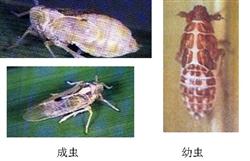
Damage symptoms: Adults and nymphs gather in colonies at the base of rice plants and pierce and suck the sap, causing the leaf tips of rice leaves to lose green and turn yellow, and in severe cases the whole plant withers and dies. Damage during the heading stage can also cause difficulty in heading, blighted panicles, or browning of the panicles, along with many empty grains and other damage symptoms. Morphological characteristics: Adults have two forms, the long-winged type and the short-winged type. The long-winged adult is 4-5 mm long, grayish yellow, with a rather narrow vertex projecting in front of the compound eyes; the face has 3 raised longitudinal ridges, with the ridges light in color and the grooves dark, black and white sharply distinct; in the center of the scutellum on the thoracic dorsum grows a pentagonal white or bluish-white spot; in females the
-
What are the control methods for the white-backed planthopper on rice?
Scientific name Sogatella furcifera (Horvath), belonging to the order Homoptera, family Delphacidae. Distributed in the water bamboo and rice-growing areas of China. Hosts include rice, water bamboo, corn, barley, wheat, sugarcane, sorghum, barnyardgrass, bluegrass, and others. Damage characteristics are the same as those of the brown planthopper. Morphological features: macropterous male body length 3.2-3.8 mm, light yellow, with dark brown spots. Vertex projecting forward; on the outer side of the lateral carinae of the pronotum and mesonotum, behind the compound eyes, there is 1 crescent-shaped dark brown spot; the lateral area of the mesonotum is dark brown
-
Which varieties can be used to control the white-backed planthopper in rice?
To control the white-backed planthopper in rice, the varieties that can be used are: (1) Buprofezin. The recommended dosage is 7.5-12.5 grams of active ingredient per mu. The key application technique is: spray at the early outbreak stage of the brown planthopper, and it is best to maintain a water layer in the field when applying. (2) Imidacloprid. The recommended dosage is 1-2 grams of active ingredient per mu. The key application technique is: spray at the early outbreak stage of the brown planthopper.
-
Control recommendations for the fourth generation of white-backed planthopper in rice issued, please carry out timely prevention and control
For the pesticide, use 40% chlorpyrifos (Xinnongbao, Saiben) 100 ml/mu plus 25% buprofezin (Puhsiling) 50 g/mu plus 5% jinggangmycin 200 ml/mu (or 30% Aimiao 15 ml/mu), mix with 30 kg of water for fine spraying.
-
How to control the brown planthopper and white-backed planthopper in rice?
How to control the brown planthopper and white-backed planthopper in rice? Please provide an explanation of the methods. The brown planthopper has occurred at level 5 for two consecutive years, with strong pesticide resistance, while the white-backed planthopper has occurred at levels 3 to 4 for many consecutive years; the main factors affecting their occurrence are the amount of immigration and the summer-autumn climate conditions. In the winter of 2006, the brown planthopper broke out massively in the rice-growing areas of Vietnam, indicating that this...
条件筛选