-
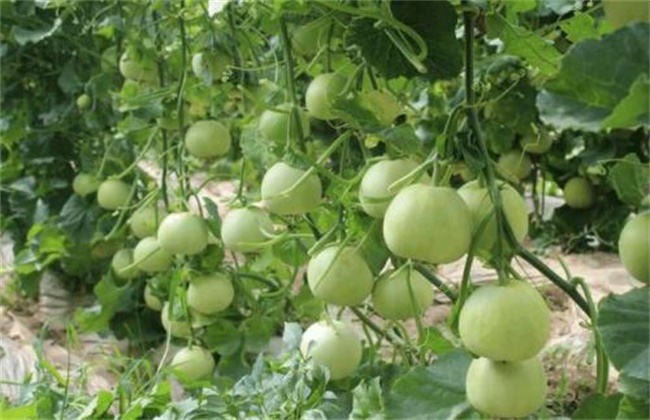
How to Grow Muskmelon in Open Fields? A Detailed Explanation of Key Cultivation Techniques
Open-Field Cultivation Techniques for Muskmelon
-

Korla Fragrant Pear Open-Center Training Technique and Cultivation Key Points
In order to continuously raise the level of orchard industry development, the "dwarf, dense, early, high-yield" cultivation technique should be adhered to in fragrant pear orchard management, and management should follow the six-character policy of "slow, drop, control, promote, cut, even." 1. Conditions and methods for open-center reshaping. 1. Fragrant pear trees over 25 years old are basically the traditional three-main-branch delayed open-center form, and the tree form has already set. If the tree form is complete, the three or four main branches at the base are sound, and the canopy has already filled the space, the central leader can be directly dropped for open-center; if the lower main branches are incomplete, with only 1~
-
Cotton seed: never harvest prematurely opened bolls; pay attention when saving and selecting seed
According to data from seed management department testing, in recent years the germination rate of some cotton seed has been only around 60%, still far from the national standard of 80% germination rate. From extensive surveys, the reasons for low cotton seed germination rates are: first, harvesting immature prematurely opened bolls; second, purchasing "favor bolls" with high moisture content; third, mixing in diseased seed from rotten cotton bolls; fourth, storing cotton seed in the warehouse before it is fully sun-dried; fifth, containing some cotton seed broken during processing; sixth, relatively high residual acid content in coated cotton seed; seventh, not strictly
-
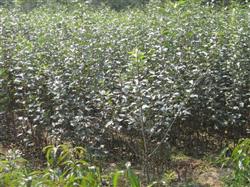
The six-character method for opening the main branch angle of young apple trees
In the winter pruning and training of young apple trees and trees in their first fruiting period, according to the requirements of a high-yielding tree structure, the angles of the basal main branches are: base angle 60 degrees, waist angle 65 degrees, tip angle 40-45 degrees. Ideal angles not only allow fruiting at the proper age and early high yields, but also make the tree framework strong, extend the fruiting years, and prevent premature senescence. Mast...
-
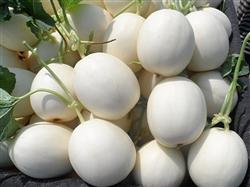
Detailed Explanation of Key Techniques for Open-Field Cultivation of Thin-Skinned Melons
For open-field melon cultivation, the traditional method has always been to let the vines crawl along the ground. The vines intertwine in a chaotic manner, making them very difficult to manage, and yields are also low. If melons are grown the way cucumbers are, with the vines trained up on a trellis, there are quite a few advantages. First, dense planting is possible. Taking Hongcheng No. 7 melon as an example, ground-crawling cultivation uses a plant-to-row spacing of 50 cm x 6...
-
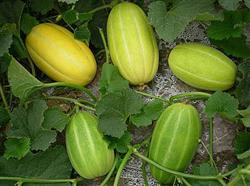
Key Technical Points for Open-Field Cultivation of Melons in Spring
Open-field melon cultivation in spring has low input costs and is easy to manage, making it one of the best choices for farmers to increase income and get rich in the short term. Optional varieties include Xiangmi 900, the Shabai series, and others. 1. Seed soaking: After selecting good varieties, the seeds can be appropriately sun-dried in fine weather and then screened. For warm-water seed soaking, soak in 55-degree water for 1 minute, then cool to 25 degrees, remove after 6 hours and let them dry slightly, then promote germination (keep the germination temperature at around 28 degrees). When the seeds sprout and turn white, sow them promptly.
-
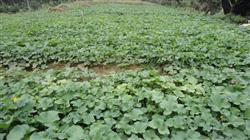
Key Technical Points for Open-Field Spring Muskmelon Cultivation
Apply all the base fertilizer at once, open a furrow 30 cm from the plants, and apply 50-100 kg of potassium sulfate compound fertilizer per mu, or 2-3 cubic meters of decomposed livestock and poultry manure. Or apply 50-100 kg of ternary bio-organic fertilizer, and in the middle and late stages spray the leaves with potassium dihydrogen phosphate + Xin Gao Zhi Mo (New High Lipid Film) at 600-800 times dilution, while also spraying Cuihua Wang No. 3 to balance vegetative growth...
-
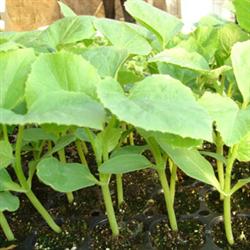
Open-field sowing methods and technical key points for melons
Open-field melon sowing method: open-field melons are grown using plastic film mulching with a water-and-dry bed system. Generally, the water bed is 0.5 m wide, the dry bed is 1.5-1.8 m, and the furrow is 20 cm deep. A north-south orientation of the beds is best. Before forming the ridges, open a small furrow (8-10 cm) with a small plow on both sides of the dry bed at 30 cm from the ridge edge line and apply organic fertilizer. The ridge height is 20 cm, the top opening of the water furrow is about 50 cm wide, and the depth is...
-
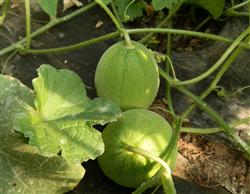
Open-field Melon Cultivation Techniques and Management Key Points
1. Production site conditions: 1.1 Temperature conditions The minimum temperature required for thick-skinned melons is 15°C, the optimum temperature is 18°C-32°C, and the effective accumulated temperature ≥15°C required throughout the growth period is above 1500°C. 1.2 Soil conditions The soil layer is deep, with a pH of 7.0-8.0 being suitable, soil salt content below 0.3%, and a loam or sandy loam texture...
-
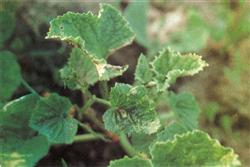
What to Do When Open-Field Melons Get Mosaic Virus Disease? Symptom Identification and Control Methods
Symptoms: In the early stage of the disease, the leaves show mosaic mottling interwoven with yellow-green and dark green, the leaves become smaller, and the leaf surface is wrinkled, uneven, and curled. The main vine is distorted and stunted, the plant is dwarfed, the melons are small, and the fruit surface has mottled patches of alternating light and dark, or slight bump-like protrusions. Causes: The incidence of mosaic virus disease has been relatively high in recent years...
条件筛选