Detailed Explanation of Key Techniques for Open-Field Cultivation of Thin-Skinned Melons
For open-field melon cultivation, the traditional method has always been to let the vines crawl along the ground. The vines intertwine in a chaotic manner, making them very difficult to manage, and yields are also low. If melons are grown the way cucumbers are, with the vines trained up on a trellis, there are quite a few advantages. First, dense planting is possible. Taking Hongcheng No. 7 melon as an example, ground-crawling cultivation uses a plant-to-row spacing of 50 cm x 6...
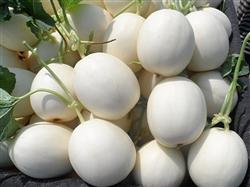
For open-field melon cultivation, the traditional method has always been to let the vines crawl along the ground. The vines intertwine in a chaotic manner, making them very difficult to manage, and yields are also low. If melons are grown the way cucumbers are, with the vines trained up on a trellis, there are quite a few advantages.
First, dense planting is possible. Taking Hongcheng No. 7 melon as an example, ground-crawling cultivation uses a plant-to-row spacing of 50 cm x 65 cm, with a density of 2,050 plants per mu, while trellis cultivation can reach a density of 2,850 plants per mu, an increase of 800 plants per mu;
Second, it favors high yields. Ground-crawling cultivation generally yields 3,000 kg per mu, while trellis cultivation can reach 5,000 kg per mu;
Third, less contamination and fewer pests and diseases. After the vines are trained up on the trellis, ventilation and air movement within the plot are greatly improved, which helps make full use of light energy, and because most leaves are higher off the ground, contamination is reduced, so pests and diseases are also less severe;
Fourth, it saves labor and time. After the vines are trained up on the trellis, management is convenient and less laborious, and harvesting is easier;
Fifth, the increase in returns is significant. Due to increased density, plastic film mulching, and seedling transplanting, not only are yields raised, but more importantly, the melons can reach the market earlier and fetch a good price, with returns generally between 4,000 and 6,000 yuan per mu.
Main Cultivation Techniques
Land preparation and fertilization: Choose a sandy loam plot with good permeability and drainage and irrigation conditions. The best preceding crops are spring corn, sweet potato, or cotton; avoid bean crops and avoid continuous cropping. Apply more than 5,000 kg of decomposed organic fertilizer per mu, 50 kg of diammonium phosphate, and 30 kg of potassium sulfate. Along with deep plowing, plow 60% of the chemical fertilizer into the soil together with the organic fertilizer. Open furrows with a small row spacing of 50 cm and a large row spacing of 80 cm, and apply the remaining chemical fertilizer in the furrows. Then combine the two rows of the small row spacing into a high ridge 12 cm high and 60 cm wide, leaving a 70 cm furrow between the two high ridges for watering and management. After ridging, cover with white plastic film.
Seedling raising: The seedling age of melons is generally 25-30 days, so the local sowing date can be calculated by counting back 25-30 days from the planting date. The planting date is best when the local soil temperature is stable at 15°C and the last frost has just passed.
Preparation of nutrient soil: Use half decomposed organic fertilizer and half fertile garden soil that has not grown melons or beans in recent years. Add 2 kg of Sakefu compound fertilizer per cubic meter of nutrient soil, mix well, sieve, and fill into 8 cm x 10 cm nutrient pots.
Seed soaking and germination: Choose thin-skinned melon varieties such as Hongcheng No. 7 or Shiji Tian, or other excellent varieties suitable for local cultivation. Soak the seeds in cool water at 12°C-15°C for 1 hour, then soak in 800-fold chlorothalonil or 300-fold watermelon continuous-cropping agent for 5 hours. Wash with cool water and place in a 25°C-30°C environment for germination.
Sowing and seedling-stage management: Place 2 seeds flat in each nutrient pot, cover with 1 cm of fine soil, and cover with a small arched frame and straw curtains to increase temperature and retain moisture. Before emergence, keep it at 25°C-30°C during the day and 20°C-22°C at night; after emergence, keep it at 25°C-28°C during the day and 15°C-18°C at night; maintain humidity above 90%. Thin the seedlings in time. When the seedlings grow to 2-3 true leaves, remove the film to harden them. The seedling age is 25-30 days, and transplant when they have 3 leaves and 1 growing point.
Planting: Transplant when the soil temperature is stable at 15°C and the last frost has just passed. Punch holes in the film and transplant with water. Plant 2 rows on each high ridge, with large and small row spacings of 50 cm and 80 cm respectively, a plant spacing of 35 cm, and a density of 2,850 plants per mu.
Post-planting management: (1) Fertilizer and water management: 5-7 days after planting, choose a sunny day to water for seedling recovery. In the early stage, moisture should not be too much to prevent excessive growth and flower and fruit drop. During the fruit enlargement period, ensure sufficient water supply. When the melons grow to the size of an egg, apply 10 kg of urea per mu with irrigation. After each subsequent batch of melons sets, apply 5 kg each of urea and potassium sulfate. Do not water within 7-10 days before harvest.
(2) Trellising and pruning: After the vines begin to run, set up the trellis. Use one 2 m long thin bamboo pole per melon plant, insert it on the ridge, and weave it into a diamond-grid A-frame trellis, tying the vines to the trellis in stages. Every leaf axil of a melon has an axillary bud (if allowed to grow, it will become a lateral vine). First remove the axillary buds of the two leaves closest to the ground, and keep the axillary buds of leaves 3-7. When an axillary bud grows its first leaf and a small melon appears in its leaf axil, remove the leaf in front of the melon, leaving only 1 leaf and 1 melon. Prune all axillary buds of leaves 3-7 in this way. After fruiting, select and keep 3-4 melons with thick fruit stalks and proper fruit shape. The main vine continues to grow. When the lower melons begin to ripen, count down from the top of the vine and keep 3-4 axillary buds; prune the axillary buds as before and set 2-3 melons. Remove all other axillary buds as soon as they appear. Each plant bears two batches of melons, top and bottom, generally 5-7 melons in total.
(3) Artificial supplementary pollination: Dip the tip of a brush in a male flower, then apply the collected pollen to the stigma of the pistil. You can also use 5 ml of 2,4-D diluted in 1 kg of water to dip the flowers. Note that dipping should be done on the day the female flower opens. To prevent repeated spraying of flowers from causing cracked melons, bitter melons, and deformed melons, add some pigment to the solution as a marker. This method is simple, easy to perform, and results in a high fruit-setting rate, fast fruit enlargement, and early maturity with high yield.
Main pest and disease control: (1) Diseases: For downy mildew, use phosethyl-Al, mancozeb, or Kelu; for powdery mildew, use triadimefon or Triflumizole; for Fusarium wilt, spray thiophanate-methyl, mancozeb, or drench the roots with Dexon.
(2) Insect pests: Use Yibianjing, pirimicarb, or Tianwangxing for control; for red spider mites and tea yellow mites, use fenpropathrin, propargite, or abamectin; for whiteflies, spray with buprofezin or hang yellow boards coated with waste engine oil to trap and kill them.