-

What Are the Benefits of Returning Wheat Straw to the Field? Methods and Precautions Explained in Detail
I. Benefits of Returning Wheat Straw to the Field. Returning wheat straw directly to the field not only reduces the number of tillage operations in the wheat field and lowers the cost of @#@245@#@ production, but also achieves rational use of the high-stubble wheat straw resource, avoids the practice of burning wheat straw, and helps conserve soil and water. After wheat straw is returned directly to the field, the straw covering the plow layer can reduce surface runoff during the rainy season, lessen soil compaction and cracking, and improve the soil's capacity to store water and conserve moisture; after the wheat straw decomposes, it can increase soil organic matter content, improve soil physical and chemical properties, and provide crops with various nutrient elements
-

Detailed Explanation of Key Points and Methods for Conch Aquaculture Technology
Conch Aquaculture Technology
-

Detailed Guide to Management Methods for Sunflowers at Different Growth Stages
Management of Sunflowers at Different Growth Stages
-
What are the control methods for tea tussock moth in tea gardens?
The tea tussock moth, also known as the tea yellow tussock moth and the head-swaying worm, belongs to the family Lymantriidae of the order Lepidoptera. It is distributed in every tea-producing province nationwide and is an important pest in China's tea regions. It mainly damages tea leaves and can also damage oil tea, citrus and others. Young larvae bite and feed on old tea leaves, leaving a semi-transparent membrane, and later bite young shoots and mature leaves, leaving notches. The larvae feed in groups, often dozens to hundreds gathering on the underside of leaves to feed. When the outbreak is severe, tea leaves are eaten almost completely.
-
Detailed Explanation of Harvesting and Processing Methods for Codonopsis pilosula
For direct-sown fields, harvest in the third year; for transplanted fields, harvest after two years of growth following transplanting. For medicinal Codonopsis pilosula, the harvest period runs from when the aboveground parts wither until before the ground freezes, but the best quality is obtained when harvested within the half-month before and after the White Dew solar term. When harvesting, first remove the support stakes, cut off the stems and vines, then dig up the roots. Take care not to damage the roots while digging, to prevent the loss of sap. Remove the residual stems from the dug roots, wash off the soil, and sort them by size, length and thickness into old, large and medium grades for drying in the sun. After drying until half-dry, briefly blanch in boiling water, then sun-dry or oven-dry (oven-drying must use only a low fire, with the temperature around 60°C
-
Causes and Control Methods of Ginger Bacterial Wilt
1. Symptoms The pathogen attacks the roots and the underground and aboveground stems. The affected underground fleshy stem initially becomes water-soaked and yellowish-brown, loses its luster, and then the internal tissues gradually soften and rot, leaving only the outer skin. Squeezing the diseased part exudes a dirty white turbid juice with a foul odor; the affected roots also turn pale yellowish-brown and eventually rot completely. The affected aboveground stem turns dark purple, and the internal tissues turn brown and rot, leaving fibers behind. The affected leaves appear wilted, turn pale yellow, with curled edges, and eventually the whole plant dies. 2. Pathogen This disease is caused by the bacterium Pseudomonas solanacearum (P
-
What are the methods for keeping garlic scapes fresh? Do this to store them longer
1. Harvesting garlic scapes 1. Harvest at the right time. The suitable harvest period is when the scape stalk has grown out of the terminal leaf and bends to one side (that is, hooks) around in a full circle. Harvested too young, the flavor is poor and it does not keep well; harvested too old, the quality is poor and it has no value for long-term storage. 2. Harvesting method. The "lifting the seedling" method is preferable: hold the scape stalk where it emerges from the terminal leaf with your hand and lift upward, so that the scape stalk breaks off from the base. The cross-sectional wound caused by "lifting the seedling" heals easily, whereas the wound from "cutting the seedling" harvest rots easily. 3. Harvesting time. Choose a sunny day, and by no means harvest on a rainy day.
-
Key Technical Points and Methods for Light Pruning of Tea Plants
Light pruning is a shaping and pruning operation carried out on the basis of formative pruning, with the aim of continuing to develop the tea plant canopy and the plucking surface. The cutting position is generally raised 4-8 cm above the previous year's cut. For spring tea harvested with leaves retained, keep the spring shoots and cut off the summer and autumn shoots. For spring tea harvested without leaves retained while summer tea is harvested with leaves retained, cut off the shoot position above the true leaves retained from the summer and autumn shoots. If both spring and summer tea are harvested with leaves retained, pruning should be based on the net increase in height of the canopy surface, and the stubble left should not be too high. Light pruning is done with horizontal shears in a single pass to cut level, and the cuts should be smooth. Light pruning is best carried out in late autumn or
-
Introduction to the Variety Characteristics and Cultivation Methods of Dutch Parsley
Variety origin: native to the Netherlands. Introduced from the Beijing Academy of Agriculture and Forestry Sciences. Characteristics: prefers a cool climate, relatively cold-tolerant, with optimal growth at around 20 degrees Celsius; long daylight easily promotes bolting and reduces quality, so it should be cultivated in protected areas with delayed autumn planting or advanced early planting. Cultivation points: transplant when seedlings are about 40 days old, water frequently with small amounts, keep the soil moist, apply sufficient base fertilizer, ensure topdressing, and take care to prevent the soil from drying out and waterlogging in the field.
-
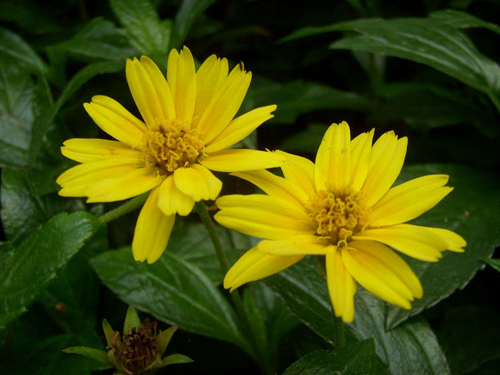
Cultivation and Care Methods and Medicinal and Other Uses of Wedelia trilobata
Wedelia (Wedelia trilobata, also known as South American wedelia) Scientific name: wedeliatrilobata. Common names: Three-lobed wedelia, Dijinhua, Chuandilong (Yunnan), Longguqi. Family and genus: Asteraceae. Morphological characteristics: Perennial herb. Stems creeping, leaves opposite, ovate-lanceolate.
条件筛选