-
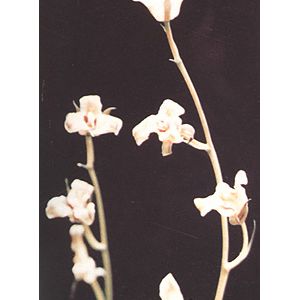
Introduction and Appreciation of the Yellow-White Holding-Butterfly Cold Orchid Variety
This plant is a butterfly-type Cymbidium kanran, specifically a winter-flowering Cymbidium kanran holding-butterfly flower, produced in Sichuan. Most of its sepals are short and slender, with a few having become lip-like; the holding petals are equal in size to the lip and fully lip-like, and the column also shows fission. The flower color has a white base with a yellow tinge. Its fine leaves stand obliquely, beginning to arc and droop from the middle. The leaf surface is smooth and yellow-green, the veins are raised and crystal-bright, and the leaves often show...
-
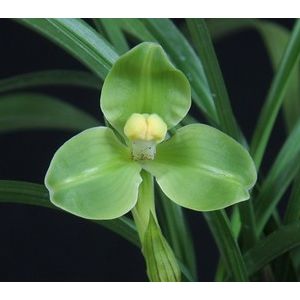
Introduction to the Characteristics and Care Points of the Cuitao Chunlan Variety
The three outer sepals are exceptionally wide, with a constricted base forming a diamond shape, thin in texture, emerald green in color, resembling peach blossom petals, hence the name. The petals (petaloids) fold back against each other, hardening into a yellow hard mass. The lip is thick and small, shaped like "three petals and one nose." The scape is tall and purplish-red, and the leaves are broad and arching. When the scape is tall and emerald green, the leaves are narrow and slanting upright. The leaf texture is hard.
-
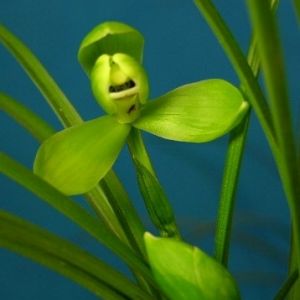
Introduction to the Characteristics and Appreciation Points of the Green Ying Chunlan Variety
Green Ying - selected and bred by Gu Xiangxiao of Suzhou in 1902. Leaves semi-drooping, thick and glossy. Flower scape tall, almost level with the leaf surface, blue-green. The flower is a narcissus-form plum-petal type, the staminal column petals form a hood, slightly open, the lip is short and small, a large ruyi tongue, with a red spot in the middle. New shoots purple-green, the shoot tips slightly tinged with purple-red blush and red streaks. Leaf texture...
-
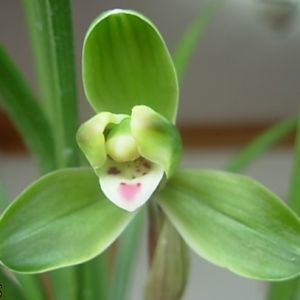
Introduction to the Characteristics and Care Methods of the Xiaoda Mei Chunlan Variety
The leaf posture is a mix of semi-drooping and slanting-drooping, the leaves are narrow and slender, the leaf groove is V-shaped, the leaf color is emerald green with a slight luster, the leaf stalk is slender and tapered, the leaf tip is pointed and long, and the leaf buds are purplish-red and slightly pale. The flower bud is pale red, with green color on the tip and reddish-purple veins. The flower stalk is pinkish-purple, with the top node turning green. The three outer petals are short and ovate, with the edges curling inward, shaped like a shallow soup spoon; the silkworm-moth stamen is held in the center, with a liu-hai tongue and red spots...
-
Introduction to the Chunlan 'Lao Shiyuan' (Jiyuan) Variety
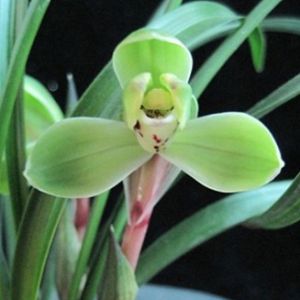
New shoots are purple-green. The sheath leaves are light green, not reddish either, and on close inspection have extremely fine pink-purple vein lines. The leaf shape is somewhat similar to Song Mei, slanting upright and spreading, with the tip semi-drooping, tall-waisted and elegant; some outer leaves also semi-droop, with 1-2 narrow slender leaves in the middle. The leaf texture is thick and glutinous, feeling relatively soft to the touch, though some feel hard. The petiole is thick and strong, medium-long and broad, with deep veins, and the tip is slightly blunt, about 26-29 cm long and about 1.1-1.3 cm wide, deep green and glossy. The bract leaves are green with red coloring or purple-red mixed with green coloring; some have a red-green base with red-purple, and an upper part with a green ground marked by purple vein lines, while the green coloring gradually intensifies from outside to inside. The bracts are emerald green with a purple-red base, some with a white tip, and some with a purple-red tip bearing green coloring. The 3 sepals are rounded at the base, short, round, broad and large, hence the name Jiyuan; tightly edged, spoon-shaped, of plum-petal form, though sometimes they also open in plum-form narcissus-petal form. The two lateral sepals appear somewhat longer, tender emerald green tinged with yellow, with white edges, but not as pronounced as in Song Mei, and with hidden green vein lines; the petal base has a pale red blush and purple-red colored stripes, exceptionally gorgeous, and the lateral sepals form a single line. The silkworm-moth (can'e) hold, thin and soft in texture, almost transparent, tightly edged, gathered into a pocket shape, slightly rounded at the base, bluntly rounded at the tip, tender green, with a smooth surface; the pocket head sometimes shows a faint pale purple-red blush, and the two pieces are joined. The Liu Hai tongue, sometimes opening as a Ruyi tongue, is well-formed, with bright vermilion spots in a pin-shaped arrangement, though some have disordered red spots; the lip margin curls upward, with an upward pocket, extending flat, with the tip slightly plunging downward, so compared with Song Mei the lip is slightly looser and the spirit slightly inferior. Jiyuan blooms a few days later than Song Mei, with a long flowering period; the flower scape is slender and long, about 15-20 cm tall, and perhaps due to light or soil composition, the scape color shows two variations: green-green and purple-red. The flower shape is sometimes as variable as Song Mei, and can have five petals separated at the base, with a flower diameter over 5 cm. With a dignified and graceful flower appearance, the Jiyuan orchid stands tall above the leaves, elegant and freely open, full of charm.
-
Introduction to the characteristics of the Cymbidium ensifolium variety Caiyun Zhuiyue
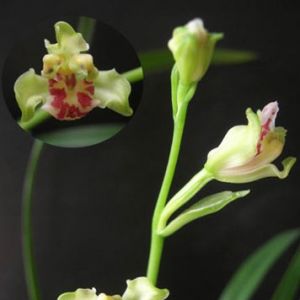
Caiyun Zhuiyue is a Cymbidium ensifolium (Jianlan) narcissus-petal variety originally from Sichuan. Its place of origin is Meishan, Sichuan. A few years ago, an orchid enthusiast in Meishan, Sichuan, gambled on a dragon-root grass and won a fine "piaomen" flower of Sijilan (four-season orchid), hailed as the best gamble grass in the Meishan area over the years. It was later collected by Dr. Li of Sichuan. When Mr. Chen Xutong, an orchid enthusiast from Chenghai, heard of it, he went to Dr. Li to seek...
-
Introduction to the Characteristics and Care Essentials of the Cymbidium ensifolium 'Xiahuangmei' Variety
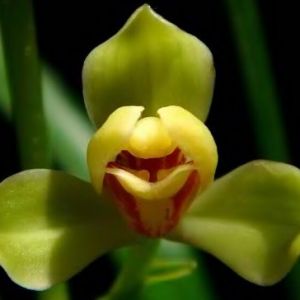
Each plant has 3-5 leaves, leaf length 26-42cm, width 1.4-1.6cm; leaf color emerald green; plant form loose; leaf posture semi-pendulous; lateral veins prominent; leaf surface flat and glossy; fine serrations at the leaf tip obvious; leaf tip has a small short point. The flower scape is upright, height 15-24cm, yellow-green; one scape bears 3-6 flowers, loosely arranged; the sheath at the base of the inflorescence has a yellow-green background color, slightly covered with purplish-red vein lines; the flower bracts are long and broad, similar in color to the flower scape; the sepals (outer three petals) are oblong, narrow at the base, gradually broadening toward the front, widest at the 2/3 point, narrowed at the front end with tightly rolled edges, the tip folded in pairs, the midline portion protruding outward, sepal length 1.6-2.0cm, width 0.7-0.9cm, color yellow-green, leaning yellow; the petals (pollen cap, petal lips) are shorter and smaller than the sepals, standing separately with the lip (tongue) on the three sides of the column (nose tip), and close to the column, the petal base is narrow and long, tightly edged from the middle, the front end rounded and blunt, forming a deep pouch, the front ends of the two petals are widely separated, the top of the column is clearly exposed, the petals are pale yellow, with uniform purplish-red spots on the lower part and the abdomen of the column; the lip is short and round, the front end of the middle lobe slightly drooping, noticeably thickened, the edges slightly rolled inward forming a shallow pouch, the side lobes are not obvious, the lip background color is pale yellow, both sides densely covered with purplish-red lines, and showing through to the outside; flower diameter 1.8-2.2cm. It is a variety that blooms and multiplies readily.
-
What is the Rainbow Butterfly Cymbidium? A detailed introduction to its variety characteristics
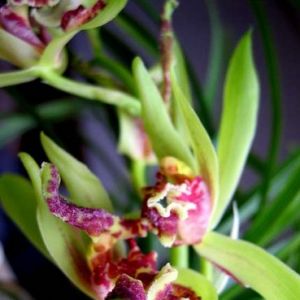
Rainbow Butterfly is a Cymbidium (Hui) flower discovered in 2001, rebloomed in 2003, and bloomed again in 2004. It is a vigorous bloomer with stable butterfly-form transformation. The plant is medium-sized at about 40 cm, with soft, drooping leaves; the flower scape is over a chi in height, and because the leaves are soft and drooping, the flower scape stands above the foliage. The main petal is broad and large, sometimes fused with the side petals into a single petal; the butterfly-transformed parts of the lateral petals are brilliant, with markings arranged in regular linear patterns,...
-
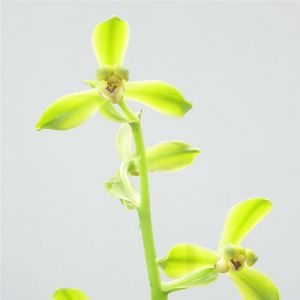
Introduction to the Characteristics and Care Methods of the Cymbidium faberi 'Xinhua Mei' Variety
Cymbidium faberi, plum-petal type, a famous variety. It was discovered at the end of the last century in Xiaojiang Town, Xinchang County, Zhejiang, when Mr. Liang Benhong found it with a local mountain farmer. A green Cymbidium faberi plum-petal type, when it blooms well the small bracts of each flower all become standard outer petals, and sometimes the outer petals are also partly variegated into petaloid form; the flower color is emerald green with a strong fragrance.
-
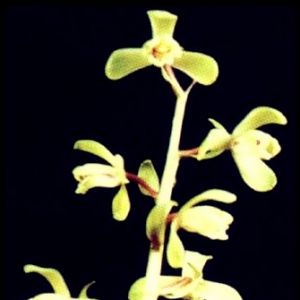
A Brief Introduction to the Characteristics of the Cymbidium faberi cultivar Hanbi Mei
Petal type: Red-to-green-shell plum petal. History: Selected in 1918 by Liu Delin of Shaoxing, Zhejiang. Characteristics: The three petals are short and broad with tightly incurved edges and thick substance; the divided-keel semi-hard column (slightly closed at the base of the back); a dragon-swallowing tongue (long, curled labellum); and slender, tall flower scapes. The flower color is like jasper. It has not spread widely, and because its flower form is dignified and elegant, it is regarded as one of the outstanding cultivars among Cymbidium faberi...
条件筛选