-
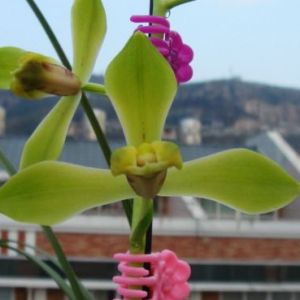
Introduction to the Traditional Fine Variety Shanghai Mei of Cymbidium faberi
Petal type: Cymbidium faberi green-shell type plum petal. History: Selected by Li Liangbin in the early years of the Jiaqing reign of the Qing Dynasty. Characteristics: The three outer petals have long stems and round tips, with a straight horizontal shoulder line, semi-closed hard column, and a small ruyi tongue piercing the cheek (the two edges of the tongue curl upward and inward, the tongue petal is upright, and the tongue tip extends straight out, as if emerging from the cheek.) When the flower bud emerges from the bract shell, it has a "small sanbing" head shape. The flower stem...
-
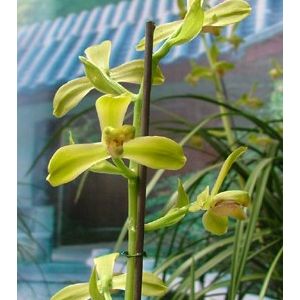
Introduction to the Variety Characteristics of Pan Lü Mei Huilan
Petal type: Huilan green-shell type plum petal. History: Qing Dynasty Qianlong period, originated in Yixing. Characteristics: The three outer petals have long feet and round heads, resembling the shape of boxwood leaves, with a notch at the petal tip, claw points, and the outer petals tend to wrinkle. Flat shoulders, split-head combined-back holding heart, pointed ruyi tongue, tucked within the holding petals. Flower color pale green. Not easy to bloom, requires plenty of sunlight. Listed among the eight old varieties of Huilan.
-
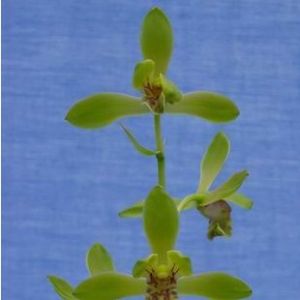
Introduction and Appreciation of the Diecui Huilan (Emerald-Green Huilan) Variety
Petal type: Green-shell type lotus-form narcissus petal. History: In the spring of the Gengyin year of the Guangxu reign of the Qing Dynasty (1890), it originated at Qixingtan in Yanzhou, and was later cultivated by Shao Zhiyan of Hangzhou. Characteristics: The five petals are divided into separate segments. The outer petals contract at the base and flare at the corners, the petals are thick, and the petal tips have sharp points, forming a straight-line shoulder. Deep cupped soft silkworm-moth-held petals, with a large spread lip. The flower resembles "Da Yipin", with a flower form slightly smaller than "Da Yipin".
-
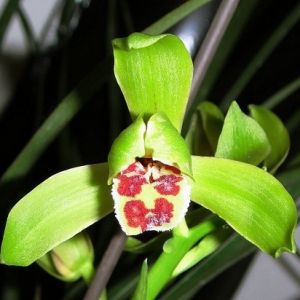
Loumei Huilan Orchid Variety Introduction: A Classic Huilan Meibian Masterpiece
Petal type: Green-shell lotus-form narcissus petal. History: Selected during the Guangxu period of the Qing Dynasty (1892) by the Lou family of Shaoxing, Zhejiang, hence the name "Loumei." Legend has it that after the host had finished entertaining guests and was seeing them to the door, this huilan happened to unfurl its petals and release its fragrance, so the host invited the guests back to admire the flowers, hence it is also called "Liumei." Characteristics: The three outer petals have large heads, fine root contractions, flat shoulders, light...
-
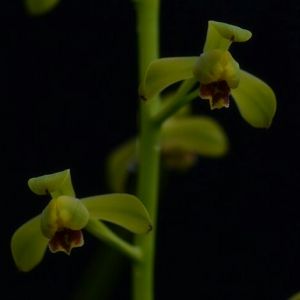
Introduction to the characteristics and care methods of the Qinghua Mei cymbidium variety
Now also called Lao Qinghua, Liu Mei! Petal type: Cymbidium green-shell plum petal. History: In the early years of the Republic of China, Che Qing from Shaoxing, Zhejiang, selected it at Huaxing Hotel, and Wu Enyuan of Hangzhou exchanged an old variety worth several tens of gold for it. Six years later, it bloomed with six flowers and was a fine plum-petal specimen. Characteristics: outer petals with short feet and round tips, thick petals, and level shoulders. The inner segments are divided-socket silkworm-moth segments, ...
-
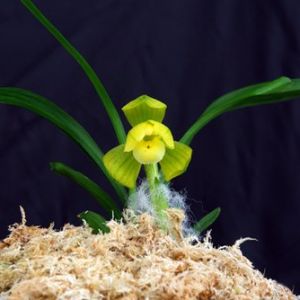
Tianyihe Cymbidium goeringii Variety Characteristics and Appreciation Introduction
Descended from the mountains in 1992 from the Meitan area of Guizhou. Selected and bred by Mr. Chen Jiwu, who also named it. Characteristics: a standard round-headed dwarf variety of Cymbidium goeringii, with a short and sturdy plant form. The flower color is golden yellow, the flower is large, lotus-petal type, solid-color center, with no mixed colors. This variety combines a dwarf type, lotus petals, and a yellow solid-color flower all in one. It can be called an unprecedented rare treasure. This...
-
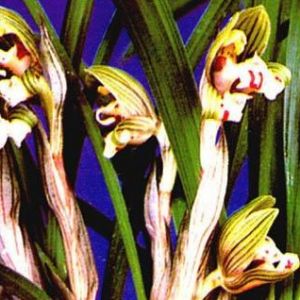
Introduction to the Little Butterfly Cymbidium goeringii Variety and Key Care Points
Leaves are slender and semi-pendant. The flower is a lotus-form butterfly-petal type: the lower half of the lower sepal (the lateral petal) is lip-like and curled backward; the lip is short and round, curled backward, and bears three red patches.
-
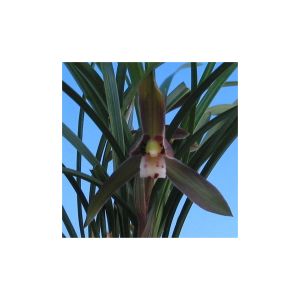
Introduction to the Variety Characteristics of Tang Zibao Chunlan
Also known as Tiansihuang. The leaves are semi-erect, hard in texture, and dark green. The flowers are of the bamboo-leaf petal type, purplish-red, with a white lip that is revolute and bears two red patches in the center.
-
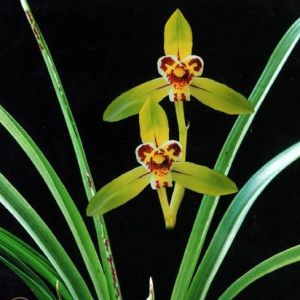
Introduction to the 'Hanxue Baoma' Cymbidium tortisepalum var. longibracteatum Variety
'Hanxue Baoma' originated in 2002 from Jiuzhou, Yunlong, Yunnan Province. It is a natural hybrid of Cymbidium tortisepalum var. longibracteatum (Lianban Lan) and Cymbidium goeringii var. serratum (Douban Lan), combining the delicate elegance and subtle fragrance of the former with the thick petals and large flowers of the latter. It can be said to gather the strengths of both; the biological "hybrid vigor" is perfectly embodied here. It has seven leaves; the leaf blades are curled, with deep grooves and thick texture, 30-40 cm long and 0.5-0.8 cm wide; most of the leaves that emerge after the fifth leaf show butterfly-like variegation, the green leaves paired with red coloration truly making one marvel at the wonder of nature's creation! It bears two or three flowers, the blooms are large, and it is a standard three-star butterfly type, with three complete lips distributed in a "pin" character arrangement, the red spots on the lip surface bright and eye-catching, with a high degree of butterfly-like transformation; the petals are thick and substantial, yellow-green in color. Such a yellow-flowered three-star butterfly is truly a masterpiece never before seen in the orchid world!
-
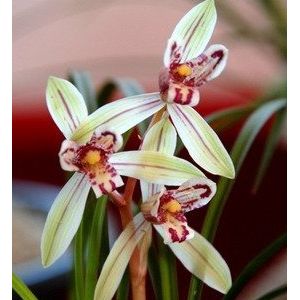
Introduction to the Xinghai Die Cymbidium Lianban Variety and Its Cultivation Methods
Xinghai Die, also known as Xinhai Die, is a famous three-star butterfly variety of the fine-leaf Cymbidium lianban. The leaves are 20-30CM long and about 0.6CM wide, with a fine, glutinous and glossy leaf texture, semi-pendant leaves, and relatively fewer leaves than other Cymbidium lianban, generally 5, with twisted leaf tips; the young shoots are purplish red, and the color remains basically unchanged from emergence to opening. After the young shoots of this variety open...
条件筛选