-

Huangshan pine named by Annan in 2006, shaped like an umbrella, now under special protection
On May 21, 2006, then-UN Secretary-General Kofi Annan ascended Mount Huangshan. While walking through the Huiming Bridge scenic area in the North Sea (Beihai) region of Mount Huangshan, a Huangshan pine that looked like an umbrella caught Annan's attention. Upon learning that the remaining tens of thousands of pine trees had not yet been named, Annan...
-
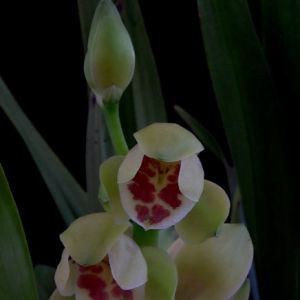
A Review of China's Eight Great Cymbidium ensifolium Famous Cultivars of 2006
Meizhou local wild-collected dwarf lotus-petal cultivar
-

Shennong 014 Rice Variety Profile (Liaoning Rice Approval [2006] No. 174)
Bred by the Rice Research Institute of Shenyang Agricultural University in 1996 through artificial hybridization and line selection using Shennong 265 as the female parent and 9660 as the male parent. Approved by the Liaoning Provincial Crop Variety Approval Committee in 2007. Characteristics: The growth period of this variety is about 150 days, belonging to the medium-early maturing type. At the seedling stage, the leaf color is dark green and the leaves are erect. Plant height is 107 cm, the plant type is compact, tillering ability is medium to strong, the main stem has 15 leaves, the panicle type is erect, panicle length is 19 cm, grain number per panicle is 170, 1000-grain weight is 25 g, the glume color is yellow-white, occasionally with sparse short awns. According to
-
Complete Collection of the Latest Feed Databases Excel Edition 2006 17th Edition
Excel Edition 2006 (17th Edition) Complete Collection of the Latest Feed Databases
-
Liaofu 2006, a premium-quality hybrid japonica rice variety
Liaofu 2006 is a new disease-resistant hybrid japonica rice combination bred in recent years by the Rice Research Institute of the Liaoning Academy of Agricultural Sciences by crossing a high-quality male sterile line with a premium-quality restorer line; it offers high quality, high yield, high efficiency and wide ecological adaptability. In Shenyang its whole growth period is about 165 days, making it a mid-to-late maturing combination. Plant height is 110-120 cm and panicle length is 25-30 cm; at maturity the panicles hang below the leaves in a loose-panicle type. The stems have good elasticity, and the basal stem nodes are thick and short, giving strong lodging resistance; tillering ability is strong and the percentage of productive tillers is high, with the number of effective panicles per 667 sq m (1 mu) generally
-
What are the new cotton varieties nationally approved in 2006
Xiangzamian No. 11. This variety was jointly bred by the Hunan Cotton Science Research Institute (15 Yuxia Avenue, Qiaonan, Changde City, Hunan Province, postal code: 415101), the Biotechnology Research Institute of the Chinese Academy of Agricultural Sciences and other institutions. Characteristics: it is a transgenic insect-resistant hybrid first-generation variety, with a spring-sowing growth period of 126 days in the cotton region of the Yangtze River Basin. The plant is tower-shaped, with a plant height of 113.1cm, thick stems with more fine hairs, medium-sized dark green leaves, the first fruiting branch node at 6.6 nodes, and 2 bolls per plant
-
Liaoxing 14 rice variety (Liaoning Rice Variety Approval No. 177 of 2006)
Bred by the Liaoning Provincial Rice Research Institute in 1999 through artificial hybridization and line selection, using Liao 93-77 as the female parent and Liao 34 as the male parent. Approved by the Liaoning Provincial Crop Variety Approval Committee in 2007. Characteristics: The growth period of this variety is about 156 days, belonging to the medium-maturity type. At the seedling stage, the leaf color is light green, the leaves are wide, the plant height is 105-110 cm, the plant type is semi-compact, the tillering ability is medium, the main stem has 16 leaves, and the panicle type is loose. The panicle length is 18-20 cm, the number of grains per panicle is 120-140, and the 1000-
-
Forecast of Major Diseases and Pests of Edible Fungi (2006)
The edible fungi industry has been ranked among the six major industries of agriculture in China, with an annual output of over 12 million t, becoming a distinctive and pillar industry in agricultural regions. With the acceleration of industrialization, the cultivation area of edible fungi nationwide has continued to increase by 15% annually, among which the number of medium-temperature and high-temperature varieties has grown, the types of diseases and pests have increased, and the degree of damage has worsened. Through multi-point disease and pest surveys and information collection across the country, the occurrence status of diseases and pests in major edible fungi production areas nationwide in 2005 was summarized, and on this basis, a forecast for 2006
-
Shendao 1 (Liaoning Crop Variety Approval [2006] No. 172)
Bred by Shenyang Agricultural University in 1998 through artificial hybridization and line selection using Qiandaijin as the female parent and Shennong 8801 as the male parent. Approved by the Liaoning Provincial Crop Variety Approval Committee in 2007. Characteristics: This variety has a growth period of about 150 days and belongs to the medium-early maturing group. At the seedling stage, the leaves are dark green and erect; plant height is 95 cm; plant type is compact; tillering ability is medium; the main culm has 15 leaves; semi-compact panicle type; panicle length is 17 cm; number of grains per panicle is 120; 1000-grain weight is 25 g; glume color is yellow-white, awnless. According to the Rice and Rice Products Quality Supervision, Inspection and Testing Center of the Ministry of Agriculture,
-
Introduction to the Huaidao 9 (Su Shen Dao 200607) rice variety
Huaidao 9, originally named "Huai 68", is a late-maturing medium japonica rice variety systematically bred by the Huaiyin Institute of Agricultural Sciences of the Xuhuai Region of Jiangsu from Huai 9712 (Yangdao 3 / 02428 // IR26 /// Zhongguo 45 / Lianjing 1), and was developed in 2000. It is suitable for planting under medium-to-high fertility conditions in central Jiangsu and the hilly areas of Nanjing, Zhenjiang and Yangzhou. Yield level and characteristics. It participated in the Jiangsu provincial regional trial from 2003 to 2004, with a two-year average yield of 586.0 kg per mu, compared with the control Wuyujing 3
条件筛选