The Origin Story of Korean Dried Persimmons and the Flavor Characteristics of Fuping Dried Persimmons
The fiery red persimmons hanging all over the branches are a common autumn sight in Korea, and persimmons are also a relatively cheap fruit in Korea. Fresh ripe persimmons are attractive, but hard to keep for long. Once dried into persimmon cakes, they become a traditional delicacy beloved by Koreans.
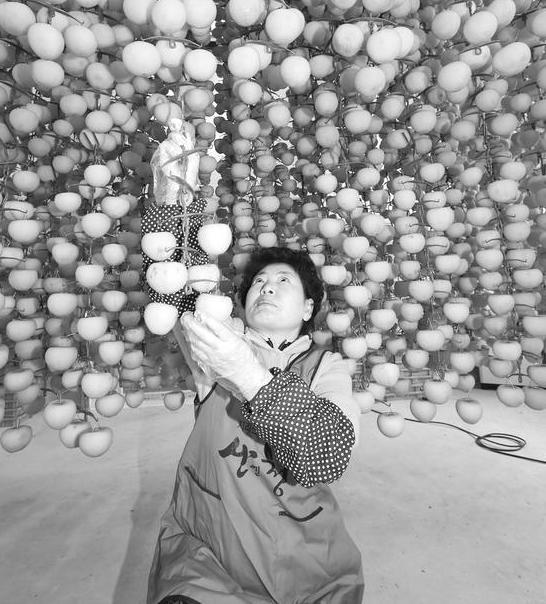
A Korean woman is drying persimmon cakes.
Unlike the flat persimmon cakes found in China, Korean persimmon cakes are mostly long and round hanging persimmon cakes, literally called “skewered persimmons” the persimmons are threaded into a string with bamboo skewers or string, then dried and made through multiple processes. The flat, round persimmon cakes are called “squat persimmons.” Because persimmon trees can be seen everywhere, persimmons are low in price. In ancient times, highly sweet persimmon cakes were one of people's important sources of sugar, and so they were a very popular food in ancient times, eaten mainly on important festival occasions for ancestral rites and at weddings.
On these important occasions, virtuous housewives would stuff walnut kernels or pine nut kernels into the persimmon cakes to make snacks, arranging them in the shape of flowers and placing them on the offering table. After letting the ancestors “taste” them, these offerings became a treat for the children; the fragrance of the walnuts and pine nuts balanced the cloying sweetness of the persimmon cakes, and the soft, chewy persimmon cakes also gained a fresh, fragrant texture.
The deliciousness of persimmon cakes can also be read about in Korean fairy tales. One night, a tiger came to a village and overheard a mother in a household coaxing her child. The mother said: “The tiger is here, stop crying.” But the child kept crying. Having no other option, the mother took out a persimmon cake as a “bribe,” saying, “The persimmon cake is here, stop crying.” The greedy child stopped crying. Outside, the tiger was startled and thought, “It seems this thing called a persimmon cake is more terrifying than a tiger; I must run away quickly.”
Historically, persimmon cakes once became a prop in palace intrigue. According to the Veritable Records of the Joseon Dynasty, King Seongjong of Joseon disliked Queen Yun, and so on the grounds that she had hidden persimmon cakes containing arsenic, he deposed her to commoner status and ultimately ordered her put to death. But when Queen Yun's son grew up and succeeded to the throne, he began a crazed revenge against his father and the ministers of that time, causing chaos. This can be called a tragedy caused by persimmon cakes; this king was the famously notorious tyrant in Korean history —— Yeonsangun.
Persimmon cakes can be said to be one of the symbolic foods of the Korean Spring Festival; persimmons that ripen in autumn are just right for making into persimmon cakes in winter. Therefore, persimmon cakes are indispensable in Spring Festival gift boxes of New Year goods. Previously, the amendment to the Kim Young-ran Act, an anti-corruption law implemented in Korea, relaxed the upper limit for agricultural and fishery gift items, and affordable, high-quality persimmon cake gift boxes became even more favored.
Unlike in China, where persimmon cakes with a white frost are considered the best, Korean persimmon cakes are prized for being orange-red, and the high-grade persimmon cakes in gift boxes are all bright red. Besides being eaten, persimmon cakes can also be added to beverages; the traditional Korean drink “Sujeonggwa” is made with ginger, cinnamon and persimmon cakes. According to the Korean folklore text Haedong Jukji, in the past Koreans would drink this sweet, slightly medicinal beverage on the first day of the Lunar New Year.
In Korea, the persimmon cakes of Sangju in North Gyeongsang Province are the most famous. Sangju holds a persimmon cake festival at the end of each year, and a persimmon cake park has also been built there. Persimmon cakes produced in Sangju were once selected as a Spring Festival gift from the President of Korea. Last year, on the eve of U.S. President Trump's visit to Korea, a photo of Korean First Lady Kim Jung-sook sitting under the eaves with persimmon cakes hanging down while reading a newspaper went viral online. Netizens all felt this photo was “very down-to-earth,” turning the presidential office into an ordinary rural farmhouse. When hosting the U.S. First Lady, Kim Jung-sook served persimmon cakes with walnuts as tea snacks.