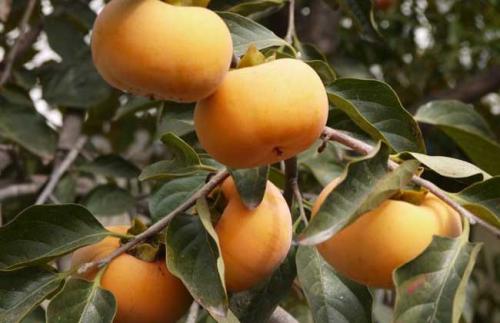
What is the difference between sweet persimmons and astringent persimmons in Taiwan, China, and which has better prospects and prices?
Do you know the yellow peach cultivation technique? But what we are going to talk about today is persimmons. Season-limited persimmons have become the hottest fruit this year because of the heated election battle! Gao Dezheng, deputy director of the Taichung District Agricultural Research and Extension Station of the Council of Agriculture, said that common persimmons in Taiwan, China are divided into astringent persimmons
Do you know the yellow peach cultivation technique? But what we are going to talk about today ispersimmons.Season-limited persimmons have become the hottest fruit this year because of the heated election battle! Gao Dezheng, deputy director of the Taichung District Agricultural Research and Extension Station of the Council of Agriculture, said that common persimmons in Taiwan, China are divided into two major categories, astringent persimmons and sweet persimmons. Among them, astringent persimmons are further divided into red persimmons and soaked persimmons, with a total planting area of about 5,300 hectares; sweet persimmons, which are crisp and sweet in taste and fetch the best prices, have a planting area of nearly 4,000 hectares, becoming the mainstream product in the "persimmon" market.
Astringent persimmons got their name because after harvest they must undergo further ripening treatment. Their planting area is about 1,300 hectares. Red persimmons must be ripened with calcium carbide until soft before they can be eaten. Because their shape is square with a bit of roundness, they are also called "four-sided ones," or four-sided persimmons. Their production period is concentrated in July, with Fengyuan, Tanzi and Dakeng in Taichung City as the main production areas. Soaked persimmons, also called crisp persimmons, must be soaked in limewater to ripen before they can be eaten. Ox-heart persimmon is one type of soaked persimmon, with a production period from August to October, and Miaoli County, Zhuqi and Fanlu in Chiayi County as the main production areas.
Sweet persimmons are currently the most produced "persimmon" product. Common varieties on the market, such as Fuyu, Jiro and Hanagosho, were all introduced from Japan and are suitable for planting in mountainous areas at an altitude of about 1,000 m, but in recent years some farmers have also tried planting at low altitudes. November and December are the main production season, and the production areas are concentrated on both sides of the Daan River, including Heping and Dongshi in Taichung City, as well as Zhuolan in Miaoli County.
Gao Dezheng said that the earliest persimmons planted in Taiwan, China were actually stone persimmons, which were air-dried using the nine-day wind to make dried persimmons, and were only cultivated in Beipu and Xinpu in Hsinchu County. Later, farmers planted ox-heart persimmons, followed by four-sided persimmons, and in recent years sweet persimmons were introduced from Japan.
The main production areas for sweet persimmons in Hsinchu County are Wufeng and Jianshi, and they have also passed global traceability certification. One can sell for 100 yuan; this is a premium fruit. Gao Dezheng revealed that sweet persimmons can be eaten as soon as they ripen on the tree and are picked, without further processing or ripening, and market conditions look promising. For each sweet persimmon weighing six liang, each jin can sell for 40 yuan. For every increase of one liang in the weight of a single fruit, the price per jin increases by 10 yuan; after the weight of a single fruit exceeds eight liang, for every increase of one liang, the price per jin increases by 20 yuan, making it the mainstream choice for persimmon farmers to plant.
Most persimmon farmers in Hsinchu County plant stone persimmons, while those in the south plant ox-heart persimmons. Both can be used to make dried persimmons. When you go to buy dried persimmons, you will find two sizes. The larger ones are made from ox-heart persimmons; the smaller ones are made from locally grown stone persimmons in Hsinchu County. Because making dried persimmons is very labor-intensive, a box of eight dried persimmons sells for 150 yuan.