How is the red-heart red-flesh plum variety? Growing conditions and environmental features of the Tengzhi tribe
During the Japanese occupation era, when Taiwan was colonized by the Japanese, the Tengzhi tribe in Taoyuan, Kaohsiung was in early times a vast expanse of cedar and tung blossoms. The Bunun tribespeople living here enjoyed peaceful lives and were content with their lot. After chatting and interacting with them, one feels that just like the place name here, being here is like a hidden paradise on earth!
During the Japanese occupation era, when Taiwan was colonized by the Japanese, the Tengzhi tribe in Taoyuan, Kaohsiung was in early times a vast expanse of cedar and tung blossoms. The Bunun tribespeople living here enjoyed peaceful lives and were content with their lot. After chatting and interacting with them, one feels that just like the place name here, being here is like a hidden paradise on earth!plum fruit set rate we did pay some attention to it.
Caring for people while staying close to the land - cherishing all living things and being grateful
The host we visited that day, Chen Weiqi, is known by all his close friends as Miki. He currently has a full-time job in downtown Kaohsiung, and as for the farming-related work of cultivation, he completes it using spare time on his days off. Hearing that he ordinarily devotes his time outside work to cultivation, one cannot help but be a little surprised - is it not too tiring? He answered with a smile: almost every household in our tribe has a plot of land, and parents pass the land down to their children. It would be such a pity to let it go to waste. Based on this starting point, he, who originally had no great interest in farming, quietly threw himself into it for more than ten years! Almost all of his spare time is spent in the orchard, and he has evidently developed a deep bond with this land.
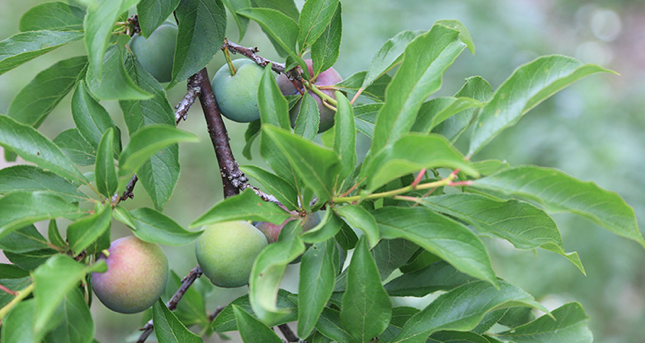
The red-flesh plums in the Tengzhi tribe orchard are still at the stage where green and red meet, and they can be harvested around early June each year!
High altitude, shale soil, large day-night temperature difference
Why did he have the idea of returning home to grow red-flesh plums? Miki said it is because, starting from the previous generation, the elders here have always been growing them... a very direct and unpretentious answer. But he also explained to us: because of the terrain, Taoyuan in Kaohsiung is located at a high altitude of about 1200-1300 m, and the soil belongs to "shale," containing earth mixed with sandy texture. Then, adding in the climate factor and the large day-night temperature difference, this has a positive and substantial benefit for fruit growth. As for the red-flesh plum crop, under such a geographical environment, the fruit cultivated is simply larger and juicier than in other areas, and the flesh is even sweeter and more plump and beautiful! Doubt it? Why not try it for yourself!
Tengzhi tribe red-flesh plums are grown at a high altitude of 1200-1300 m, with a large day-night temperature difference, and the environment is especially suitable for their growth. Tea is also a major crop of the Tengzhi tribe. The peaches and red-flesh plums between the rows of the tea garden were originally planted by Miki with a casual "plant a little extra" mindset, and in recent years the volume of production can be called an unexpected harvest.
Besides the common crop of red-flesh plums, Miki has also tried growing field persimmons, peaches and crystal pears, hoping that while continuing tradition, he can also actively develop other new crops. That a non-full-time farmer can still have such intentions is truly not easy. Doing farm work in the gaps between work, one would intuitively think there would be many difficulties in management that need to be overcome, but Miki does not feel it is hard at all. He does not spray herbicides just to reduce the burden of farm work, and instead steadily uses a mower to cut grass; he also repeatedly weighs his choice of fertilizers, taking not harming the land as the premise, not using chemical fertilizers or seeking rapid results for the crops, and unwilling to abuse chemical things just to make the fruit look beautiful. "The ones that look better and larger are taken to sell; the smaller and less beautiful fruit can also be used in making processed products, such as jam, or made into red-flesh plum liqueur, which is also quite good." Miki takes the growth of the fruit calmly and does not force things too much, once again letting one feel the Bunun people's attitude of taking life as it comes.
A full and juicy fresh-sweet taste - you will know it once you taste it
Miki Chen Weiqi did not go into farming to make a living in the first place, so there is no so-called pressure from the harvest. Originally, in order to carry on the land left by his parents, he chose to return from Taipei to his hometown in Kaohsiung. It is more like cultivating an interest outside work; just like that, he has grown red-flesh plums for more than ten years. They must be picked at about seven-tenths ripe, and even at this not-yet-fully-ripe stage they taste quite delicious. As for the flavor after full ripening... there is even less need to go on about it: the flesh is fresh and sweet, full and juicy, with a bouncy, juicy texture... take a bite and you will know!