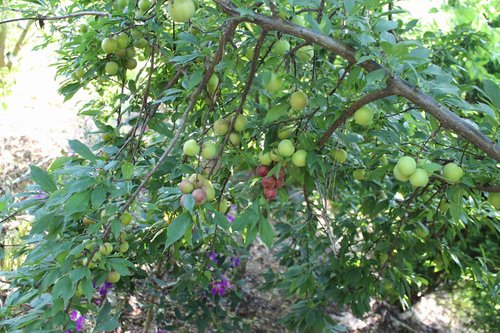
Plum Tree Cultivation and Management Methods, Plus Fertilization Timing and Application Rates
The plum is a fruit we see often, but do you know how it is grown? Is it the same as the cultivation method for Black Amber plums?
1. Propagation
Plum trees, depending on the species or cultivar, can be propagated by cuttings, layering, division and root cuttings, but grafting is generally used. In this province, plum trees mostly use peach or plum as the rootstock for graft propagation. The period for cleft grafting is from December to February, and budding is carried out from August to October.
2. Planting
Plum trees are planted as one-year-old nursery stock. The planting period runs from after leaf fall in autumn to before bud break in spring. Row and plant spacing is 5 x 5 m to 7 x 7 m, varying with terrain, soil, rootstock type and cultivar. Plum trees are often self-incompatible, so about 10-30% pollinator trees must be interplanted.
3. Fertilization
Fertilizer management for plum trees should be based on their growth and fruiting habits, combined with local soil and climate conditions, carrying out rational fertilization and timely irrigation.
(1) Fertilization timing
Post-harvest fertilization: after the plums are harvested from April to June, apply a thank-you fertilizer, adjusted according to tree age and vigor to help the branches grow strong, thicken the leaves, promote flower bud differentiation and enhance winter hardiness.
Post-leaf-fall base fertilizer: applied during the winter dormancy period from October to December. Fertilizing after leaf fall helps plum trees accumulate nutrients over winter, supporting normal growth of flower buds and leaf buds the following year. Applying large amounts of organic fertilizer also loosens the soil, improves aeration and improves the soil's physical properties.
Pre-bloom fertilization: although base fertilizer has already been applied, spring flowering and leaf bud growth consume large amounts of nutrients, so a moderate application of chemical fertilizer promotes uniform flowering, increases fertilized eggs and reduces flower and fruit drop.
Topdressing at the early stage of young fruit swelling: after the young fruit sets, it swells rapidly and new shoots begin to grow. This is the critical period when plum trees need large amounts of nutrients. Topdressing at this time can promote fruit enlargement and also create good conditions for flower bud differentiation.
Topdressing at the late stage of fruit swelling: adding phosphorus and potassium fertilizer can increase the sugar content and quality of the fruit.
(2) Fertilizer application rates
In general, the fertilization standard is about 1% nitrogen fertilizer of the yield, phosphorus fertilizer at ½ of the nitrogen fertilizer, and potassium fertilizer about 20% more than the nitrogen fertilizer.
4. Water management
In spring, plum trees flower, sprout, set fruit and grow new shoots rapidly. If the soil is dry, it causes flower and fruit drop and little branch and leaf growth, so an appropriate water supply is needed at this time. In summer, rainfall is plentiful and leaf growth reaches its maximum; rain can cause fruit cracking, so drainage should be attended to at this time. Irrigation during dry autumn and winter periods allows the soil to store enough water, which benefits root development, flower bud differentiation and the tree's biochemical activities. Irrigation periods can be divided into pre-bloom, young fruit stage and overwintering water management.
5. Training and pruning
The purpose of training is to develop a strong, well-balanced tree framework, with large branches reasonably distributed and many small branches that are not tangled, making full use of the effective space of the canopy. At present, the open-center shape or the modified leader shape is mostly used. The planted sapling is cut off 60-70 cm above the ground, and on the trunk at intervals of 25-30 cm, three main branches are selected and kept, growing in different directions, of similar vigor and at an angle of no less than 45 degrees to the trunk. The following year, 3-4 secondary main branches are developed from the main branches. In the modified leader shape, three main branches per tier are completed on the trunk over successive years. After reaching fruiting age, the central leader is cut out to favor the development of spur groups and expand the fruiting surface. If the tree becomes weak or has too many spurs, appropriate thinning or renewal pruning should be carried out to help restore normal productive tree vigor.
Now that you know the cultivation method, if you want to grow them, get started right away!