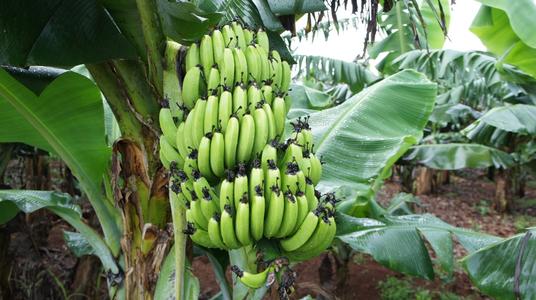
Planting History and Disease Resistance of the Banana Varieties Xianrenjiao and Aijiaojiao from Taiwan, China
Banana yellow leaf disease is a rather serious disease, and when you encounter this kind of disease you must deal with it promptly. Below, let us learn about the characteristics of Xianrenjiao and Aijiaojiao!
Xianrenjiao: "Xianrenjiao" is a bud sport of "Beijiao". In 1919, it was discovered in Zhuzikeng, Taichung, by the farmer Lin Chuan. At that time, banana bunchy top disease was pandemic, but Xianrenjiao did not suffer from bunchy top disease. The farmers regarded it as a gift from the immortals, so they called it "Xianrenjiao", and it was consequently planted in large quantities; but perhaps because of its long planting history and continuous propagation of new growth, its disease resistance is no longer obvious today.
In appearance, "Xianrenjiao" is very similar to "Beijiao", with extremely slight differences, but the Xianrenjiao plant is taller than Beijiao, and its leaves are narrower and longer. As with Beijiao, Xianrenjiao has weaker wind resistance because its plant is taller, and its leaf shape ratio is mostly above 2.6. The male flower bracts all fall off in summer, but in winter low temperatures, some often remain, and this phenomenon of all bracts falling off after flowering is also one of its characteristics. Xianrenjiao has strong adaptability to poor mountain soil, so it is planted the most in the central banana plantations, and bananas generally called "shanjiao" or "Taichung banana" should all belong to this variety. The growth period of Xianrenjiao is about 15~20 days longer than that of Beijiao. Apart from being taller, its yield, fruit shape and quality are all better than those of Beijiao, but it is still easily infected by Panama disease in this province.
Aijiaojiao: Aijiaojiao belongs taxonomically to the Dwarf Cavendish group, and has a long history of cultivation in Taiwan, China. Its leaves are short and wide, with a leaf shape ratio of 1.8~2.2. Most of the male flower bracts remain, and in winter almost all remain, with especially many neutral flowers. The Aijiaojiao plant is especially short, with a height of only about 1.5 m. Because its plant is short, its wind resistance is the strongest. Taiwan, China is in a typhoon belt, so in theory Aijiaojiao should be cultivated, but because it is easily infected by bunchy top disease, and because many new banana varieties have been continuously planted, its yield is far lower than that of Xianrenjiao and Beijiao.
Aijiaojiao is now only sporadically cultivated in Taiwan, China, and as far as is currently known it is only occasionally planted in field ridges and along roadsides in Tainan or other areas; the fruit bunch of Aijiaojiao today is relatively small and pointed, and its taste and flavor are inferior to "Beijiao". Its fruit stalk is shorter, which is especially obvious in winter low temperatures, so that the fruit bunch has difficulty emerging or leans, making the fruit shape irregular. In addition, it does not keep well for storage and transport, so there is no commercial cultivation of it in Taiwan, China; although Aijiaojiao is less cultivated in Taiwan, China, it can still be regarded as an important economic variety in the world.