What are the differences in characteristics and morphological features between the banana varieties Danjiao and Beijiao?
If you love eating bananas, then do you know that the cultivation techniques for bananas are relatively simple? What about the two banana varieties Danjiao and Beijiao? What characteristics and differences do these two bananas have? Let's take a look together! Danjiao is also known as sweet banana, Pisang Ma
If you love eating bananas, then do you know that the cultivation techniques for bananas are relatively simple? What about the two banana varieties Danjiao and Beijiao? What characteristics and differences do these two bananas have? Let's take a look together!
Danjiao is also known as sweet banana, Pisang Mas (Malaysia), Amas (Philippines), Gongjiao (Vietnam), etc.; in Thailand it is called KluAi Khai, with Khai meaning "egg". Danjiao is one of the important cultivated varieties in Thailand and Malaysia. The Danjiao of the Kamphaeng Phet region in central-northern Thailand is especially the most famous.
Danjiao is also known as sweet banana, Pisang Mas (Malaysia), Amas (Philippines), Gongjiao (Vietnam), etc.; in Thailand it is called KluAi Khai, with Khai meaning "egg". Danjiao is one of the important cultivated varieties in Thailand and Malaysia. The Danjiao of the Kamphaeng Phet region in central-northern Thailand is especially the most famous.
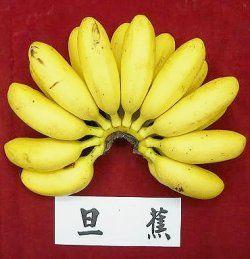
The main characteristics of the "Danjiao" plant are that the pseudostem is blue-green with obvious brown patches. The plant height is about 250~350 cm, the leaves are yellow-green, and the petioles are smooth without wax. Danjiao has medium yield, a short fruit bunch, and a yield per plant of about 7~13 kg, with 6~7 hands of fruit, and it can be harvested about eleven months after planting. Its fingers are short and round, blue-green when unripe, and golden yellow when ripe, which is why Malaysia calls it "Pisang Mas", with Mas meaning gold. The peel is extremely thin, the flesh is soft and smooth, orange-yellow, high in sweetness, with a slight aroma. It should be noted that Danjiao should not be eaten when overripe.
According to research, Danjiao may be resistant to physiological race 1 of yellow leaf disease, but not to physiological race 4. When planting, attention should be paid to controlling fruit flies and flower thrips to avoid damage to the fruit bunch. Danjiao was once introduced during the Japanese occupation period, but farming households in Taiwan have never grown it, so the amount currently grown in Taiwan proper is not much. According to market trial sales response surveys, it is quite popular with consumers and has potential for domestic sales.
Beijiao: "Beijiao" is a traditional excellent cultivated variety in Taiwan, introduced from South China, and has been grown in Taiwan for 250 years. It belongs to the Giant Cavendish group and is the most important and common cultivated variety in Taiwan, distributed across all major banana regions in the province. Among all the banana varieties grown in Taiwan, it has the widest distribution area, but it is still grown most in the south, and is the most important variety for both domestic and export sales in this province.
The pseudostem of Beijiao is slightly cylindrical, green with brown, and the trunk height of a new plant is about 270~300 cm, 25~30 cm shorter than Xianrenjiao. It develops rapidly and can be harvested about twelve months after new planting; it is quite tolerant of moisture but avoids being continuously soaked in water. Generally speaking, it has wide adaptability, but because its plant is tall, it is more susceptible to wind damage. The male flower bud of Beijiao is purplish-red, and some bracts remain on the rachis. The petiole and leaf length are shorter than those of Xianrenjiao. The average leaf length of the first generation is 201.07 cm, and that of the second generation is 222.59 cm, 20~30 cm shorter than Xianrenjiao. The leaf shape ratio (leaf length/leaf width) is smaller than that of Xianrenjiao, averaging 2.42~2.53 (Xianrenjiao is mostly above 2.6). The unripe fruit is green, and after ripening it turns golden yellow. The flesh is pale yellow, fine in texture, sweet and fragrant, and of excellent quality, especially from March to June. The fruit weight generally reaches 25~30 kg, and under good management can reach 30~50 kg, averaging 8~9 hands of fruit. The fingers are 20~25 cm long, and the finger shape is slightly curved. It takes about 12 months from planting to harvest, 15~20 days shorter than Xianrenjiao, but the yield is slightly lower than that of Xianrenjiao. It is susceptible to Panama disease in this province and is not resistant to yellow leaf disease, so it is not suitable for planting in diseased orchards.