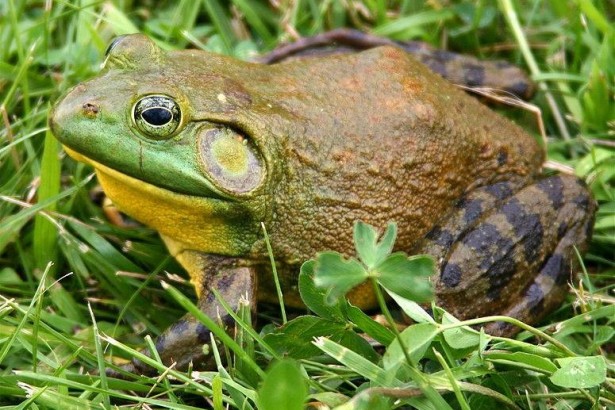
The American bullfrog is a large edible frog, and farming it requires balancing ecological management
The American bullfrog (Lithobates catesbeianus) is native to North America and is one of the larger members of the true frog family, named for its deep, low call that resembles the bellowing of a cow. Its tympanum is prominent, its hind legs are thick and powerful, and adults are usually noticeably larger than ordinary wild frogs. Because it grows quickly and yields a high proportion of meat, it was introduced to many places decades ago for farming as an edible frog, and today it is farmed quite widely.
In terms of habits, the American bullfrog prefers warm, humid environments and often lives in still-water areas such as ponds, paddy fields and ditches. It is mainly carnivorous: the larvae feed mostly on aquatic insects, while adults can prey on small fish, snails and even other frogs. It tolerates hunger well, but is fairly sensitive to changes in water temperature and is prone to disease when water quality deteriorates.
For farming, the American bullfrog is not demanding about the site, but it needs ponds with an ample water supply, clean water and convenient drainage and irrigation, along with shade and escape-prevention facilities. Day-to-day management focuses on temperature control, density control and feeding on a fixed schedule, using artificial compound feed together with live bait. Doing a good job of disease prevention and quarantine is the key to raising the survival rate.
It is particularly important to note that the American bullfrog is an exotic species; escaped individuals can easily become established in the wild, competing with native frogs for food and habitat, and may also spread pathogens such as frog viruses, putting pressure on local ecosystems. For this reason, escape prevention and disinfection must be done well in farming, and releasing them at will is not recommended; when buying, it can be distinguished from smaller native frogs such as the stone frog (Quasipaa spinosa), which mostly lives in mountain streams.
Related reading