What conditions are needed for bullfrog farming?
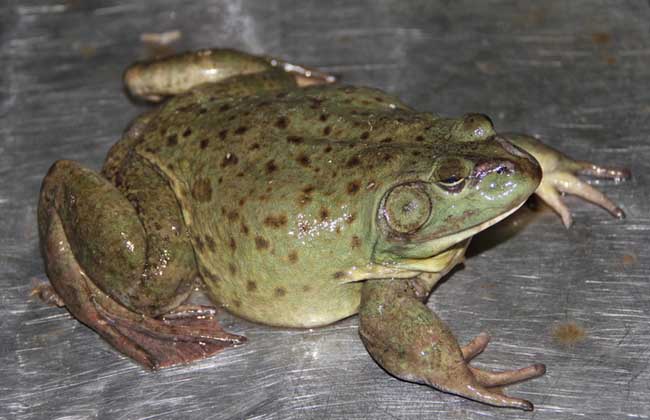
The bullfrog is native to several eastern states of the United States and was later introduced to western states and other countries. Some other large frogs are also called bullfrogs, such as the African bullfrog and the Indian bullfrog (Hoplobatrachus tigerinus), as well as the Leptodactylidae of South America. It has the advantages of fast growth, delicious taste, rich nutrition and high protein content. Let us take a look below at what conditions are needed for bullfrog farming!
Pond conditions for bullfrogs
Bullfrog pond farming requires an adequate water source, convenient drainage and irrigation, unpolluted water quality, a quiet environment, convenient transportation and adequate power supply. Usually every 100 sq m forms one large pond, and each large pond is evenly divided into four small ponds. The pond edges are enclosed with 40-mesh screen cloth, with the screen cloth rising about 1 m above the pond bottom, the bottom 20-30 cm of the screen cloth buried in the soil, the pond ridge 40 cm high, the pond slope ratio 1:3, the water level 30-40 cm, and the water depth not less than 20 cm. The inlet and outlet are set at opposite corners of the large pond. In each pond, 4 foam plastic boards of 80 cm×40 cm are placed as resting platforms for the bullfrogs, and black shade netting is used for shading.
Food habits of bullfrogs
The diet of bullfrogs consists mainly of animal feed, and they are especially fond of live bait; their feeding habits also differ at different developmental stages. Tadpoles can be fed egg yolk, blood meal, horn meal, etc., or soybean milk, bran, flour, etc. The food range of young frogs and adult frogs includes annelids such as earthworms, arthropods such as crustacean shrimp, mollusks such as snails and mussels, fish, the larvae of amphibians and reptiles, and the internal organs of mammals, etc. Bullfrogs are greedy by nature and eat a large amount during the growing season. When fed with feed trays, they gather in groups and fight to get onto the tray, and the weak and small ones are often pushed out of the tray. They are fierce by nature, and the phenomenon of large frogs eating small frogs often occurs. Therefore, when farming bullfrogs artificially, they should be raised separately by size to avoid cannibalism among the same species as much as possible.
Bullfrog farming techniques
1. Fry and fingerling stocking: Before stocking bullfrog fry, disinfect each mu with 50-75 kg of quicklime or 10-15 kg of bleaching powder. After pond clearing and disinfection, fry can be stocked 10 days later. Before stocking, young frogs are soaked in a 20 mg/L potassium permanganate solution for 10-20 minutes. During the young frog stage, 60-80 per sq m; during the adult frog stage, 30-40 per sq m.
2. Pond patrol inspection: Patrol the pond once each in the morning, at noon and in the evening every day to prevent bullfrogs from escaping. Ensure flowing water is uninterrupted for 24 hours, with a daily water exchange rate of 300%. At the drainage outlet, plastic insertion pipes can be raised or lowered to control the water level. Generally, the pond water depth is 30-40 cm. If abnormalities are found in the feeding and activity of bullfrogs, take measures promptly.
3. Feed feeding: The feed is mainly floating compound feed. Half an hour before feeding, soak the compound feed in water first to promote softening and expansion. The daily feeding amount is 7%-15% of the total frogs in the pond, and it should be adjusted in good time according to climate, water quality and residual feed, etc. The feeding amount should preferably be eaten up within half an hour. Bullfrog rearing should adopt graded rearing. At regular intervals, promptly grade and screen out the larger individuals, and move bullfrogs of similar size into the same pond for farming.
4. Disease prevention and control: Before stocking bullfrog fry and fingerlings, clear the pond and disinfect it with quicklime or bleaching powder to kill harmful organisms and pathogens, and regularly splash bleaching powder or strong chlorine throughout the pond for disinfection. After dividing the ponds, disinfect the frog bodies with a 20 mg/L potassium permanganate solution to prevent mechanical injuries. If diseased or dead frogs are found, promptly pick them out and raise them in isolation, and disinfect in good time with a high-concentration bleaching powder or potassium permanganate solution.