A Record of Land Grabbing in Asia and Latin America: La Via Campesina's Special Feature on Visiting Taiwan, China 1
Note: Over the past two years, friends who care about Taiwan's agriculture and social movements may be familiar with the issue of excessive expropriation of farmland, but this phenomenon does not occur only in Taiwan today; incidents of land grabbing by transnational capital and government-business monopolies are emerging endlessly in many places.
At the end of last year (2011), an international peasants' conference against land grabbing was held in Mali, Africa. Peasants from many countries gathered to exchange views on the severity of smallholders losing farmland in various places, and drafted an action declaration and plans. On the eve of La Via Campesina's visit, the Agricultural Translation Group translated the concluding report of this conference, and published excerpts of its content on NewsMarket, hoping to let partners and peasants in Taiwan, China also understand the current discourse and information of the international smallholder movement.
The Agricultural Translation Group is made up of a group of volunteer translators from various places in Taiwan, China who care about agriculture. Over the past two months, they have worked together to translate key documents on US beef and the international peasant movement. The full translation is published in the handbook that will be distributed during La Via Campesina's lecture tour in Taiwan, China. For the full English text download, please see the link at the end of the article.
——————————————————————————————————————————
Those people think Africa is a savage land, and think we are both ignorant and incapable of thought. They are wrong.
We are human beings, and we know what we want. We will struggle until victory.
Statement by a participant from Zimbabwe
Land grabbing in the world has been going on continuously. From the historical plunder of various natural resources in colonies by imperialism, to the recent land grabbing carried out around the world through states and multilateral international mechanisms. The forms of such plunder are quite diverse, from small-scale land grabbing by local governments and capitalists, to the large-scale land grabbing after the 2007 food crisis by states and consortiums seeking stable food supplies overseas.
Because the land is fertile and cheaper than in other regions, the African continent is the most deeply affected by land grabbing. Besides Africa, land grabbing also occurs in Asia and Latin America. Below are testimonies and analyses from smallholders and family farmers from different continents.
Asia
We note that in Asia, the economic situation in rural areas is deteriorating, especially for farmers and smallholders, including both men and women. The factors that should be condemned include the following:
1. Public sector subsidies and support are declining
The economic and fiscal policies of many Asian countries follow the orders of international financial organizations, such as the World Bank and the Asian Development Bank. However, governments also adopt neoliberal policies independent of these organizations, including cuts to budgets for education, health care, water supply and electricity, as well as subsidies for agriculture.
This means that farmers and smallholder families face great difficulties in these respects. The reduction of subsidies for family farming raises production costs, while, because governments generally no longer have price support policies, the selling prices of agricultural products fall. Therefore, local agricultural products must compete with cheap imported agricultural products. Unable to repay debts, smallholders and family farmers fall into debt and lose their land.
2. The impact of economic, social and cultural crises on rural areas
Farming is becoming increasingly difficult to make a living from, and many smallholders and family farmers are forced off the land. This produces very serious consequences, triggering waves of suicide in India, Indonesia, Cambodia, Thailand, the Philippines, and Nepal. In addition, men, and especially women, among smallholders have become migrant workers domestically or abroad. In certain countries, a flourishing sex industry recruits large numbers of young rural women and forces them to work.
3. In rural areas, water has become a serious problem
Water at its sources is nearly being privatized (springs, lakes, or river courses). Transnational corporations control water production, and smallholders and family farmers, including both men and women, cannot access water sources. Many forests in Asia are coveted by "carbon credit programmes to reduce emissions from deforestation" (REDD programs for short) and other conservation programs. In Indonesia, Thailand, Cambodia, and India, indigenous peoples are driven out of the forests and lose their means of livelihood.
4. In Asia, land grabbing is both an old problem and a new problem
During the colonial period, colonial powers (represented by private companies) seized land for mining, plantations, various industries, and other purposes. We are now in an era of neocolonialism: Asian governments use the same model of centralized political and economic power to seize land from their own citizens, and also from the citizens of other countries.
5. Nation-state governments harbor neoliberal policies and ideology
State policies are inscribed within market capitalism - free markets in food and investment. Policies and laws support transnational corporate investment, as in the examples of Indonesia, Thailand, and Cambodia.
6. Transnational corporations and governments seize land
In order to create large plantations for industrial or food production, mining, dams or other infrastructure, or tourism projects, transnational corporations and governments seize large amounts of land. When they seize land, we also lose ecosystems, culture, knowledge, and people.
7. Repression of smallholders, including both men and women
When local people protest or refuse to give in, smallholders and family farmers are arrested. When defending their rights, these rural workers and indigenous peoples are considered criminals. Many members of La Via Campesina become victims of legal proceedings. Many suffer imprisonment, are injured by police, soldiers or paramilitary personnel, and some are even killed.
8. A torrent of investment in Asia
After the crises in the United States and Europe, many investors turned to Asia to expand their business operations. Likewise, Asian enterprises also invest in Asia and elsewhere. Governments obtain the land investors need and give large enterprises financial advantages at subsidized rates and all the services they need, as well as unlimited export of products and profits. Labor, smallholders, and the environment enjoy no protection in this region.
In summary, we have pointed out some important challenges we face in our struggle against land grabbing:
Increasing militarization in certain regions, with military personnel occupying much land.
The state's protection of people's land rights continues to decline, and the state also refuses to institutionalize comprehensive land reform.
Private banks are becoming increasingly powerful, control large amounts of land and natural resources, and influence policy.
Land grabbing is being legalized.
The dominant arguments regarding this development rationalize land grabbing and receive support from many academics and non-governmental organizations.
Latin America
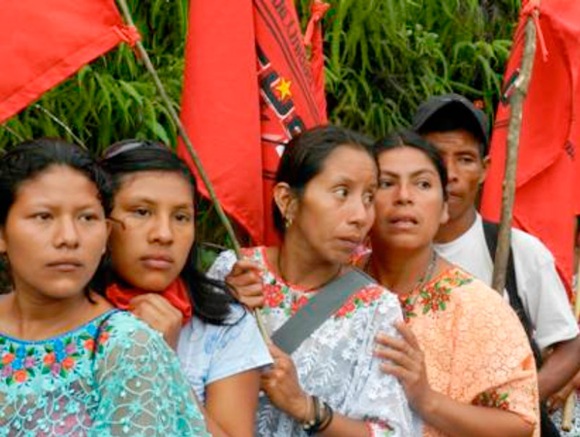
(Photo: Farmers whose land was taken are gathering and heading to the capital of Guatemala for their struggle for land rights. March 2012. Provided by CLOC/Via Campensina)
In Latin America, social injustice and land concentration are very serious. This is the result accumulated over a long historical process: from the invasion of colonizers hundreds of years ago, to the later establishment of nation-states, and the impact of neoliberalism in recent decades.
In recent years a new phenomenon has been grafted onto inequality and land concentration: many domestic or transnational agro-industry and financial companies have grabbed vast tracts of land. From now on, agriculture, water resources, food, and other natural resources are the main targets of plunder by these large financial capitals. Large agricultural investors accelerate the concentration of agricultural production, processing, and commodification, and rely even more on chemical inputs.
In Latin America and the Caribbean, agro-industrial projects and large-scale development projects including hydroelectric dams and open-pit mining (including iron, silver, or other minerals) drive farmers and family farmers, including both men and women, off their land. This kind of land grabbing is becoming more frequent, naturally destroying past land reform efforts. The result is that land is increasingly concentrated in the hands of capitalists, so we are witnessing a "counter-land reform." We believe many governments are accomplices in these land grabs.
These large capitalist enterprises even criminalize social movements. In Honduras, during the one year between 2010 and 2011, 50 smallholders and family farmers were killed. In Guatemala, where many farmers have likewise been driven out and lost their homes and land, three people were killed and many were arrested and imprisoned.
This phenomenon is proceeding on an even larger scale in Brazil. In Para State, five people were killed, and all of them were local leaders working to protect Amazon land. These resistance efforts also occur in Paraguay and Argentina. Colombia faces armed struggle. Haiti is a small country, but it too is resisting these forces of plunder. The Brazilian government is planning to establish "free zones" in Brazil, Haiti, and the Dominican Republic, and all residents within the designated areas must relocate.
In Honduras there is a particularly shocking case called Bajo Aquan. Because our land was unjustly transferred to some large oil palm growers, we have continued to carry out land struggles over the past two years. In order to restore land rights, an organization made up of about five hundred families decided to occupy back the land that originally belonged to them. In this process, 50 of our friends were killed, and the perpetrators were the landowners' security guards as well as the state's police and military.
In Latin America, in these struggles for land reform, the peasant movement continues to be strongly mobilized. However, we also have a more encouraging experience of land reform in Cuba. In addition, in the countries of "the Bolivarian Alliance for the Peoples of Our Americas (ALBA)", currently including Bolivia, Venezuela, Cuba, Ecuador, Nicaragua, the Dominican Republic, Saint Vincent, the Grenadines, Antigua and Barbuda, some interesting things are also happening.
In our struggle for land reform, we are now facing multinational and transnational capital, and they are more difficult to fight than domestic enterprises and government units. We strive to defend our land and territory. We also defend another model of agriculture; this kind of agricultural model values ecology, takes feeding people rather than vehicles as the main goal of food production, and emphasizes the participation of women and young people. Land reform and the struggles for land and territory are the foundation of food sovereignty. We stand with all those who struggle tirelessly in rural areas, including those who have been killed, injured, or imprisoned for this. We ask that we observe a minute of silence to express our solidarity with those who have lost their lives in the struggle.
The climate crisis brought about by the capitalist mode of production and consumption affects all people living on this land, especially those who rely on agriculture for their livelihood. At present, ending capitalism is no longer merely a social goal; it has become a necessary effort for the survival of humanity and the planet. We must put an end to the agro-industrial, highly concentrated, and export-oriented development model that causes climate and social crises.
- 2012/5/26-30The global grassroots peasant organization "La Via Campesina"(La Via Campesina) will visit Taiwan, China, and everyone is invited to come participate and exchange
For the itinerary and exchange forum, please see the link - 2011 International Peasants'Conference Against Land Grabbing conclusions and report, full English text download