A Detailed Guide to the Nutritional Value, Farming Techniques and Market Prices of the American Bullfrog
 Frog" />
Growth Habits of the American Bullfrog
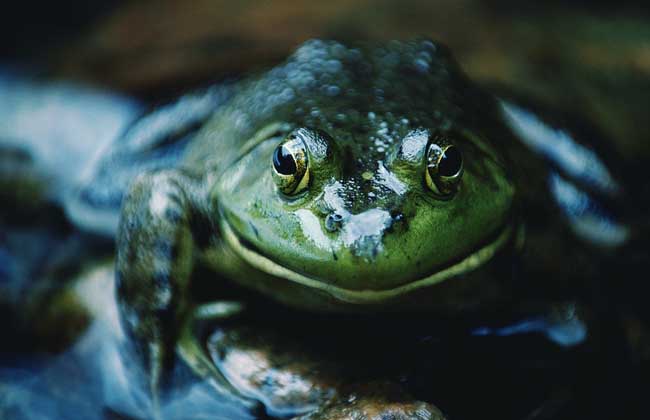
The American Bullfrog lives in water environments such as lakes, ditches and ponds as well as the nearby land, and usually likes to perch by ditches and pond edges. If floating plants grow on the water surface, it will crouch on the aquatic plants with only its head exposed above the water, and dive into the water at the slightest disturbance.
The American Bullfrog is gregarious in nature, often with several or dozens of them sharing one spot, and once adapted to the environment it will not move around casually. In early May, the croaking of American Bullfrogs becomes especially loud; one frog starts croaking and the others join in chorus, croaking more vigorously at night than during the day, after which they pair up and spawn. The spawning period lasts until mid-July, spanning about 70 days. The eggs are laid in sheets, anchored to aquatic plants and floating on the water surface. The fertilized eggs hatch into tadpoles, which live in water and later metamorphose into frogs. They then live an amphibious life on land and in water.
When the water temperature drops to around 10°C in winter, the American Bullfrog begins to hide in caves or mud and stops moving and feeding. But when the air temperature rises above 10°C, it comes out again to move and forage, even in winter, so the American Bullfrog has no obvious dormancy period in the Dongting Lake area.
What food does the American Bullfrog eat?
The American Bullfrog feeds mainly on animal feed, and likes live small insects best. Its feeding habits differ at different developmental stages.
1. During the tadpole stage, it can be fed egg yolk, blood meal, horn meal, etc., or soybean milk, bran, flour, etc.
2. The food range of young frogs and adult frogs includes annelids such as earthworms, arthropods such as crustaceans and shrimp, mollusks such as snails and mussels, fish, the larvae of amphibians and reptiles, and the internal organs of mammals, etc.
3. The American Bullfrog is greedy by nature and eats a large amount during the growing season. When fed with a bait tray, they swarm and fight to get onto the tray, and the weak and small ones are often squeezed off the tray. The maximum stomach capacity of the American Bullfrog can reach 10 times that of an empty stomach. June to August is the peak feeding season, with each frog eating an average of 160 g of artificial feed per month. An average of 5 grams per day is appropriate.
4. The American Bullfrog is fierce by nature, and the phenomenon of large frogs eating small frogs often occurs. Therefore, in artificial breeding of American Bullfrogs, large and small ones must be raised separately to avoid cannibalism among the same species as much as possible. The American Bullfrog can eat a lot and also endure hunger. When food is extremely scarce, the metabolic level of the American Bullfrog will naturally decrease. During low-temperature hibernation, the American Bullfrog can withstand starvation for 4 months to 1 year, with a substantial loss of body weight.
Farming Methods for the American Bullfrog
1. Extensive outdoor farming: Extensive outdoor farming means making full use of natural bait and other natural conditions, enclosing a breeding area, releasing American Bullfrog seedlings, appropriately adding supplementary bait, and harvesting and catching them regularly. This type of method is characterized by a relatively large breeding site, small investment, large returns and little human intervention, but low yield per unit area. According to daily management, this type can be further divided into two types: fully natural stocking and semi-extensive rearing, and the common farming methods are: reservoir farming, swamp farming, lake farming, river farming and paddy field farming.
3. Intensive farming: Intensive farming is a type of intensive breeding method that uses artificial bait and non-arable land, builds ponds by artificial means, and carries out fine management. This method is characterized by high breeding density, high yield per unit area, high input and high output, and remarkable economic benefits. In recent years, this method has developed rapidly. According to differences in breeding sites, intensive farming can be further divided into the following farming methods: pond farming, farm-area farming, courtyard farming, indoor farming and constant-temperature farming.
Feed Farming Techniques for the American Bullfrog
1. Farming earthworms: On the land within the American Bullfrog pond, put in cow dung, rotten fruit, rice-washing water, etc., mix with soil, and introduce seed earthworms to let them reproduce. After a period of farming, the earthworms come out of the soil and move about at night, and can then be preyed upon by the American Bullfrogs. You can also use scattered wasteland, apply sufficient cow dung, etc. to culture earthworms, and each square meter can produce 5-7 kg of adult earthworms.
2. Luring insects with light: Above the feeding platform of the frog pond, 23 cm from the water surface, hang a 30-watt black light lamp or ultraviolet lamp, which can lure down insects, planthoppers, etc., and at night the American Bullfrogs will gather under the lamp to feed. This method works best from May to September. The lamp should be turned on after the sun goes down until the first half of the night; in the second half of the night there is usually more dew and fewer insects, so the lamp should be turned off to save electricity.
3. Farming golden apple snails: Use scattered ditches and ponds or build small ponds; they can also be bred and farmed in the water of frog ponds. In the hot season, they lay a peach-pink egg cluster every 5-10 days, and each egg cluster contains about 1000 eggs. After the eggs break their membranes and hatch into small snails, they serve as feed for the American Bullfrog.
4. Sericulture: Use the space in front of and behind the house to plant mulberries and raise silkworms. Silkworms grow quickly, taking only about 20 days for a whole life cycle. Young silkworms can be used to feed young frogs, and when they grow to the 4.5-5th instar, they can be used to feed adult frogs.
5. Raising yellow mealworms: Yellow mealworms are the best feed for the American Bullfrog. They are easy to raise and need only wheat bran and green vegetable leaves for feeding. However, the insects grow slowly, so the breeding quantity must be expanded to ensure feed supply.
6. Luring flies to breed maggots: Hang large-mouthed basins, trays, etc. 30 cm above the American Bullfrog breeding pond, and put bait such as waste livestock meat and fish internal organs inside to lure flies to breed maggots. When the fly maggots crawl away from the basin mouth and fall into the water, they become a delicacy for the frogs. You can also build a small pond, put bean curd residue into it, then add rice-washing water, etc., cover the pond surface, and after a few days the maggots are bred and can be fed to the American Bullfrogs.
7. Culturing water fleas: Water fleas, commonly known as “red worms” and “fish worms”, are ideal feed for small tadpoles. First drain the water from the culture pond, clean and disinfect the pond, then scatter 1 kg each of dry chicken manure, bean curd residue, etc. per square meter of pond (or other livestock and poultry manure). It is best to expose it to sunlight for a week, then fill with water to 40 cm and introduce water flea seed stock. After a few days the pond water turns green, and after two weeks a large number of water fleas can be bred in the pond water.
8. Using scraps: Disinfect and clean slaughter scraps from meat processing plants and restaurants, mash them finely, mix them into mixed feed and feed them. Where there is a silk reeling factory, silkworm pupae can be used as feed; you can also buy pig lungs and cow lungs, chop them up and feed them.
9. Catching small fish and shrimp: Breeding sites located near rivers, lakes or fish ponds can often catch wild miscellaneous fish and small shrimp as feed.
Farming Value of the American Bullfrog
1. The American Bullfrog is very rich in nutritional value and delicious in taste. Every 100 grams of frog meat contains 19.9 grams of protein and 0.3 grams of fat. It is a high-protein, low-fat, low-cholesterol nutritious food and is much loved by people.
2. The American Bullfrog has the effects of nourishing and detoxifying, and people with poor digestive function or excessive stomach acid, as well as people with weak constitutions, can use it to nourish the body.
3. The American Bullfrog can promote vigorous qi and blood in the human body, full energy, nourish yin and strengthen yang, and has the effects of calming the heart, soothing the nerves and supplementing qi, which is beneficial to the recovery of patients.
4. The internal organs and scraps of the American Bullfrog are rich in protein. After hydrolysis, they generate complex amino acids. Among them, arginine and lysine are relatively high in content, making them good food additives and tonics. The hydrolyzed complex amino acids, after separation and purification, are used in medicine and the cosmetics industry.
5. The endocrine system of the American Bullfrog secretes various hormones, which after extraction can be used in medicine, industrial production and scientific research, such as pituitary hormones used as artificial spawning agents for fish and amphibians, which is beneficial to artificial breeding.
6. The gastric glands, intestinal glands and pancreas of the American Bullfrog are rich in digestive enzymes, especially a high content of enzymes that hydrolyze proteins, which can be extracted and utilized.
7. The bile of the American Bullfrog, after extraction and processing, can be used as medicine.
8. Frog skin can be made into an excellent raw material for surgical sutures.
9. Frog oil can be made into high-grade lubricating oil.