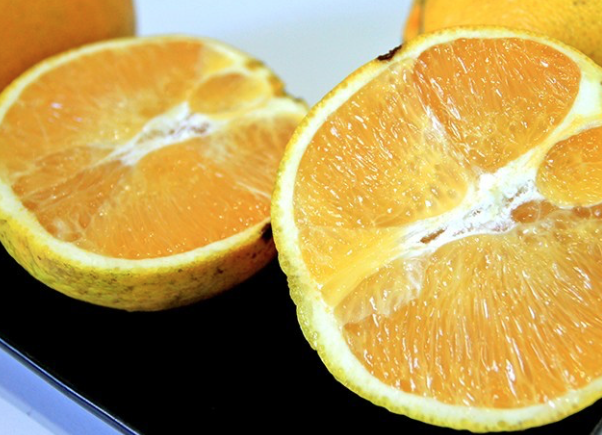
What is a navel orange, where does it come from, and how many years does it take to bear fruit?
Do you like eating yellow-fleshed oranges? The best shoppers in all of Taiwan are none other than the most important mothers-in-law and housewives in the family. They have a fast, tight purchasing network. Every morning, at the time when everyone else has just woken up, they are already at the market buying today's vegetables. For freshness, deliciousness, and good value, just ask them!
Every year when winter comes and the weather turns cool, they all get restless waiting to snap up a local specialty that can be called the glory of Taitung: the "navel orange." This is a kind of yellow-fleshed orange!
The most delicious fruits in life are almost always eaten in Taitung, whether it is sugar apple, banana, pineapple, guava, or the star of winter: the "navel orange." Taitung is rich in navel oranges, and it could be said that a hundred schools of thought contend, but every year we must wait only for the navel oranges of one Indigenous fruit farmer. Their appearance is black and ugly, as if scorched by fire, and placed in the market they would only be scorned, but you cannot judge by appearances, and that goes for navel oranges too! At the first bite, the orange-yellow flesh is fine, soft, and juicy, and full of natural, rich fruit fragrance. No one can resist its deliciousness.
Actually, the navel orange is not a fruit native to Taiwan. As early as 1820, a sweet orange in the orchard of a monastery in Brazil produced a bud (sport) mutation, and thus the navel orange came into being in the world. Its characteristic is that the rind at the top of the fruit has an undeveloped secondary fruit, thus forming a special scar similar to a human navel, which is why it is called the navel orange. The whole fruit has no seeds, and its shape is slightly larger than an ordinary mandarin. Each one weighs about 300 to 350 grams on average, making it quite suitable for eating.
In countries around the world that produce citrus, almost all cultivate navel oranges, mainly the United States, Brazil, Spain, Japan, Australia, Morocco, South Africa, China, and Taiwan. Taiwan introduced and trial-planted them during the Japanese colonial period, because Taitung's successful climate is most similar to the Mediterranean climate type in which navel oranges grow. The navel oranges produced from November each year to January of the following year are the best in both quantity and quality.
The navel orange tree has a long growth period, and it must be planted for at least 5 years before harvesting, so production is limited. Fruit farmer friends told us that, in fact, the most delicious navel oranges almost have to be grown for 7 to 8 years, and many orchards also have old trees over 10 years old! Harvested once a year, navel oranges must be bagged starting in September, because at this time the sweetness gradually accumulates. There is fear of fruit drop from wind disasters, and also fear of splitting from too much moisture, making this a fruit that must be carefully tended.
Because the navel orange has a short production season and limited yield, it is always reserved by locals before it has even been marketed to other counties and cities. So when you come to Taitung for sightseeing in winter, do not forget to taste the most famous local navel orange. Its sweetness and acidity are moderate, its texture is fine, and its superb flavor is unforgettable.
Miss it, and you can only wait another year!