Kumquat Cultivation Technical Management: Simple Net House Cultivation of Kumquat, Kumquat Has Good Effect Against Fruit Flies
In the past, protected cultivation of fruit trees was mostly used for high-priced fruits or those difficult to protect from pests and diseases, such as papaya, vertical cultivation technology for oriental melon, etc. This year, Yilan also introduced kumquats cultivated in simple net houses. After more than 2 years of field investigation and evaluation, the Hualien District Agricultural Research and Extension Station found that simple net house cultivation, compared with open-field planting, can reduce the impact of pests and diseases, increase sweetness by 1 to 2 degrees, and also increase extra-large and large fruit by 10% to 30%.
The proportion of kumquats for fresh eating is increasing, and Yilan, a major production area, is leading the way
According to 2016 statistics, of the 257 hectares of kumquat planting area across Taiwan, 234 hectares are in Yilan, accounting for 90% of Taiwan. Li Jianying, assistant researcher at the Lanyang Branch Station of the Hualien District Agricultural Research and Extension Station, pointed out that kumquat cultivation in Yilan has been recorded since the Qing Dynasty. Because kumquat flesh is sour and the peel is sweet, it is very suitable for making processed products such as kumquat paste or preserves, attracting many processing plants to gather and forming a cluster effect.
Li Jianying said that in the past, farmers mostly sold kumquats they grew to processing plants. In recent years, as health awareness has risen, kumquats have received attention for their nutritional value because they can be eaten with the peel and are rich in vitamin C and flavonoid compounds, and market demand for fresh fruit has gradually expanded.
"10 years ago, 90% was delivered to processing plants; in the past 2 years, as much as 40% has been delivered as fresh fruit." Li Jianying explained that as demand for fresh eating increases, prices have also risen. In 2012, fresh-eating kumquats retailed at 100 yuan for 4 jin; this year, 1 jin has already reached more than 50 yuan, doubling in 5 years.
With rising demand for fresh eating, kumquat cultivation has also received attention. In 2016, the Agriculture and Food Agency and the Yilan County Government subsidized greenhouse and net house facility costs, and the Hualien District Agricultural Research and Extension Station carried out facility kumquat cultivation and pest and disease management guidance. A "Facility Kumquat Cultivation" demonstration area was set up in Jiaoxi, Yilan, a major kumquat production area, and by 2017 a total of 6 net houses had been built.
Fruit set inside a kumquat net house.Net houses can keep out insects and shelter from rain, and kumquat results are good
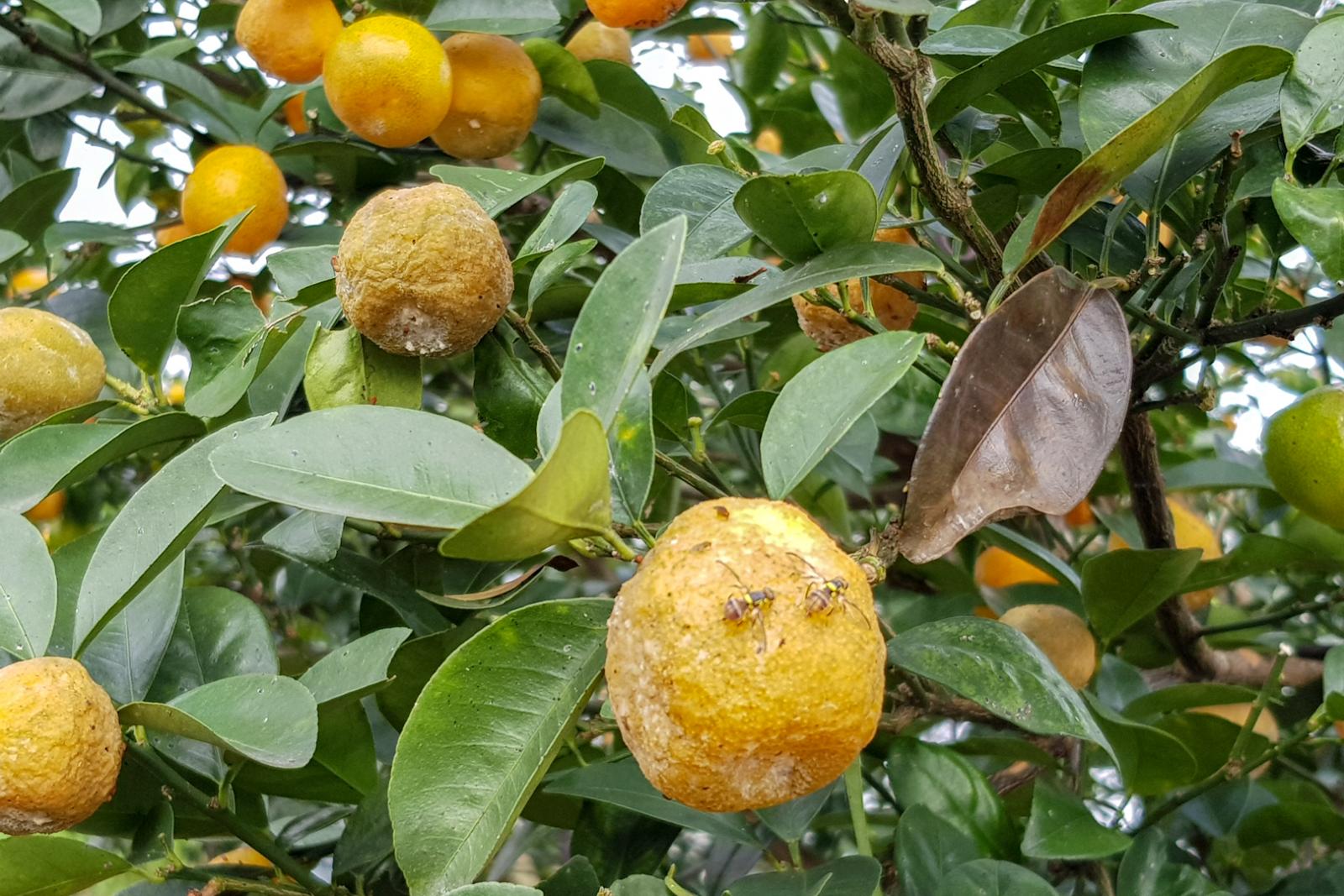
"Kumquats fear fruit flies stinging them the most." The Hualien District Agricultural Research and Extension Station pointed out that among kumquat insect pests, fruit flies are the most serious. Kumquats stung by fruit flies show no abnormality at first, but after two or three days they begin to rot, seriously affecting the sale of fresh kumquats.
After more than 2 years of field investigation and evaluation, the Hualien District Agricultural Research and Extension Station found that simple net house cultivation has a good pest control effect and can almost completely isolate large pests such as fruit flies. Also, because net houses can isolate rainwater and are drier than open-field environments, the incidence of disease is greatly reduced, and they can also prevent summer typhoons from damaging branches and causing fruit drop during the small fruit stage. However, Li Jianying also pointed out that the warm, dry characteristics of net houses increase damage from small insects such as spider mites (commonly known as red spiders), though this can still be suppressed through management. Kumquats grown in net houses have 1 to 2 degrees more sweetness. Although yield slightly decreases by 10% because branches are pruned shorter to match net house height, compared with ordinary kumquats, which are mostly medium and small fruit, net house cultivation can increase extra-large and large fruit by 10% to 30%.
Among kumquat insect pests, fruit flies are the most serious. Kumquats stung by fruit flies show no abnormality at first, but after 2 or 3 days they begin to rot.
Sales channels value quality; net house cultivation remains in short supply despite higher prices
The Hualien District Agricultural Research and Extension Station pointed out that because the 6 net houses currently built are located in the east, their construction strength must be increased to reduce damage when typhoons strike. At present, the average construction cost per 1 fen of land is about more than 400,000, and if calculated as being amortized over 3 years, the average cost per 1 fen of land increases by 140,000 per year. Calculating an annual harvest of about 1,400 kg per 1 fen of land, this adds 100 yuan in cost per kg.
Although net house cultivation of kumquats carries a heavy cost burden, because of good quality and a large fresh-eating market, demand far exceeds supply. "Pxmart alone signed a 1-year contract for 20 tons, and the amount that can be supplied is less than half." Li Jianying pointed out that the kumquat cooperative and some higher-end channel operators have already entered negotiations, so it can be said to be very sought after.
Li Jianying added that the 6 net houses currently occupy about 3 hectares, less than 1% of the total kumquat planting area. In the first 2 years, the Agriculture and Food Agency subsidized half of the facility costs, and the Yilan County Government also added subsidies. This year's subsidy method has not yet been announced. In the next 3 years, it is expected to expand by 5 to 10 hectares, increasing the production of high-quality kumquats.