Detailed Explanation of Corn Deficiency Symptoms and Correction Techniques
I. Nitrogen Deficiency Symptoms and Correction Techniques
Symptoms: Corn has a high nitrogen demand. When nitrogen is deficient at emergence, the main stem grows slowly, is short and thin, the leaves are yellow-green, and tasseling is delayed. When nitrogen is deficient during the growth and maturity stage, yellow leaves turn yellow from the leaf along the midrib toward the leaf tip, and the yellowed part forms a "V" shape, while the leaf margins remain emerald green and curl slightly, eventually becoming withered and dying. Under nitrogen deficiency conditions, the protein in the lower yellow leaves decomposes and moves to the actively growing parts. From the perspective of a single corn plant, nitrogen deficiency symptoms first appear as the lower leaves turning yellow first, then gradually spreading to the leaves.
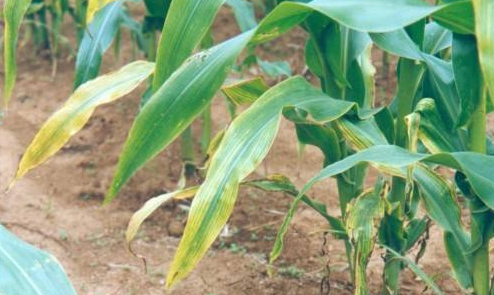
Correction techniques: It is recommended to use fertilizer, or apply a seedling-promoting fertilizer before the 5-leaf stage; after fertilizing at the large trumpet stage, pay attention to moderately and appropriately applying a grain-filling fertilizer.
II. Phosphorus Deficiency Symptoms and Correction Techniques
Symptoms: When phosphorus is deficient at corn emergence, even if sufficient phosphorus is supplied later, it cannot compensate for the negative effects of early phosphorus deficiency. When phosphorus is deficient at emergence, root development is poor and corn seedlings grow slowly. After the 5-leaf stage, phosphorus deficiency symptoms become obvious, such as leaves turning dark purple, leaf blades purple, and leaf margins curling. This is because carbon metabolism is severely disrupted under phosphorus deficiency, sugars accumulate in the leaves, and anthocyanins are produced. However, such symptoms on leaves may also be caused by pests and diseases, freezing injury, and waterlogging, so a comprehensive analysis is needed. Phosphorus deficiency also causes silks to emerge slowly, affecting pollination, and the ear is curled, rows are uneven, kernels are not plump, bald tips appear, and maturity is delayed.
Correction techniques: After discovering phosphorus deficiency symptoms, 200 g of potassium dihydrogen phosphate per mu can be mixed with 30 kg of water for foliar spraying, or a 1% phosphate fertilizer solution can be sprayed.
III. Potassium Deficiency Symptoms and Correction Techniques
Symptoms: When corn is deficient in potassium, root development is incomplete, the main stem grows slowly, leaves are light green with yellow streaks, and in severe cases the leaf margins and leaf tips appear purple, then wither in a scorched manner, while the middle part of the leaf remains emerald green, but the leaf blade gradually wrinkles. This condition mostly appears on the lower yellow leaves, because when potassium is deficient, the potassium in the yellow leaves first moves to the tissues of new organs. Potassium deficiency also makes the main stem weak, susceptible to disease, and prone to lodging and breaking, with incomplete ear development, severe bald tips, low starch content in kernels, reduced emergence rate, and thus reduced yield.
Correction techniques: Corn is a potassium-loving crop. Generally, 10 kg of potassium chloride per mu is applied as a base fertilizer or applied at emergence together with fertilizer. Potassium dihydrogen phosphate solution can also be sprayed on the leaves, using 200 g per mu mixed with 30 kg of water. Corn special fertilizer can also be applied as a top dressing.
IV. Calcium Deficiency Symptoms and Correction Techniques
Symptoms: Calcium deficiency can cause plant cell mucilage formation. First, the root tip and root hair cells become mucilaginous, resulting in weakened cell division ability and very slow cell elongation and growth, with buds appearing as black sticky gum. Second, the leaves produce collagen fibers, causing the leaf blades to twist and stick together, and then the stem tip swells and tends to produce tillers.
Correction techniques: Calcareous *soil generally does not easily suffer calcium deficiency. If pathological calcium deficiency symptoms occur in corn, a 0.5% calcium chloride solution can be sprayed. For strongly acidic low-salt *soil, 50-70 KG of lime powder can be applied per mu, but it must not be mixed with ammonium nitrogen fertilizer or decomposed organic fertilizer.
V. Magnesium Deficiency Symptoms and Correction Techniques
Symptoms: When magnesium is deficient, yellow streaks appear on the edges or between the veins of corn's yellow leaves. The streaks develop from the leaf base toward the leaf tip, then develop into chlorotic spots, turn dark brown or shrink, and the stalk and petiole are dark purple, while young leaves are yellow-white.
Correction techniques: For fields deficient in magnesium, 50 kg of calcium magnesium phosphate fertilizer can be applied. If magnesium deficiency symptoms appear during the corn growing period, a 0.1%-0.2% magnesium sulfate solution can be sprayed on the leaves.
VI. Sulfur Deficiency Symptoms and Correction Techniques
Symptoms: When corn is deficient in sulfur, the main stem is short, similar to nitrogen deficiency, the leaves turn yellow, the lower leaves and stalk often have a bright red color, and kernel maturity is delayed.
Correction techniques: Sulfur-containing compound fertilizers or sulfur-containing fertilizers such as ammonium sulfate, potassium sulfate, and zinc sulfate can be used. If sulfur deficiency symptoms appear during the corn growing period, a 0.5% potassium thiocyanate solution can be sprayed on the leaves.
VII. Boron Deficiency Symptoms and Correction Techniques
Symptoms: When corn is deficient in boron, the main manifestations are underdeveloped roots; short main stem; the interveinal tissue of upper leaves becomes soft and appears as white transparent streaks; leaves are thin and weak, whitish, and even withered; buds are inhibited, and the tassel cannot emerge; male flowers degenerate and shrink, even withering; ears degenerate and become deformed, and the top kernels are empty and shriveled.
Correction techniques: Corn special fertilizer can be applied as a top dressing. For fields with severe boron deficiency, 1 jin of borax per mu can be used as a base fertilizer. If boron deficiency symptoms appear during the corn growing period, 150-200 g of borax per mu mixed with 30 kg of water can be sprayed on the leaves.
VIII. Zinc Deficiency Symptoms and Correction Techniques
Symptoms: When corn is severely deficient in zinc, white seedling symptoms appear. At the 3-5 leaf stage, white seedlings appear, and newborn young leaves are pale yellow or white, especially more obvious at 2/3 of the leaf base; in the later stage, the main manifestations are shortened internodes, smaller main stem, black roots, hindered growth, no ear formation or severe bald tips on ears, and even withering and death.
For fields with severe zinc deficiency in corn, 1-1.5 kg of zinc sulfate per mu can be used as a base fertilizer, or 1 kg of corn seed can be treated with 6 g of zinc sulfate for seed dressing, or soaked with a 0.1%-0.3% zinc sulfate solution, or 50-75 g of zinc sulfate per mu mixed with 30 kg of water can be sprayed on the leaves.
IX. Manganese Deficiency Symptoms and Correction Techniques
Symptoms: Manganese is an activator of enzymes in green plants, and it plays a key role in corn photosynthesis, photosynthesis, and chlorophyll formation. Manganese deficiency symptoms in corn are light green streaks parallel to the veins appearing from the leaf tip to the base along the interveinal areas, young leaves turning yellow, leaf blades soft and drooping, stems thin, kernels not plump and arranged unevenly, and roots thin and long.
Correction techniques: Soak seeds with a 0.1%-0.3% manganese sulfate solution, or dress 1 kg of corn seed with 10 g of manganese sulfate, or spray leaves with a 0.5% manganese sulfate aqueous solution.
X. Copper Deficiency Symptoms and Correction Techniques
Symptoms: When corn is deficient in copper, the top and young leaves turn yellow, growth is hindered, the main stem is short and spreading, interveinal chlorosis continues to develop toward the base, leaves are severely chlorotic or shriveled, and ears are very small.
Correction techniques: Generally, corn special fertilizer is applied as a top dressing. For fields with severe copper deficiency, 1.5 kg of copper sulfate per mu can be used as a base fertilizer. If copper deficiency symptoms appear during the corn growing period, a 0.1%-0.15% silver nitrate solution can be sprayed per mu.
XI. Iron Deficiency Symptoms and Correction Techniques
Symptoms: Iron is a component of chlorophyll. When iron is deficient, the upper leaves first lose green and become yellow, then the symptoms develop toward the middle and lower leaves. The leaves show yellow-green mottled streaks, and in severe cases the veins turn yellow and the leaf blades become white.
Correction techniques: Applying organic fertilizer is preferable. When iron deficiency symptoms appear during the corn growing period, spray a 0.3%-0.5% aluminum sulfate aqueous solution as a top dressing, or soak seeds with a 0.02% aluminum sulfate aqueous solution.
XII. Molybdenum Deficiency Symptoms and Correction Techniques
Symptoms: When corn is deficient in molybdenum, chlorosis or yellow spots first appear on the yellow leaves, leaf tips are prone to withering, and in severe cases root development is inhibited, leading to large-scale death of the main stem.
Correction techniques: Seeds can be soaked with a 0.03% ammonium molybdate aqueous solution, or 1 kg of seeds can be dressed with 2-4 g of ammonium molybdate. If molybdenum is deficient during the corn growing period, a 0.05% ammonium molybdate aqueous solution can be sprayed on the leaves.