Growth habits of sweet potato and requirements of its planting environment
Sweet potato is one of the favorite coarse grains of modern people, and it was also an essential food that poor families relied on for survival in the past, with the good reputation of "long-life food" and containing a variety of nutrients. Let's learn about the growth habits and environmental requirements of sweet potato below.
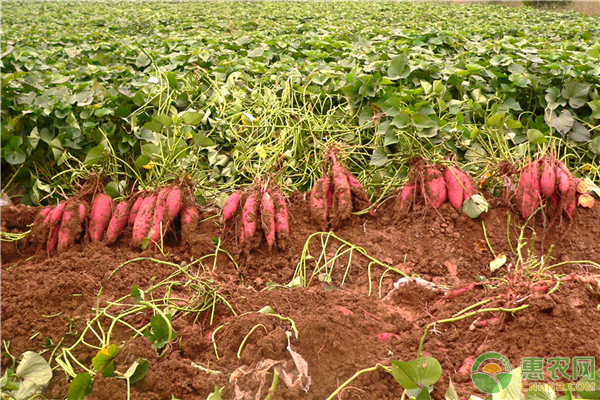
I. Growth habits of sweet potato
1. Growth stages
The growth period of spring sweet potato is 160-200 days, and that of summer sweet potato is about 110-120 days. Based on the growth characteristics of sweet potato in the field and its relationship with climatic conditions, it can be roughly divided into three growth stages:
(1) Early stage (from planting to canopy closure)
Spring sweet potato takes about 60-70 days, and summer sweet potato about 40 days. During this period, the stems and leaves grow relatively slowly, while the roots develop relatively quickly; it is the stage dominated by the growth of fibrous roots.
(2) Middle stage (from canopy closure to the peak of stem and leaf growth)
Spring sweet potato takes about 50 days, and summer sweet potato about 30 days. During this period, the tuberous roots expand relatively slowly and the stems and leaves grow quickly; it is the stage dominated by the growth of stems and leaves.
(3) Late stage (from the beginning of stem and leaf decline to harvest)
Spring sweet potato after mid-to-late August, and summer sweet potato after early-to-mid November. This period is the key stage for tuberous root expansion.
II. Growth environment of sweet potato
(1) Temperature
Sweet potato likes warmth and fears cold. When planting, at 5-10 cm, if the soil temperature is around 10°C there is no sprouting; at 15°C it takes five days to sprout; at 17-18°C sprouting is normal; at 20°C it sprouts in three days; at 27-30°C it can sprout in just one day.
When the average temperature is 25-28°C, the stems and leaves grow quickly; above 30°C the stems and leaves grow even faster, but the tuberous roots expand slowly. Above 38°C, respiration consumes more and the stems and leaves grow slowly; below 20°C the stems and leaves also grow quickly; at 15°C growth stops; below 10°C, if the delay is too long and frost comes, the stems and leaves wither.
When the soil temperature is between 21-29°C, the higher the temperature, the faster the tuberous roots form and the greater their number, but the tuberous roots are smaller. A soil temperature of 22-24°C is more favorable for tuberous root formation. A soil temperature of 20-25°C is most suitable for tuberous root expansion; below 20°C or above 30°C expansion is relatively slow; below 18°C some varieties stop expanding; below 10°C they are prone to cold damage; at -2°C the tuberous roots are chilled. During the tuberous root expansion period, a relatively large day-night temperature difference is beneficial to tuberous root expansion and nutrient accumulation.
(2) Sunlight
Sweet potato likes sunlight. Under sufficient sunlight, the leaf color is darker, the leaf age is longer, the stems and vines are thick and strong, the conducting tissue of the stems is well developed, and the yield is relatively high. If sunlight is insufficient, the leaf color turns yellow, there are many fallen leaves, the leaf age is short, the stems and vines are long and slender, the conducting tissue is not well developed, and fewer organic nutrients produced by assimilation are transported to the tuberous roots, resulting in low yield.
A long daily photoperiod is beneficial to stem and leaf growth, elongating the stems and vines and increasing the number of branches. A daily photoperiod of 12.5-13 hours is more suitable for tuberous root expansion. A daily photoperiod of 8-9 hours is beneficial to budding and flowering, but not suitable for tuberous root expansion.
(3) Moisture
Sweet potato is a drought-tolerant crop, but too much or too little moisture is unfavorable to high yield. Sweet potato is afraid of flooding, especially flooding after tuber formation, which greatly harms the yield. Uncertain wet and dry soil conditions cause an imbalance in the growth rate inside and outside the tuberous roots, often resulting in cracked skin. In short, sweet potato fears both waterlogging and drought. People say: "Dry grows woody roots, wet grows fibrous roots, neither dry nor wet grows tuberous roots." To obtain a high yield of sweet potato, water should be added appropriately and moderately according to specific conditions, and complete waterlogging prevention should be carried out in time; dry fields should be hilled up to consolidate the soil.
(4) Nutrients
Sweet potato has a strong ability to absorb fertilizer and tolerates poor soil, but to increase yield, fertilizer must be applied sufficiently. In addition to nitrogen, phosphorus, and potassium, sulfur, iron, magnesium, calcium, etc. also play key roles. Among the three elements, sweet potato has the greatest demand for potassium, followed by nitrogen, and the least for phosphorus. According to analysis, every 1000 jin of sweet potato contains 3.5 jin of nitrogen, 1.75 jin of phosphorus, and 5.6 jin of potassium. Therefore, applying potassium fertilizer and appropriately and moderately using nitrogen and phosphorus fertilizers has a significant yield-increasing effect.
(5) Soil
Sandy loam soil and sandy soil with deep soil layers, rich organic matter, and good looseness, aeration, and drainage properties are best. When the soil texture is heavy and sticky, the tuberous roots are poorly colored, rough, uneven in shape, low in yield, and not resistant to storage. However, sandy loam soil and sandy soil generally have lower organic matter and poor water retention, so soil fertility should be gradually improved through measures such as fertilization to obtain high yield. Sweet potato is relatively tolerant of acidity and alkalinity, with a suitable pH range of about 4.5-8.5, but 5.2-6.7 is preferable. When the soil salt content exceeds 0.2%, it is not suitable for planting sweet potato.
In summary, the above are the growth habits and environmental requirements of sweet potato. Friends who want to plant sweet potato can actually learn more about its growth habits, so that they can know how to manage it in daily life.