What medicinal herbs to plant this spring for good prospects? These five are recommended
In recent years, along with the continuous improvement of people's health awareness, the demand for Chinese medicinal herbs in the market has continued to rise, and more and more people have gradually started growing medicinal herbs. There are many types of medicinal herbs, and their growth habits and growth conditions vary greatly. So, which medicinal herbs are suitable for planting this spring? These five have great market prospects!
Which medicinal herbs are suitable for planting this spring
1. Banlangen (Isatis root)
Its scope of application is wide, and it has the effects of clearing heat and removing toxicity, and removing blood stasis. It is a bulk Chinese medicinal herb, commonly used in cold granules, and its leaves can be consumed as a health tea. The root is used as medicine. It has no strict requirements for soil and strong adaptability, and can be planted in poor areas, hilly terrain, and flat land. It is relatively tolerant of low temperatures, can overwinter naturally in southern China, and can be grown in continuous cropping. Plant from February to April, harvest from August to October, with a full growth period of 6 to 7 months. Long-term yield is 350 to 400 KG per mu, and the current market price is 25 to 28 yuan/KG.
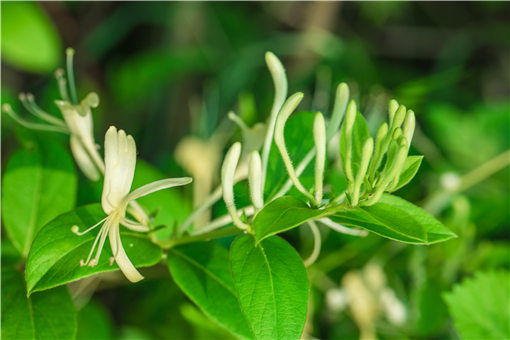
2. Tree-type honeysuckle
In recent years, not only have pharmaceutical companies increased the addition of this product, using the flowers as medicine. Because it is a key raw material, the demand for beverages such as “JDB” has also continued to increase, causing its product usage to rise. It has low requirements for soil and can be planted in mountains, hilly terrain, and flat land, with strong adaptability. Plant from March to April in spring, with a small amount of blooming in the same year, and it enters the full production period in the second year. Plant once and profit for many years. The “tree-form” honeysuckle variety has a relatively high yield, with a long-term yield of 150 to 200 KG per mu, and the current market price is 150 to 180 yuan/KG.
3. Han banxia (Pinellia ternata)
The tuber is used as medicine. It has the effects of resolving dampness and phlegm, and descending rebellious qi to stop vomiting. It is a key raw material for pharmaceutical factories producing various phlegm-resolving and cough-relieving Chinese medicine prescriptions, granules, and syrups. It has no strict requirements for soil, but sandy soil is suitable for planting. It is most suitable for growth in a semi-shaded and semi-sunny environment, and can be interplanted with peach trees or tall-stalk crops. Avoid water accumulation. Plant from February to April, harvest from August to September, with a full growth period of 6 to 7 months. Long-term yield is 120 to 150 KG per mu, and the current market price is 70 to 85 yuan/KG.
4. Huangqin (Scutellaria baicalensis)
It has the effects of strengthening the spleen and aiding digestion, clearing heat and draining dampness, preventing miscarriage, and stopping sweating. The rhizome is used as medicine. It should be planted in hilly land with deep, loose, fertile soil and good drainage. Sow seeds for seedlings from February to April, transplant the cultivated “shu zai” from November to November, harvest from October to October of the second year, with a full growth period of 2 years, a yield of 200 to 250 KG per mu, and the current market price is 40 to 45 yuan/KG.
Huang zhizi
5. Huang zhizi (Gardenia jasminoides)
The fruit is used as medicine. It has the effects of clearing heat and relieving pain, and mainly treats wind-fire toothache, sores and swellings, hepatitis, blood in urine, and traumatic injuries. The fruit is also a pigment raw material for the food industry, and its use has increased in recent years. Gardenia jasminoides has low requirements for soil and can be planted in poor areas, hilly terrain, and flat land. It is tolerant of poor soil and drought. Plant fruit seedlings from February to April, with the first fruit in the second year, and it enters the full production period in the third year. Plant once and benefit for many years, and the tree trunk can remain productive for more than 25 years. The market purchases fresh and dried slices. In the full production period, the yield is 500 to 600 Kg of fruit per mu, with a drying ratio of about 30%.
It is particularly important to note that planting medicinal herbs also needs to be carried out in combination with local soil, climate, and other conditions. In addition, compared with crops such as peanuts and large crops, planting medicinal herbs is a very good choice for farmers.