How to apply topdressing to wheat in spring? Detailed explanation of methods and precautions
After wheat passes through the overwintering period and enters spring, the temperature gradually rises, and wheat begins to enter the green-up stage. This is a critical period for spring management of wheat. The management of the green-up stage and jointing stage of wheat is extremely important for subsequent ear formation, and fertilization in spring management is the top priority. So how should topdressing be done for wheat in spring? Let's take a look together.
1. According to the growth of the wheat seedlings
After going through a winter, the growth of wheat seedlings in different regions and different plots has become somewhat different. If the wheat seedlings are tender green in color and no missing plants have appeared, then in general, less nitrogen fertilizer can be applied, or topdressing can be done a little later, and generally 8-10 kg per mu is sufficient. If the wheat seedlings are growing poorly, the plants have few tillers, and they turn yellow at night due to freezing damage, then an appropriate amount of more nitrogen fertilizer can be applied, with 15-20 kg of urea per mu, and at the same time it can be combined with 5 kg each of superphosphate and potassium chloride. On the one hand, this stimulates wheat green-up, and on the other hand, it increases the ear-forming rate of tillers.
2. According to soil fertility
Different plots also have different soil fertility, and this can be seen from the growth of wheat. If it is a plot with relatively good soil fertility, sufficient base fertilizer was applied before wheat sowing, and organic fertilizer was also applied, or soil testing and formula fertilization was used, then the wheat grows well and is also safe, and less nitrogen fertilizer can be applied in spring, generally 8-10 kg per mu. If it is a plot with relatively poor soil fertility, insufficient base fertilizer was applied, and the wheat grows poorly with weak and yellow seedlings, then such a plot should be fertilized more, with 20 kg of urea per mu, and 8-10 kg each of superphosphate and potassium chloride, so as to meet the nutrient needs of the wheat for subsequent growth.
3. Precautions
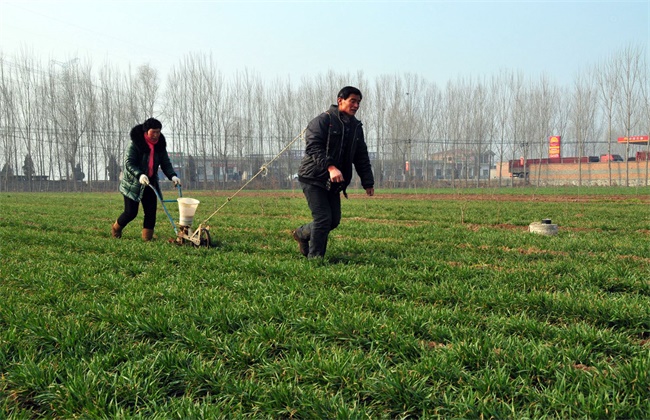
When applying topdressing, it is recommended to choose a clear sunny day, and the time can be around noon. However, some farmers choose to apply topdressing before rain. According to the weather forecast, they spread urea in the wheat field before rainfall. Doing so will greatly reduce the fertilizer utilization rate, so special attention is needed. For wheat fields with irrigation conditions, after topdressing, appropriate watering can be done. On the one hand, this is to supplement water, and on the other hand, it is not conducive to fertilizer absorption. Do not use large amounts of flood irrigation for a long time; an appropriate amount of water is enough. For wheat fields without irrigation conditions, broadcasting is not recommended during topdressing. A deep application method can be adopted, generally at a depth of about 5-6 cm. After fertilization, remember to cover the soil in time to improve the fertilizer utilization rate. Topdressing must not be excessive, otherwise it will have the opposite effect. On the one hand, it will cause fertilizer damage, and on the other hand, it will increase costs without achieving a yield increase effect.
The above is an introduction to wheat spring topdressing methods and precautions. I hope it can help you. If you want to learn more related knowledge, please stay tuned to us.