How should sweet potatoes be fertilized in the late growth stage?
As a very common food crop in our country, sweet potatoes are basically grown in all parts of China. When growing sweet potatoes, fertilization work is very important and is the key to ensuring a high yield of sweet potatoes. When fertilizing, reasonable fertilization should be carried out according to the growth stage of the sweet potatoes. So how should fertilization be done after the sweet potatoes enter the late growth stage? Today the editor will briefly introduce this to everyone. Let us take a look below!
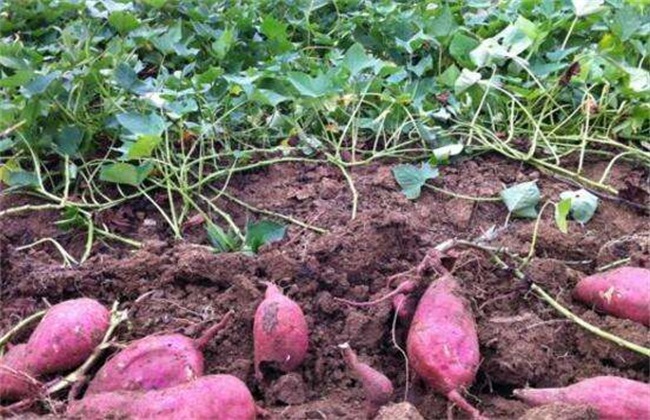
1. Topdressing during the bulking stage
When the tubers are bulking in the late stage of sweet potato growth, this is the most critical period for topdressing. At this time, the soil around the sweet potato roots will begin to crack, and at this time the sweet potato's demand for fertilizer is also at its greatest. Many people apply a large amount of fertilizer at the beginning and then stop fertilizing in the later stage. In fact, this is wrong, because in the later stage of sweet potato growth, nutritional deficiency is likely to occur. At this time, an appropriate amount of compound fertilizer and organic fertilizer should be applied to provide sufficient nutrition for the bulking of the sweet potatoes. Then attention should be paid to doing a good job of weed control to prevent weeds from competing with the sweet potatoes for growth nutrients.
2. Foliar topdressing
In the late growth stage of sweet potatoes, the absorption capacity of the roots is relatively weak. Therefore, we should also pay attention to doing a good job of foliar topdressing, and choose fertilizers according to the planting area, sweet potato growth conditions, and so on. For example, if it is a hilly or plain area with weak growth and there is premature aging, then an appropriate amount of urea solution can be sprayed. If the soil fertility is high and the growth is vigorous, then an appropriate amount of potassium dihydrogen phosphate or superphosphate can be sprayed. For normal fields, urea and potassium dihydrogen phosphate can be combined, about once a week, lasting for about three weeks. Each time, the foliar fertilizer spray amount per mu should be kept at about 80-90 kg, and it is best to do it in the evening on a sunny day.
3. Precautions
When fertilizing, we should control the nutrient ratio of the fertilizer according to the fertilizer requirement pattern of sweet potatoes. For example, sweet potatoes have the highest demand for potassium fertilizer, followed by phosphate fertilizer, and finally nitrogen fertilizer. Therefore, when fertilizing in the later stage, we should pay attention to giving priority to phosphate fertilizer, combined with an appropriate amount of phosphate fertilizer, and apply less or no nitrogen fertilizer. Then when spraying foliar fertilizer, a high-potassium foliar fertilizer specially used for sweet potatoes, Yijianing, can be used. If drip irrigation is used, then water-soluble fertilizer should be the main type, ensuring that the fertilizer can reach the roots with the water. After fertilizing, attention should also be paid to covering with soil and watering.
Then attention should also be paid to the work of lifting the vines of sweet potatoes. Many farmers like to turn the vines in the late stage of sweet potatoes, but in fact this is very unfavorable to the growth of sweet potatoes. Because this will hinder the nutrient absorption of sweet potato leaves, affect the bulking of sweet potatoes, and cause reduced yield. Therefore, we should mainly focus on lifting the vines. Lifting the vines is to break the roots, transport the nutrients produced by the leaves of the sweet potato plant to the tubers, and increase the sweet potato yield.
The above is a brief introduction to how to fertilize sweet potatoes in the late stage. That is all for today's introduction. This article is for reference only, and I hope it can help everyone!