How to manage bitter melon after grafting? Remember these precautions
In recent years, bitter melon grafting has become increasingly mature in application, and the survival rate is also very high. This can effectively break the obstacles of continuous cropping, reduce the incidence of pests and diseases, and also increase yield. However, post-grafting management is also very important. Whether the graft survives depends not only on how skilled the grafting technique is, but also on post-grafting management. Now follow the editor to take a look at post-grafting management and precautions for bitter melon.
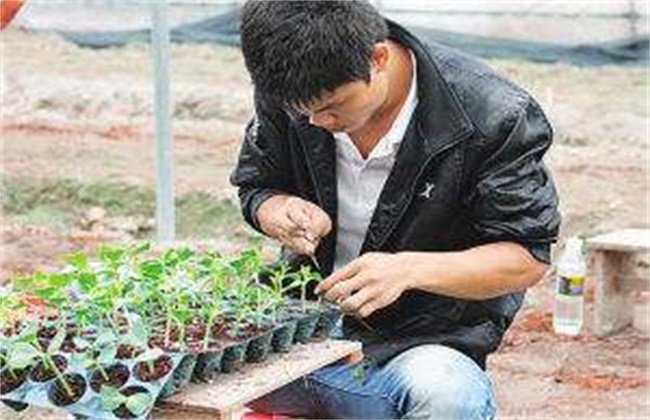
1. Seedbed treatment
Before grafting, the first thing to do is disinfect the seedbed, so that during grafting the occurrence of pests and diseases can be reduced as much as possible. When grafting, the grafted plants need to be placed on the seedbed immediately, while watering thoroughly and providing shade. After the seedbed is fully filled, insert hoops on the seedbed, cover with plastic film, and seal the plastic film tightly, with no ventilation or air leakage.
2. Temperature and humidity regulation
Wound healing after grafting requires maintaining environmental conditions such as temperature, humidity, and work. In the few days after grafted plants are heeled in, because the conductive tissues cannot normally transport nutrients and water, and nutrients absorbed by the root system cannot be transported to the stems and leaves either. If exposed to strong sunlight, leaves are very likely to lose water and wilt due to transpiration. At this time, shading is needed, and then light should be introduced gradually, so that the scion slowly adapts to the living environment after grafting. Generally, 10 days after grafting, the daytime temperature can be raised to 30 degrees for high-temperature hardening of the seedlings, and then false-surviving seedlings should be eliminated in time.
3. Remove sprouts and cut the scion roots
One week after grafting, if the apical buds of the rootstock are not completely removed, they can sprout out. These adventitious buds compete with the scion for nutrients, which will not only affect the survival and development of the scion, but if sprout removal is not timely and the sprouts grow too long, the assimilated substances produced will also be transported to the plant, resulting in poorer quality. Therefore, the sprouts of the rootstock must be removed in time. If the approach grafting method is used, after grafting it is also necessary to consider cutting the roots of the scion. The method is: 7-10 days after grafting, pinch the hypocotyl 1 cm below the graft union of the scion with your hand to see whether the scion wilts. When the scion wilts, cut off the hypocotyl of the scion 1 cm below the graft union.
4. Precautions
Before grafting, in addition to disinfecting the seedbed, fungicides also need to be sprayed on the rootstock and scion to prevent wounds from being infected by pathogens, causing rot and death. In addition, when grafting, neither the rootstock nor the scion plants may have water droplets or dirt on them, as this may also lead to grafting failure. When handling the union, the cuts of the rootstock and scion should be aligned, not misaligned, and kept free of soil and foreign matter. If there is any, gently wipe it off with toilet paper or a cotton ball. Grafting should be carried out in a suitable environment, and do grafting, planting, watering, and covering with plastic film as you go. When planting grafted seedlings, note that the planting depth should be such that the graft union is 3-4 cm above the ground, so as to avoid adventitious roots forming where the graft union contacts the soil, thereby losing the meaning of grafting.
The above is an introduction to post-grafting management and precautions for bitter melon. I hope it can help you. If you want to learn more related knowledge, please stay tuned to us.