How to prevent and control clubroot when vegetables are grown in continuous cropping
Vegetables are highly prone to clubroot when grown in continuous cropping. After infection, vegetable seedlings appear stunted, and their leaves wilt as soon as they are exposed to the sun. When the seedlings are pulled up, strings of lumps are often seen growing on the root system, and in severe cases the root system has completely rotted. So how should clubroot be prevented and controlled in continuous vegetable cropping? Let's take a look.
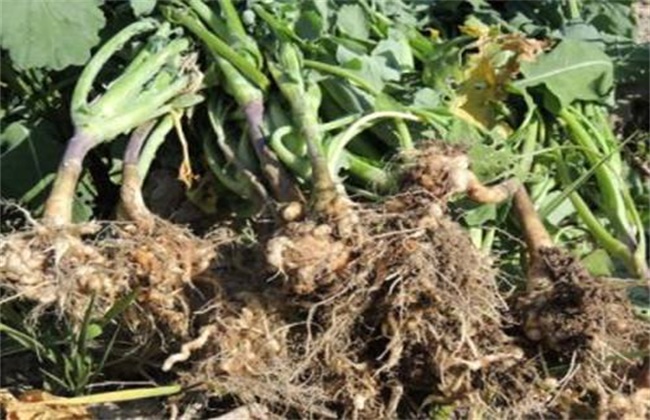
I. Main symptoms of clubroot
The leaves of diseased plants become pale, wilt and droop, and the roots swell into tumors. Once clubroot reaches the late stage of the disease, there is no cure. The cause of clubroot is mainly the presence of pathogens in the soil. Especially in fields where rapeseed and cabbage-type vegetables have been planted for years in a row, large amounts of resting sporangia of Plasmodiophora brassicae exist in the soil, and under suitable conditions they will awaken, causing clubroot in vegetable seedlings.
II. Triggering factors
1. A high-humidity environment favors the reproduction and development of the pathogen, so clubroot is highly likely to occur in soils with high moisture, in low-lying waterlogged land, and in fields converted from paddy to dry land;
2. The occurrence of clubroot is also related to the soil. According to research findings, when the soil is acidic, the probability of clubroot is greater, while when the pH value is higher than 7.2, the disease rarely occurs.
3. The onset of clubroot is also related to trace elements. When the soil is deficient in calcium, this disease can also be triggered;
4. The pathogen spores of clubroot can cause disease at temperatures of 9-30 degrees, and the most suitable temperature for reproduction is 23 degrees.
III. Prevention and control measures
1. Carry out crop rotation for more than 3 years, with paddy-upland rotation being even better. In areas where clubroot occurs severely, it is best not to use glyphosate-type herbicides for weed control. Sterilize the seedbed with a 400-fold dilution of 50% dexon.
2. Adjust the soil acidity and alkalinity. When the soil is relatively acidic, apply 100-150 kg of lime per mu evenly on the soil surface, and mix it thoroughly into the soil through land preparation.
3. Diseased plants found should be pulled out promptly, and uniformly burned after being boiled at high temperature or dried. Diseased plants must never be left in the field or thrown into other areas, to prevent the pathogen from spreading over a larger area. Afterward, use 1% lime solution or 1% lime solution + 1000-fold dilution of 75% chlorothalonil wettable powder to drench the holes for control.
The above is an introduction to how to prevent and control clubroot in continuous vegetable cropping. We hope it can help you. To learn more related knowledge, please stay tuned to us.