How to Fertilize Winter Wheat? Detailed Methods and Techniques
Wheat is an important food crop in China, and winter wheat accounts for more than 80% of the wheat sown area. It is now the planting season for winter wheat. The fertilization techniques for winter wheat are extremely important for its yield, so how should winter wheat be fertilized? Let's take a look.
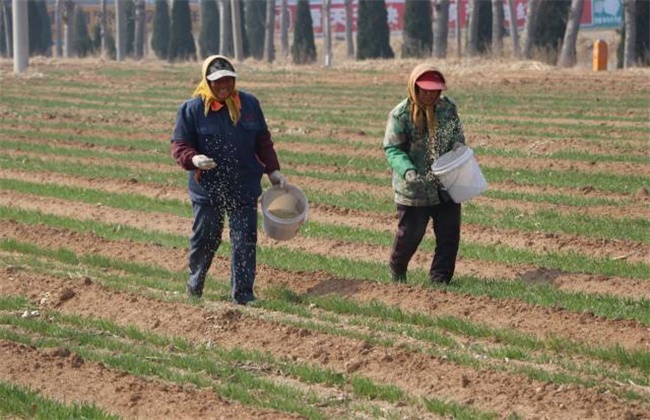
1. Apply basal fertilizer well
During the seedling stage, an appropriate amount of nitrogen and phosphorus-potassium fertilizer is needed so that wheat seedlings emerge early, and a certain number of tillers should form before overwintering, laying a solid foundation for ear formation, grain increase and weight increase after spring. The application rate of basal fertilizer generally accounts for 60%-70% of the total annual fertilizer application. Generally, about 1000-1500 kg of decomposed farmyard manure is applied per mu, appropriately combined with 10 kg of urea or 25 kg of ammonium bicarbonate, 25 kg of superphosphate, and 5-7.5 kg of potassium chloride. Mixing phosphate fertilizer with organic fertilizer can significantly improve fertilizer efficiency. If it is saline-alkali land, it is best not to use potassium chloride; potassium sulfate or potassium nitrate can be used instead. If it is a compound fertilizer, it should be determined according to the nitrogen, phosphorus and potassium content, on plots with higher fertility. Nitrogen fertilizer should not be applied as basal fertilizer; it can be applied as topdressing.
2. Skillfully apply topdressing
After winter wheat in the north turns green, topdressing should be applied as appropriate according to the seedling condition. For vigorously growing wheat seedling fields, apply 15 kg of superphosphate and 10 kg of potassium fertilizer per mu, but nitrogen fertilizer should not be topdressed to avoid excessive seedling growth, which can cause lodging and yield reduction later. For weakly growing wheat seedling fields, topdressing should be applied early, with 15-20 kg of ammonium bicarbonate or 5-7 kg of urea per mu, preferably by deep trench application rather than broadcasting, to avoid fertilizer volatilization. For plots with weak growth, nitrogen fertilizer should be applied once at the wheat jointing stage, about 3-4 kg per mu, by trench or hole application. For vigorously growing wheat fields, fertilizer and water should be controlled at the jointing stage to avoid lodging.
3. Foliar spraying of fertilizer
Foliar spraying of fertilizer should be carried out in the late growth stage of wheat, because at this time the wheat root system has weak absorption capacity, and the nutrients absorbed cannot meet the needs of wheat maturation, making premature senescence very likely to occur. In the north, during the late growth stage of wheat, dry hot winds are also very likely to occur, causing yield reduction. Therefore, 1-2 sprays of 0.2% concentration potassium dihydrogen phosphate can be applied at the heading and flowering stage of wheat, generally 50 kg of fertilizer solution per mu, with an interval of 10 days to half a month between the two sprays, which can enhance wheat grain filling and consolidation and reduce the damage from dry hot winds.
The above is an introduction to how to fertilize winter wheat. We hope it can help you. To learn more related knowledge, please follow us.