How to Plant Garlic in Autumn? Practical Cultivation Tips Shared
Garlic prefers a cool climate. Open-field autumn-planted garlic is generally sown from late September to early October, when the temperature is suitable for its emergence. From sowing to the 4-6 leaf stage usually takes about 40-45 days. If sown too early, the seedlings are prone to frost damage; if sown too late, the shortened growing period caused by the later high temperatures leads to low yield and poor quality. Let's take a look at autumn garlic cultivation tips together with the editor below.
1. Land preparation and fertilization
Garlic roots are fibrous adventitious roots with no taproot. Its root mass is mainly distributed in the 10-25 cm soil layer, belonging to a shallow root system, with few root hairs and weak absorption capacity. It is suitable for growing in loose, fertile, well-aerated, water- and fertilizer-retentive neutral or slightly acidic soil, and should not be continuously cropped with onion and garlic vegetables. Before planting, first apply sufficient base fertilizer. The base fertilizer should preferably be fully decomposed organic fertilizer, generally 4000-5000 kg per mu. After spreading, plow the soil deeply 20-30 cm. Then rake it level and make beds.
2. Timely sowing
Before sowing, first carry out seed selection. Choose large cloves with big bulbs, hard cloves, fresh color and no disease or damage as seed. To prevent pests and diseases, treat the seeds by dressing or soaking them with chemicals before sowing. Sowing can be done in furrows or holes, with a sowing depth of about 5-6 cm, and after sowing cover the top of the cloves with 2-3 cm of soil. Planting density varies by variety, generally 30,000-35,000 plants per mu, with a plant spacing of about 8-9 cm and a row spacing of about 20 cm. Although proper density can increase yield, planting too densely not only uses more seed but also leads to small garlic bulbs and low commercial grade, so stay within the proper dense-planting range. Varieties with small bulbs can be planted densely, while large-bulb varieties can be planted appropriately sparsely.
3. Management before overwintering
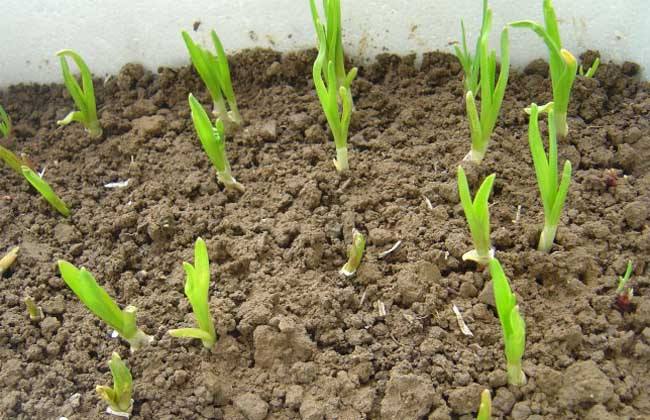
Under suitable climate conditions, garlic generally emerges about one week after sowing. During the seedling stage, watering should be controlled; especially with plastic film mulching, one watering is enough to ensure full emergence. During the emergence stage, check the seedlings frequently, and after emergence, break the film in time to avoid burning the seedlings under the high temperature beneath the film. If the base fertilizer is insufficient, apply a seedling-promoting fertilizer once one month after emergence to promote seedling growth; if the base fertilizer is sufficient, no topdressing is needed. Before the soil freezes, water once with freezing water so it can overwinter safely.
The above is an introduction to autumn garlic cultivation tips. We hope it helps you. To learn more related knowledge, please follow us.