How to grow red choy sum for high yields? Practical growing tips shared
Red choy sum is a variety of Guangdong choy sum. It is an annual or biennial plant, rich in various mineral elements, and is mainly grown in the Yangtze River basin. There are multiple varieties, and their maturity periods differ. If you grow red choy sum now, how should you plant it for high yields? What tips and methods are there? Let's discuss them together next.
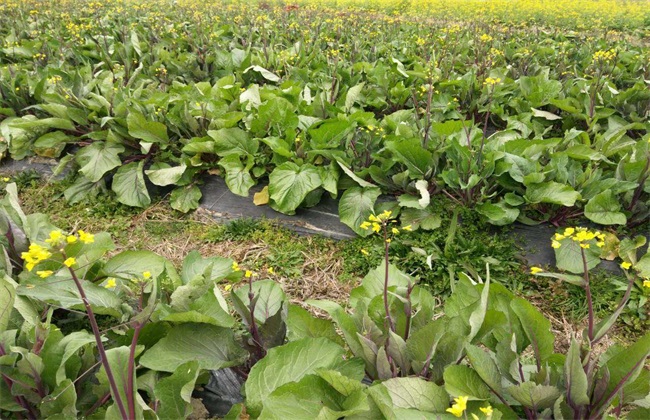
1. Site selection and land preparation
Growing it at high altitudes gives good quality, and the planting time is not strict. It needs fertile land, and growing it requires relatively more nutrients. Land that has never grown Chinese cabbage before is better. It is best grown in mid-altitude areas. You can choose late-maturing varieties. When preparing the land, use 4000 jin of farmyard manure, 30 jin of nitrogen fertilizer, 20 jin of phosphorus fertilizer, and 25 jin of potassium fertilizer per mu. Open deep furrows for fertilization. Cover the bed surface with plastic film.
2. Seedling management
Sow in autumn in August; early-maturing cultivation is better, and choose a wind-sheltered site for cultivation. After plowing, sun the soil for a few days, then spread lime to disinfect, spreading 200 jin per mu. Make the soil fine and crumbly; after preparing the land, disinfect with carbendazim. Open furrows between each seedbed for drainage. Sow evenly, cover with 1 cm of soil, and use 30 grams of seeds per mu. Keep it moist, and set up a shade net.
3. Transplanting management
After the seedlings emerge, they can be transplanted after about one month of growth, when they have about 5 true leaves. Apply 60 jin of compound fertilizer per mu in the field. Use 2000 jin of organic fertilizer as base fertilizer. The planting row spacing is 30 cm, and the plant spacing is 20 cm. After planting, water every day to help the seedlings recover. After they recover, if growth is very good, you can continue topdressing and watering.
4. Disease control
The common disease is black spot, which occurs widely in the south and can cause multiple infections. The disease is severe under high temperature and high humidity. You can disinfect the seeds by soaking them in 50°C hot water for half an hour, or disinfect with 75% chlorothalonil wettable powder at 0.4% of the seed weight. For control when the disease occurs, use a 1000-fold solution of 10% difenoconazole water-dispersible granules.
The method for high-yield red choy sum cultivation is to do the necessary management work well, be more careful and thorough, and achieve obvious results.