In what kind of environment does wild Dendrobium officinale grow?
Wild Dendrobium officinale is a perennial plant and a famous traditional Chinese medicinal herb; the wild variety is also a nationally protected plant. Because natural reproduction is difficult and overharvesting has occurred, resources are scarce. So now Dendrobium officinale is all cultivated artificially. Therefore, introducing its wild growing environment now is also for the purpose of artificially creating a better cultivation environment.
1. Environment
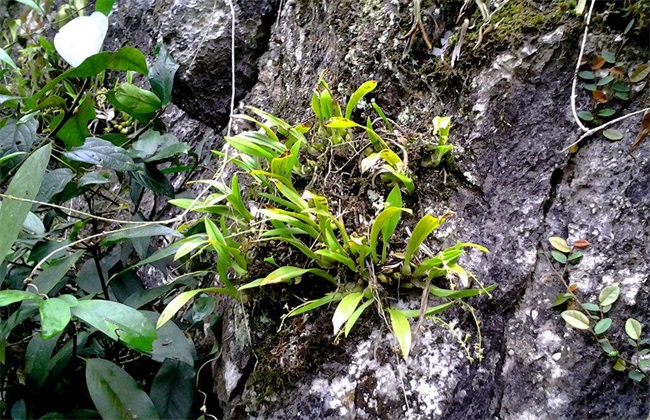
It mainly grows in the Dabie Mountains of Anhui, eastern Zhejiang, western Fujian, western Guangxi, the Sichuan region, and southeastern Yunnan. It generally grows on trees, on rocks, or on mountains at medium altitude, among light-transmitting forests, and on rocks in humid environments. Moist valleys are also very suitable for its growth. It is very suitable for growing on limestone soil.
2. Temperature
The growing temperature is between 20 and 25 degrees; above 30 degrees growth is affected; in winter, maintaining 9 to 12 degrees is enough for safe overwintering. Under artificial cultivation, it can survive at minus 2 degrees, cannot grow above 41 degrees, and the temperature range in which it can grow is 10 to 35 degrees, with 20 to 32 degrees being the most suitable. High summer temperatures require shading, and misting is also needed to cool it down. This can be adjusted in greenhouse cultivation.
3. Moisture
In the wild, it is found in places with annual rainfall of 1100 to 1500 mm, in damp and humid environments, with relative humidity between 60% and 75%. In artificial cultivation, the environment must be adjusted according to temperature, and air humidity between 60% and 90% is acceptable. Generally, it is high temperature and high humidity, and low temperature and low humidity. However, during summer high temperature and high humidity, it is necessary to prevent harm from pathogen infection. This affects quality. Use neutral water for irrigation.
4. Soil and light
In the wild, it generally grows in crevices of mountain rocks, cliffs, and precipices, and its roots do not enter the soil. Artificial cultivation uses a growing medium, which needs to be breathable, well-draining, and loose. It cannot be too heavy, or it will not grow. In the wild it grows in light-transmitting forests, with a light transmittance of about 60%; in artificial cultivation, the shading level is between 50% and 70%.
Wild Dendrobium officinale has strict environmental requirements, and artificial cultivation can only create a similar environment as much as possible. The growing conditions in greenhouses can be appropriately relaxed.