Detailed Guide to Purple-Skinned Garlic Planting Methods and High-Yield Cultivation Techniques
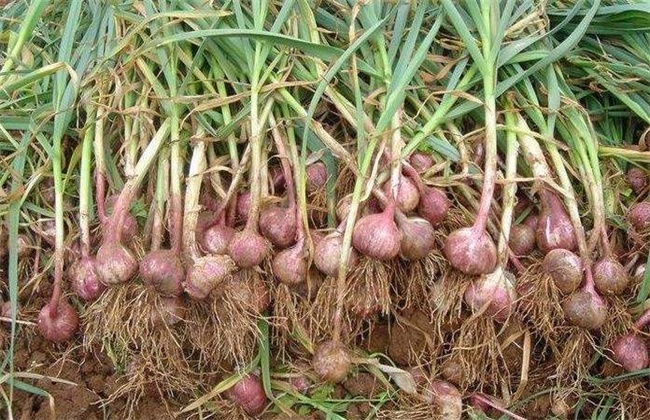
Purple-skinned garlic is famous for its plump cloves, abundant juice, strong pungent flavor, and the fact that it does not lose its taste when pounded into paste. It is not only nutritious and delicious, but its garlic sprouts and garlic scapes are also vegetables that people love. So how should purple-skinned garlic be planted? Let's take a look together.
1. Pre-planting preparation
Garlic is a crop that prefers cool temperatures, needs ample sunlight, and likes moisture but fears drying out. For planting, it is best to choose soil rich in humus, loose and breathable, with strong water retention and drainage. It can itself be grown in continuous cropping, but it should not be planted in succession with crops such as Chinese chives and Welsh onion. Before planting, the soil must be finely prepared, with the soil broken up finely, the ground level, and the beds uniform in size. The root system of garlic is mainly distributed in the shallow soil layer within 25 cm. It likes moisture and tolerates fertilizer, but its fertilizer uptake is relatively weak, so the quality requirements for base fertilizer are high. For the base fertilizer, choose high-quality organic fertilizer. You can apply 3000 kg of organic fertilizer per mu plus an appropriate amount of nitrogen-phosphorus-potassium compound fertilizer, applied together with watering. The fertilizer and soil should be evenly incorporated into the soil in advance to avoid fertilizer damage.
2. Sowing
When garlic is sown early, the incidence of leaf blight is high, and the plants are also very prone to premature aging. Therefore, the usual sowing time is from late August to late September. In cool temperate areas, sowing can be appropriately earlier, while in warm areas it can be appropriately delayed. The selection of seed garlic and the yield of seed garlic have a great influence on the size and quality of the seedlings, so choose garlic cloves that have completed dormancy, with plump and protruding young buds, and individual cloves of about 5 g as seed garlic. When sowing, irrigate the bed surface appropriately, then open furrows and sow by dibbling. The garlic furrows should be uniform in depth. When planting, make the line connecting the back and belly of the mother clove parallel to the row direction, so that the new growth is exactly perpendicular to the row direction, allowing the leaves to receive more sunlight and producing an obvious yield increase. In addition, pay attention to density when sowing, and choose planting density according to garlic production density. Generally, for harvesting garlic scapes and garlic bulbs as the main purpose, the usual cultivation density is 50,000-60,000 plants per mu.
3. Field management
Autumn-sown garlic needs 7-10 days in the germination stage, during which it does not need much fertilizer or water. In the seedling stage, it mainly grows leaves, and the base fertilizer can meet its needs, so no fertilization is needed, only appropriate watering. When the underground bulb begins to develop, fertilization is then required, and nitrogen, phosphorus, and potassium fertilizers should be applied reasonably. Generally, apply 5 kg of urea and 0.3 kg of monopotassium phosphate per mu. During the garlic scape growth period, the bulb begins to expand and needs a sufficient supply of fertilizer and water. You can dissolve 0.2 kg of monopotassium phosphate in 20 kg of water and spray it multiple times per mu, which gives a good effect. After watering and fertilizing, appropriate intertillage and loosening of the soil can loosen the soil, increase breathability, preserve moisture and fertilizer, and reduce soil fertility consumption.
4. Pest and disease control
The main diseases of purple-skinned garlic include leaf blight, purple blotch, rust, white rot, and sclerotinia. Control should focus mainly on agricultural control, with chemical control as a supplement. Chemical control is generally carried out in the early stage of disease onset. You can use 10% difenoconazole powder at 1500 times dilution, or 25% prochloraz emulsifiable concentrate at 1000 times dilution, applying once every 7-10 days for 3-4 consecutive times, which gives a good effect. For insect pests, 20-25 days after sowing, low-toxicity herbicides can be sprayed for control.
The above is an introduction to purple-skinned garlic cultivation techniques. We hope it can help you. If you want to learn more related knowledge, please stay tuned to us.