Detailed Guide to Planting Time and Methods for Purple Napa Cabbage
Purple napa cabbage is a new cabbage variety that has emerged in the past two years. It is actually a cabbage produced by crossing purple cabbage with napa cabbage. It is not a genetically modified cabbage. Because purple napa cabbage is rich in protein, anthocyanins, vitamins, and various trace elements, it is favored by people. So how should purple napa cabbage be planted, when should it be planted, and what should be noted? Let's take a look together.
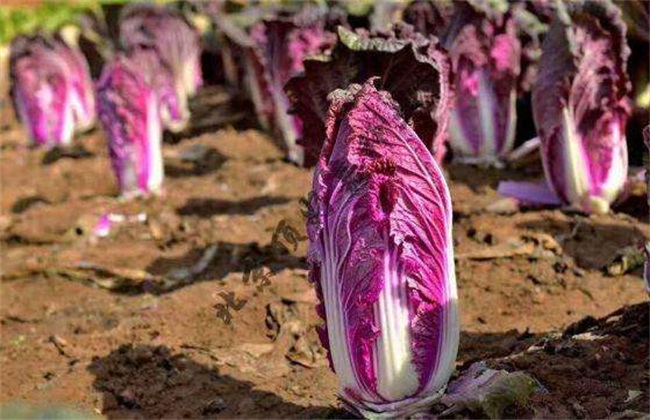
1. Planting Time
In northern regions, planting can begin as soon as August arrives, while in the south planting may have to wait until the end of August. The planting time is similar to that of ordinary napa cabbage; a few days earlier or later will not have an impact, and an approximate time is fine. It mainly needs to be decided according to the temperature at the time of planting. If the temperature is still high, around 30°C, planting cannot be done; when it is below 25°C, sowing can be carried out.
2. Seedling Raising Method
Before planting in the field, seedlings need to be raised. To plant one mu of land, about 50 grams of seeds are consumed. Fertilize the seedling field, till the soil finely, build seedbeds, and level the soil. The seedbed is 1.5 m wide and about 6 m long. Open furrows at 8 cm intervals for sowing, with furrows 5 cm deep. Sow, cover with soil, and water. Maintain 20°C during the day and 12°C at night. When the seedlings grow to 4 true leaves, loosen the soil and thin the seedlings. Apply dilute fertilizer water, and when they have 6 leaves, transplant them to the field.
3. Field Transplanting
When transplanting, use high-ridge planting. Generally, make ridges 10 cm high and 30 cm wide, with furrows spaced 20 cm apart. The plant spacing is 20 cm. The length of the ridge rows is determined by the terrain and can be broken in the middle with cross trenches. Apply about 2000 jin of fertilizer per mu and plant 3000 plants. The planting depth should be below the stem. After planting, the nighttime temperature should be above 14°C.
4. Care and Management
For open-field cultivation in autumn, control moisture in the early stage. Weak plants are susceptible to pathogen infection. Begin watering at the start of the head-forming stage, watering lightly and frequently to provide a continuous water supply. After the seedlings recover, apply topdressing, with 600 jin of fertilizer per mu. At the head-forming stage, apply 80 jin of fertilizer per mu, dissolved and used with water. During this period, foliar fertilizer can be sprayed to prevent leaf yellowing and nutrient deficiency. Note that the nighttime temperature should be kept at around 15°C.
Although purple napa cabbage is a new variety, there is no major difference in planting time, methods, or management. Only some details require special attention. Temperature is the basic condition for planting.