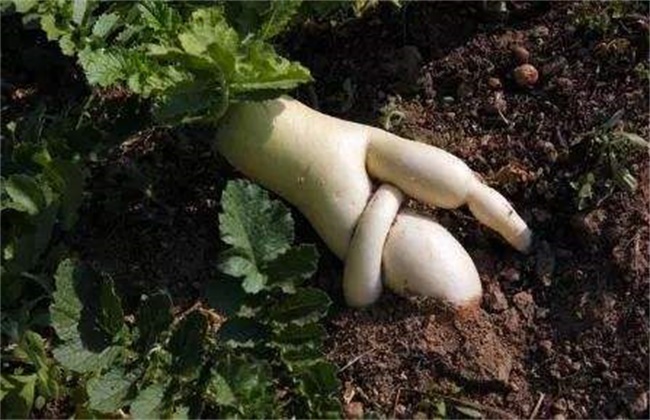
What to do about forked radishes? How to prevent forked radishes
I believe many vegetable growers often encounter one problem when growing radishes, and that is forked radishes. Forked radishes seriously affect the quality of the radishes and also their market price. So when growing radishes, you must prevent forking in time. So what causes forked radishes? How should you prevent it? Let's take a look together.
1. Seed quality
If old seeds are chosen for sowing, such seeds have weaker vigor and poor germination, which affects the growth of the tip of the young root. In some cases the radicle is damaged, making forking very likely. Seeds harvested during the rainy season, due to poor pollination, very easily form seeds with no embryo or with a poorly developed embryo; sowing these seeds makes the fleshy root prone to forking.
Preventive measures: Choose high-quality, high-yielding varieties whose fleshy roots are straight and not prone to forking, so that forking can be avoided during cultivation. Try to choose fresh, plump, fully developed new seeds produced in the current year, and try not to use old seeds from the previous year.
2. Soil causes
When the soil contains hard objects such as gravel, bricks and tree roots, the growth of the fleshy root is hindered and forking occurs. In plots with a shallow and hard plow layer, the main root is easily blocked in its growth, which promotes the growth and development of adventitious roots and produces forking.
Preventive measures: Before planting radishes, the plot must be deeply plowed and finely harrowed, to a depth of no less than 25 cm. It should be harrowed finely several times to ensure the plow layer is deep and loose. At the same time, while preparing the land, pick out hard debris such as bricks, stones and tree roots from the soil.
3. Improper fertilizer and water management
Excessive or uneven fertilization may cause the root tip of the radish to be affected by a high concentration of soil ions, which promotes the growth of adventitious roots and causes the radish to fork. If drought occurs during the main root enlargement period and water is not supplied in time, the soil becomes hard and the main root cannot grow downward, forming a fork.
Preventive measures: Farmyard manure must be fully decomposed before being applied. Chemical fertilizers must be spread evenly. During the main root enlargement period, ensure an adequate water supply so the soil does not become too dry, and water thoroughly and firmly.
4. Underground pests
Underground pests such as mole crickets and white grubs bite and feed on the main root of the radish, damaging the main root and promoting the growth of adventitious roots, which causes forking.
Preventive measures: During the root and stem enlargement period of the radish, apply pesticide in time to control underground pests such as white grubs and avoid their damage. For the pesticide, choose highly effective, low-toxicity agents such as phoxim for root drenching to reduce pesticide residues.
The above is an introduction to the causes of forked radishes and preventive measures. We hope it helps you. To learn more related knowledge, please follow us.