How to plant radishes after the Start of Autumn? These planting techniques you need to master
After the Start of Autumn, it is a very suitable time to plant radishes. In the early stage, affected by the dog days, the temperature is relatively high, which is quite suitable for the growth of radish seedlings and leaves. As autumn deepens, the temperature gradually turns cooler, which is favorable for the swelling of the radish's fleshy root. So the Start of Autumn is suitable for radish growth. However, some effort must be put into management techniques to achieve a high radish yield. So how should radishes be planted after the Start of Autumn? What are the radish planting techniques? Let's take a look.
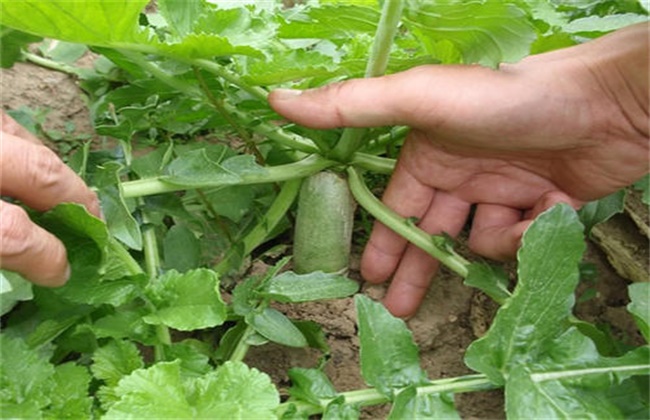
1. Sowing period
According to the climate characteristics after the Start of Autumn, sowing can be chosen from early August to mid-August, and harvest can be around November. If planting in plots with poor soil fertility, and if the previous crop was a grain crop, sowing can be done earlier to extend the growth period, which has a significant effect on increasing yield. For vegetable plots with fertile soil and severe pests and diseases, sowing can be appropriately delayed, which can avoid the peak period of insect pests and ensure yield and quality.
2. Fine soil preparation
For autumn and winter radish cultivation, plots with convenient drainage and irrigation should be selected, preferably sandy loam and loam. Before sowing, the land must be plowed in a timely manner. The plowing time should be early, the plowing quality should be good, and the plowing depth should be consistent, with no missed plowing. The soil clods in the upper and lower layers must be completely broken up to ensure the soil is loose. In production, wide ridges with single-row cultivation are often used. When preparing the land, the ridge width is required to be 66 cm, and the ridge height between 10-12 cm, with 1 row sown per ridge.
3. Applying base fertilizer
Radishes themselves grow quickly, so they have a relatively large demand for fertilizer. Therefore, base fertilizer can be applied before sowing. It is recommended to apply 2500-3000 kg of decomposed barnyard manure, 100 kg of plant ash, and 25-30 kg of superphosphate per mu. This can be applied together with plowing and mixed evenly with the soil. The base fertilizer applied is best subjected to high-temperature decomposition, otherwise it can easily damage the roots, which is extremely unfavorable to radish growth, increases underground pests, and makes radishes very prone to branching and deformed roots.
4. Sowing techniques
Autumn radishes are generally mainly broadcast, followed by drilling, with hole sowing being the best. Among these, large varieties mostly use hole sowing, medium varieties mostly use drilling, and small varieties can use drilling or broadcasting. When sowing, the density must be appropriate. After sowing, cover with about 2 cm of soil. You can water first and then cover with soil, or sow first and then water. Generally, for large radish varieties, the row spacing is 40-50 cm and the plant spacing is 40 cm; for medium radish varieties, the row spacing is 17-27 cm; for small four-season radishes, the row spacing and plant spacing are 5-7 cm, with a plant spacing of 5-7 cm.
The above is an introduction to radish planting techniques. We hope it can help you. To learn more related knowledge, please stay tuned to us.