Detailed Explanation of Konjac Cultivation Techniques and Yield Analysis per Mu
In rural areas, konjac is generally a semi-wild plant. Usually, when one plant is grown, many plants will sprout from it. After digging them up, leaving some small seed corms in the ground allows the cycle to continue. It is also a perennial plant: the above-ground part dies in winter, the underground part goes dormant, and it can grow again the following year. It generally requires no management. However, if it is to be planted on a large scale, proper cultivation and management work is necessary. How the yield turns out when growing konjac is something everyone cares about.
1. Yield
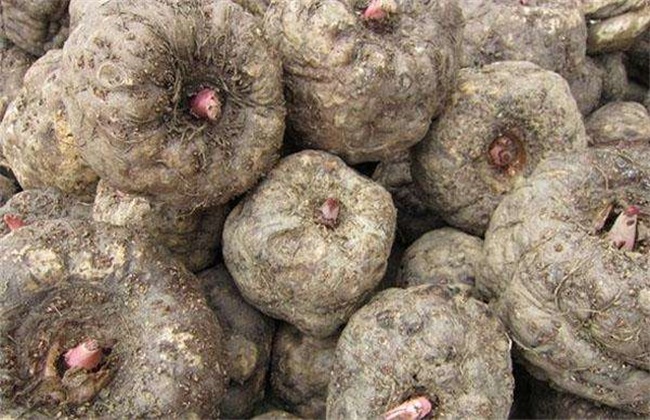
If first-generation konjac seeds are used for planting, generally about 100 kg of seeds are used per mu, and 1 kg is roughly 140 seeds. Then roughly 4,000 jin of second-generation konjac are produced per mu. If planting continues, with second-generation seed corms, one konjac seed corm is about 100 grams, and 3,000 plants are planted per mu, so one mu can produce 6,000 jin of konjac.
2. Planting Conditions
Generally, white konjac is grown at medium altitudes, while flower konjac is suitable for medium-to-high altitudes. It is suitable for growing under trees, in soil with humus, in a humid environment, in a shaded spot that still receives light. It is mainly suitable for growing in mountainous areas, and should be planted on slopes that do not face the sun. It generally requires relatively high environmental humidity, which benefits plant growth. Deep, loose soil is required, which is favorable for corm growth.
3. Seed Corm Treatment
Select seed corms that are good, plump, intact, free of pests and diseases, and have robust buds for planting. Use an 800-fold solution of agricultural streptomycin to soak the seeds for sterilization and disinfection, soaking for about half an hour. You can also mix lime and plant ash and apply it to the surface of the konjac, then dry it in the sun for one or two days to disinfect. After that, it can be sown. Alternatively, you do not have to plant a whole corm; just use a small knife to cut off the parts with buds separately, dip the cut surfaces in lime and plant ash, and then sow.
4. Planting Methods
Determine the planting density: for seed corms of about 500 grams, the plant spacing is 30 cm and the row spacing is 40 cm; for seed corms of about 300 grams, the plant spacing is 25 cm and the row spacing is 35 cm; for seed corms of about 100 grams, the plant spacing is 20 cm and the row spacing is 30 cm. Apply base fertilizer: generally apply 2,000 jin of farmyard manure per mu, along with 50 jin of potassium fertilizer and 60 jin of compound fertilizer. Sow in furrows, cover with 4 cm of soil, and cover with pine needles.
The yield of konjac per mu is also affected by cultivation management and growing conditions. Under normal cultivation, the yield is considerable. The planting methods can refer to the above content. Growing conditions must be taken into consideration.