What are the control methods for eggplant Verticillium wilt?
Eggplant, also known as half-side madness, black heart disease, and wilt disease, is an important disease harming eggplant. It generally infects plants at the seedling stage, and symptoms mostly appear only after fruit set, causing great harm to fruit growth and seriously affecting yield. So how should eggplant Verticillium wilt be controlled? Let's find out together.
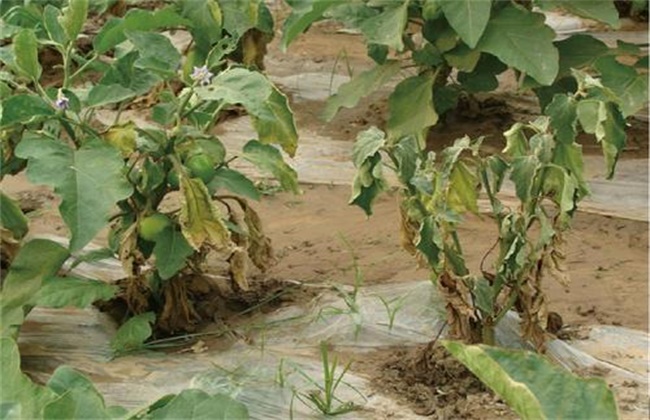
1. Disease symptoms
Diseased plants die early, bear few and small fruits, and yield reduction is relatively serious. This disease generally appears after flowering and fruiting. It first affects leaves from the bottom upward or from one side, then spreads to the whole plant, which is why it is called half-side madness. At first, the leaf margins and areas between the veins turn yellow, then develop into half a leaf or the entire leaf turning yellow, while also wilting, drooping, and even falling off. In severe cases, all leaves of the whole plant fall off, leaving bare stems. This disease is a whole-plant disease. When diseased plants are dissected at the roots, stems, branches, and petioles, the vascular bundles can be seen turning brown, so it is also called black heart disease.
2. Disease patterns
Eggplant Verticillium wilt is caused by infection by fungi of the genus Verticillium, such as Verticillium dahliae. Besides eggplant, it can also infect sweet pepper, tomato, potato, cucurbits, and many other crops, but eggplant suffers the most severe damage. The pathogen overwinters in the soil with diseased plant residues. Seeds can also carry the pathogen for long-distance spread, and organic fertilizer containing diseased residues can also transmit the disease. The pathogen has strong resistance to adverse environments and can survive in the soil for 6-8 years, so continuous cropping results in more severe disease.
3. Control methods
Practice reasonable crop rotation, rotating with non-solanaceous crops for more than 6 years, choose varieties with strong disease resistance, and before sowing and raising seedlings, disinfect and sterilize the planting site to reduce the chance of disease. The seedling-raising site should also be disinfected. Organic fertilizer applied should be fully decomposed. When planting, apply 1-2 grams of 50% carbendazim wettable powder per hole, then irrigate after planting the seedlings, using the sterilizing effect of the chemical to prevent soil pathogens and infection around the root system. For diseased plants found, carbendazim or thiophanate-methyl can be used as a root drench for control, once every 10 days, for 2-3 consecutive times, with good results.
The above is an introduction to the control methods for eggplant Verticillium wilt. We hope it helps you. To learn more related knowledge, please stay tuned to us.